AUKUS Pact India 2026: What the Nuclear Submarine Deal Means for New Delhi
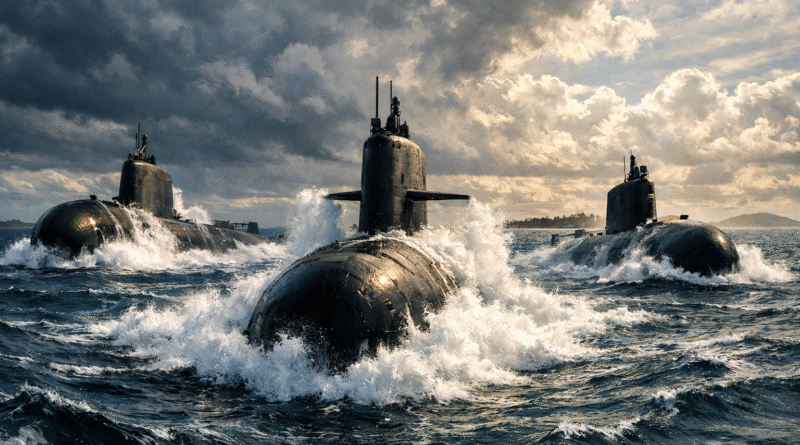
The AUKUS pact India 2026 dynamic is defined by a single structural fact: India is the most important country in the Indo-Pacific that is not a member of the alliance that is reshaping it. AUKUS the trilateral security partnership between Australia, the United Kingdom, and the United States announced in September 2021 is the most consequential military alignment in the region since the US-Japan Security Treaty. It gives Australia nuclear-powered attack submarines for the first time, creates a permanent US submarine base on the Indian Ocean at HMAS Stirling in Western Australia, and funds a joint technology development programme in AI, quantum computing, hypersonics, and cyber. India watches all of this from the Quad a separate framework that includes India, Australia, the US, and Japan, but which has no submarine component and no binding defence commitments. Whether India should engage more directly with AUKUS, and what form that engagement should take, is one of the more important and under-discussed questions in India’s Indo-Pacific strategy.
What AUKUS Actually Is: The Two Pillars Explained
AUKUS was announced on September 15, 2021, when US President Biden, Australian PM Morrison, and UK PM Johnson appeared together (virtually) to reveal the partnership. The immediate, dramatic consequence was Australia’s cancellation of a 0 billion French submarine contract giving Paris only a few hours’ notice which triggered a diplomatic crisis with France that took months to repair.
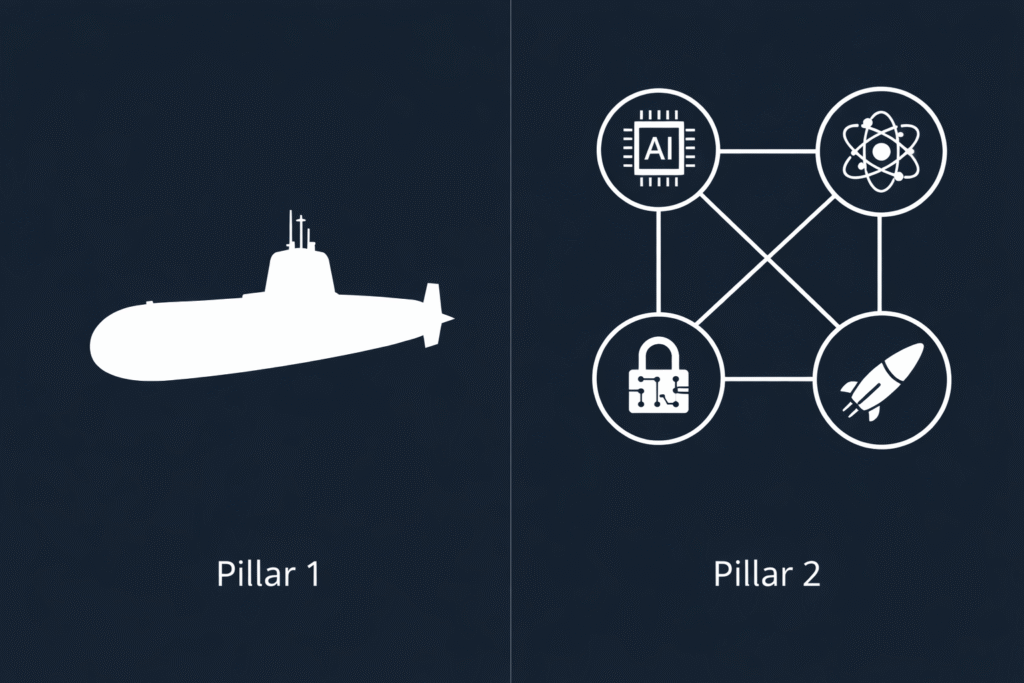
The partnership has two distinct lines of effort called pillars that operate on very different timelines and involve very different technology risks.
| Pillar | Focus | What it involves | Strategic purpose |
| Pillar 1 | Nuclear-Powered Submarines | Phase 1 (2023-26): US and UK nuclear submarines make port visits to HMAS Stirling, Western Australia. Australia builds operational familiarity. Phase 2 (2027+): Submarine Rotational Force-West (SRF-W) at HMAS Stirling — rotating US and UK SSNs based in Australia. Phase 3 (early 2030s): Australia purchases 3-5 Virginia-class SSNs from the US. Phase 4 (2040s): SSN-AUKUS — new class of submarine co-designed by UK and Australia, incorporating US technology. Both Australia and UK will operate it. | Australia gets nuclear submarine capability without nuclear weapons. US gets Indian Ocean submarine base. UK stays relevant in Indo-Pacific. |
| Pillar 2 | Advanced Technology (AI, Quantum, Cyber, Hypersonics) | Collaborative development in 8 areas: undersea capabilities, quantum technologies, AI and autonomy, advanced cyber, hypersonic and counter-hypersonic, electronic warfare, innovation, and information sharing. Pillar 2 is where other countries — Canada, Japan, NZ — have been invited to participate in specific workstreams. | Creates technology-sharing ecosystem among Five Eyes democracies. AI, quantum, hypersonics cooperation directly counters Chinese military development. |
The 2025 Trump Review: AUKUS Almost Did Not Survive
One of the most important and underreported facts about the AUKUS pact India 2026 context is that AUKUS nearly collapsed in 2025 under the Trump administration’s review process.
In June 2025, the Pentagon announced it was conducting a formal review of AUKUS to ensure the deal was aligned with the “America First” agenda. The review was triggered by concerns about whether selling Virginia-class submarines to Australia would leave the US Navy short of its own boats the US is already struggling to produce nuclear submarines fast enough for its own requirements. Policy chief Elbridge Colby said publicly he had reservations: if the US could not produce submarines fast enough, selling extra boats to Australia created a direct readiness problem for American sailors.
The review unsettled Australia, the UK, and members of Congress who saw it as undermining a cornerstone of Indo-Pacific deterrence. US Indo-Pacific Command chief Admiral Samuel Paparo defended AUKUS strongly, telling Congress that the SRF-W base at HMAS Stirling gives the US an Indian Ocean submarine hub that cuts response time to the South China Sea dramatically compared to any Pacific or US mainland base. Senate Democrats warned abandoning AUKUS would be received with cheers in Beijing. After months of uncertainty, Trump endorsed the deal in late 2025, and Australia committed an additional billion to help fund US submarine industrial base expansion. AUKUS survived but its near-death experience in 2025 revealed how contingent major alliance commitments are on US domestic politics.
AUKUS Pact India 2026: Why India Is Not a Member
The question of India’s relationship to AUKUS requires distinguishing between the two pillars because the constraints are completely different for each.
| Issue | The constraint or opportunity | What it means for India |
| Nuclear submarines (NPT) | India is a nuclear weapon state outside the NPT. AUKUS is designed for NPT signatories. Australia is under IAEA safeguards for its nuclear submarine programme. India’s nuclear status makes formal AUKUS membership legally complex. | India’s nuclear status is an obstacle to Pillar 1 membership. Pillar 2 (technology) has no NPT constraints. |
| Strategic autonomy | India does not join formal alliances. AUKUS is an alliance with treaty-like obligations. India avoided SEATO and CENTO in the Cold War — it is unlikely to join a military pact today. | India can partner without formal membership. Quad is the model — deep cooperation, no binding treaty. |
| China sensitivity | India is in active dialogue with China on LAC reset. A formal AUKUS membership would provoke Beijing. India manages China relationship carefully. | India can cooperate on technology (Pillar 2) without joining the submarine pact (Pillar 1) that most provokes China. |
| Technology access (Pillar 2) | India has strong interest in AI, quantum, cyber, hypersonic cooperation — all in AUKUS Pillar 2. India already works with US and Australia on many of these through Quad. | India-AUKUS Pillar 2 cooperation is the most realistic near-term pathway. Already in progress informally. |
| Industrial base | AUKUS partners are investing billions in submarine industrial base. India is building its own nuclear submarine programme (Project 77, S5 class). Parallel, not competing. | India does not need AUKUS’s submarine industrial base. It is building its own. |
| Indian Ocean access | HMAS Stirling (Perth) is the SRF-W base — giving the US an Indian Ocean submarine hub. India’s naval presence in the Indian Ocean is extensive. No conflict of interest, potentially complementary. | AUKUS and India’s naval expansion in the Indian Ocean are strategically complementary — both contest Chinese naval access. |
What India Could Do: The Pillar 2 Pathway
The realistic near-term pathway for India-AUKUS engagement runs through Pillar 2 the technology cooperation framework rather than Pillar 1, the nuclear submarine programme.
Canada, Japan, and New Zealand have all been invited to participate in specific Pillar 2 workstreams. Canada and New Zealand are participating in certain cyber and information-sharing elements. Japan has been brought into AI and quantum workstreams. None of them are full AUKUS members, and none of them are in Pillar 1. The AUKUS architecture, in other words, already has a mechanism for partial participation by trusted partners.
India has strong overlapping interests with AUKUS Pillar 2 in at least three areas. First, AI and autonomous systems India’s semiconductor strategy and Pax Silica alignment make it a natural partner in Indo-Pacific AI capability development. Second, undersea surveillance and detection India’s Indian Ocean surveillance network (the National Data Centre in Andaman and Nicobar, the coastal radar chains) is valuable to partners tracking Chinese submarine activity. Third, hypersonic and counter-hypersonic capabilities India’s Brahmos programme, developed with Russia, is already one of the most advanced cruise missile systems in the Indo-Pacific, and there are technology areas where exchange with AUKUS partners would be mutually valuable.
The constraint is not technology or interest it is classification and trust levels. AUKUS Pillar 2 operates at the highest levels of Five Eyes intelligence sharing. India is not a Five Eyes member. It has bilateral intelligence-sharing arrangements with the US (GSOMIA), Australia, and the UK but not the multilateral framework that AUKUS Pillar 2 uses. Building the institutional architecture for India to participate in specific Pillar 2 workstreams without full membership is a realistic 2-to-3-year project, not a tomorrow decision.
What AUKUS Means for India Whether India Joins or Not
Regardless of India’s formal relationship with AUKUS, the pact reshapes India’s strategic environment in three ways that matter regardless.
First, the Indian Ocean base. HMAS Stirling in Perth, Western Australia, is becoming the most significant new submarine base in the Indo-Pacific since the Cold War. US Virginia-class and UK Astute-class submarines rotating through that base will be operating in the Indian Ocean India’s strategic backyard. The presence of allied nuclear submarines in the Indian Ocean strengthens deterrence against Chinese naval expansion in waters India considers vital. India benefits from this even as a non-member.
Second, the Australia factor. India’s relationship with Australia has deepened substantially bilateral trade, defence exercises, the 2+2 framework, cooperation on critical minerals. AUKUS makes Australia a more capable military partner and a more important node in the Indo-Pacific security architecture. India’s relationship with Australia is worth more in a world where Australia has nuclear submarines than in a world where it does not.
Third, the China signal. AUKUS was designed explicitly to deter Chinese military adventurism in the Indo-Pacific. Every capability AUKUS develops more submarines in the Indian Ocean, AI-enabled targeting, hypersonic missiles, quantum encryption is a capability arrayed against the same military challenge India faces on its northern land border and in the Indian Ocean. India and AUKUS are not in competition. They are converging on the same strategic challenge from different institutional positions.
ThirdPol’s Take
The AUKUS pact India 2026 question is not really about whether India should join AUKUS. The NPT constraint, the strategic autonomy doctrine, and the China relationship management all make formal AUKUS membership the wrong frame. The right frame is: how does India systematically deepen its engagement with AUKUS Pillar 2 while maintaining the strategic flexibility that makes it valuable to all sides? India participates in AUKUS-adjacent cooperation through the Quad, through bilateral defence arrangements with Australia, the US, and the UK, and through its own growing undersea capability. What is missing is an institutional architecture that formalises India’s technology-sharing role in the Indo-Pacific security ecosystem without requiring it to give up the autonomy that makes it a different kind of partner than Japan or Australia. The iCET (initiative on Critical and Emerging Technology) between India and the US is the most promising mechanism for building this. What India needs to do is push iCET further, faster — toward the specific AI, quantum, and hypersonic workstreams where Indian capability and AUKUS interest genuinely overlap. Waiting for a formal AUKUS invitation that will never come in its current form is the wrong posture. Building the bilateral and plurilateral technology bridges that connect India to the AUKUS ecosystem without formal membership is the right one.
By Amit Mangal | ThirdPol | April, 2026