South China Sea 2026: Why India Cannot Afford to Be a Bystander
Role of India in the South China Sea 2026 is more consequential than New Delhi’s public posture suggests. India rarely speaks directly about the South China Sea by name, its official statements favour “freedom of navigation,” “UNCLOS,” and “rules-based order,” careful formulations that avoid directly confronting China’s claims.
But what happens in those 3.5 million square kilometres of contested water matters enormously to India: $5 trillion in annual global trade transits those routes, including a significant portion of India’s own imports and exports. China’s island-building programme has created permanent military infrastructure 2,000 kilometres from India’s coastline. And the Philippines a country India has deepened ties with under its Act East policy is locked in an escalating confrontation with China that increasingly risks pulling in the United States, Japan, and Australia. India’s strategic autonomy in the Indo-Pacific depends on understanding what is actually happening in the South China Sea in 2026 and making choices about it.
What Is the South China Sea Dispute? The Basics
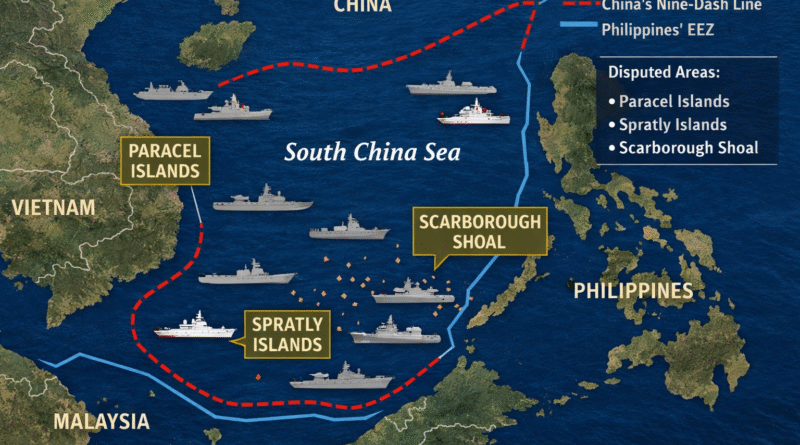
The South China Sea is a marginal sea of the Pacific Ocean, bounded by China to the north, Vietnam to the west, the Philippines to the east, and Malaysia and Brunei to the south. It contains the Spratly Islands, the Paracel Islands, and Scarborough Shoal clusters of reefs, atolls, and islets that are economically valuable (for fish stocks and potential oil and gas reserves) and strategically vital (as they sit astride the world’s busiest shipping lanes).
China claims approximately 90% of the entire sea under what it calls the “nine-dash line” a U-shaped demarcation that swallows the Exclusive Economic Zones of Vietnam, the Philippines, Malaysia, and Brunei. This claim has no basis in the United Nations Convention on the Law of the Sea (UNCLOS), which governs maritime rights based on distance from coastlines rather than historical assertion. In 2016, the Permanent Court of Arbitration in The Hague ruled comprehensively in favour of the Philippines, finding that China’s nine-dash line had no legal standing under international law. China rejected the ruling and has continued to act as if it does not exist.
What distinguishes the South China Sea dispute in 2026 from earlier periods is the physical reality China has created. Between 2013 and 2017, China dredged millions of cubic metres of sand to build seven artificial islands in the Spratlys features that barely existed above water are now military installations with runways long enough for bombers, missile systems, radar arrays, and port facilities for naval vessels. As of March 2026, AMTI (Asia Maritime Transparency Initiative) reported China is building new land at Antelope Reef in the Paracel Islands the first significant island-building Beijing has undertaken since 2017. The situation is not frozen. It is moving in China’s favour.
Who Claims What: The 2026 Claimants Map
| Country | What they claim | Military/strategic posture 2026 |
| China | Nine-dash line — ~90% of entire sea. Rejected by 2016 PCA ruling. Controls Paracels, Spratlys (partly), Scarborough Shoal. Island-building programme at 7 artificial islands. | PLAN carriers Liaoning, Shandong, Fujian deployed. 500,000+ sqkm reclaimed islands with runways, missiles, radar. Coast Guard aggressive operations. |
| Philippines | EEZ under UNCLOS — 200 nautical miles from coastline. Won 2016 arbitration ruling. ASEAN chair 2026. | Modernising armed forces. US Mutual Defense Treaty (1951). 500+ joint exercises with US in 2026. Japan, Australia defence pacts signed 2025. |
| Vietnam | Claims Paracel Islands (occupied by China since 1974) and most Spratly Islands. Second-most contested state. | Building own infrastructure in Spratlys. Expected to complete programme in 2026. Naval infantry to populate islands. |
| Malaysia | Claims parts of Spratlys — overlapping with China, Philippines, Vietnam, Brunei. | Low-profile approach. Prefers diplomacy. Significant trade dependence on China. |
| Brunei | Claims Louisa Reef in Spratlys. | Quiet claimant. No significant military posture. |
| Taiwan | Claims same territory as China (historical basis). Controls Itu Aba island. | Complex — both claim, but not coordinating. |
South China Sea India 2026: The India Stakes
India’s interest in the South China Sea has three distinct dimensions that rarely get discussed together.
First, trade routes. Approximately $200 billion of India’s annual external trade — energy imports, manufactured goods exports, electronic components — transits the South China Sea or shipping lanes that depend on its freedom. If China were to exercise the kind of maritime control it claims collecting transit fees, restricting passage for vessels it deems hostile, or simply creating uncertainty that raises insurance premiums the impact on India’s trade costs would be direct and significant. India’s $5 billion commitment to the Asia-Africa Growth Corridor with Japan was partly motivated by creating alternative shipping infrastructure.
Second, the China encirclement concern. India’s strategic community has long worried about what it calls China’s “string of pearls” strategy a series of Chinese port investments and military access points that ring India’s maritime neighbourhood: Gwadar in Pakistan, Hambantota in Sri Lanka, Chittagong in Bangladesh, Kyaukpyu in Myanmar. The South China Sea is the eastern anchor of this encirclement picture. If China consolidates its control there, it gains the ability to project naval power south and west into the Indian Ocean the waters India considers its own strategic backyard.
Third, the Act East commitments. India’s Act East policy has built meaningful security relationships with Vietnam (which India supplies BrahMos missiles to), the Philippines (with which India has defence cooperation agreements), and other ASEAN claimant states. These partners are under direct pressure from Chinese coercion in the South China Sea. If India stays silent while they are squeezed, its reliability as a strategic partner erodes. The South China Sea India 2026 dynamic is partly about whether India’s partnerships in Southeast Asia mean anything under pressure.
China vs Philippines 2026: What Is Actually Happening at Sea
The most active confrontation in the South China Sea in 2026 is between China and the Philippines, and it is escalating.
The pattern is consistent. Philippine coast guard or supply vessels approach Filipino-held outposts Second Thomas Shoal, Scarborough Shoal with food, water, and rotation of troops. Chinese coast guard vessels intercept them with water cannons, laser blinding, physical obstruction, and radio warnings. The January 26, 2026 joint exercise between USS Cincinnati, Philippine Navy, and allied forces happened just as Chinese Coast Guard warned off a Philippine aircraft near Huangyan Dao. In March, China aimed fire-control radar at a Philippine naval vessel near Sabina Shoal — an act Manila called “alarming and provocative.”
The diplomatic front is equally tense. China’s embassy in Manila warned in February that “deteriorating bilateral relations could cost millions of jobs” a statement the Philippines’ Department of Foreign Affairs condemned as “coercive.” The Philippine Senate passed a resolution condemning Chinese interference. Some senators called for expulsion of the Chinese ambassador. Manila did not go that far, but the relationship is at a sustained low point.
The US military presence has expanded significantly in response. The US will hold over 500 military exercises with the Philippines in 2026. During Exercise Balikatan in April 2025, the US deployed NMESIS coastal defence missiles anti-ship weapons positioned on Philippine territory within range of Chinese vessels in the South China Sea. Japan and the Philippines signed new defence pacts in 2025. Australia participates in joint exercises. China has responded by deploying all three of its aircraft carriers Liaoning, Shandong, and Fujian to the South China Sea for demonstrative exercises, including live fire near Scarborough Shoal.
The ASEAN Code of Conduct: Why 2026 Is Both the Target and a Dead End
The Philippines holds the rotating chair of ASEAN for 2026 and has made concluding a Code of Conduct (COC) between ASEAN and China its signature foreign policy priority. The COC is intended to create rules for behaviour in the South China Sea restricting the most dangerous activities, setting up crisis communication channels, and establishing a framework for managing disputes short of armed conflict.
The problem is structural. China has participated in COC negotiations since 1995 for over three decades without producing a binding agreement. Beijing’s position has consistently been that the COC should exclude non-regional powers (specifically the US), should not have legally binding enforcement mechanisms, and should not reference the 2016 arbitration ruling. The Philippines’ position is the opposite on all three points.
Chinese analysts have said openly that a COC “is 100% not achievable” under Philippines’ chairmanship because Manila will inevitably push the arbitration ruling. That assessment appears accurate. The South China Sea Code of Conduct will likely be discussed, workshopped, and quietly deferred to 2027 when Indonesia takes the ASEAN chair and the geopolitical pressure to conclude something may either be higher or lower, depending on what happens in the Taiwan Strait.
India supports an “effective and substantive” COC a formulation that implies the code should be binding and should not exclude external actors. India has not been a direct participant in COC negotiations, but its position matters because it is a Dialogue Partner and because China has insisted the COC exclude non-ASEAN countries from any enforcement mechanism.
What India Should Actually Do
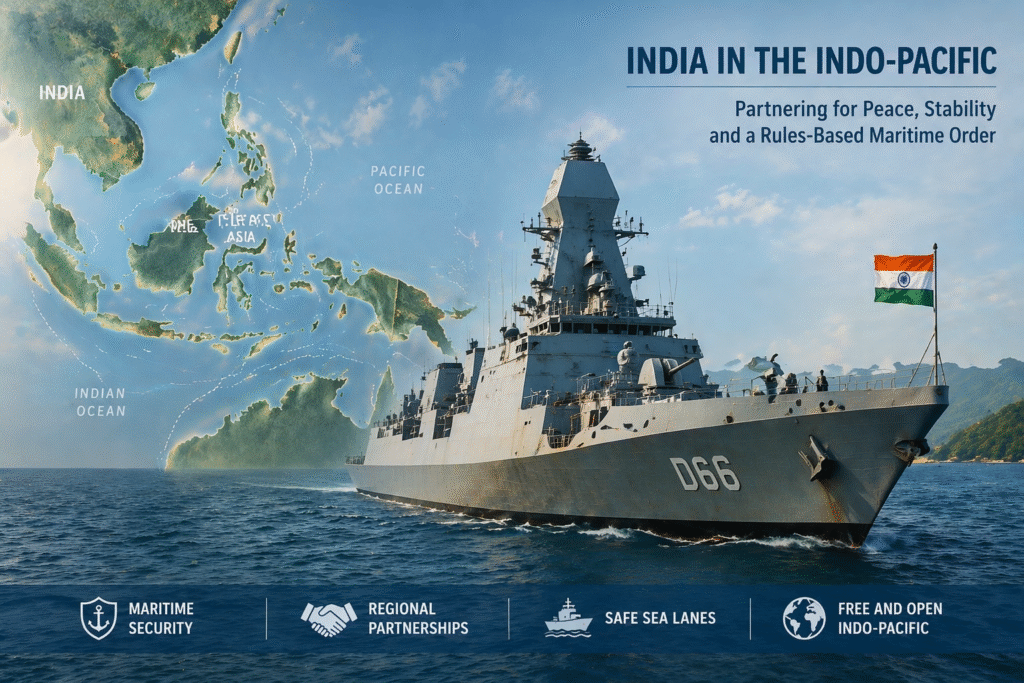
India’s current South China Sea policy is characterised by supportive rhetoric without operational presence. India supports UNCLOS, freedom of navigation, and the 2016 arbitration ruling — in statements. It does not conduct freedom of navigation operations (FONOPs) in the South China Sea, unlike the US and France. It has not publicly committed to defending any specific claimant state’s maritime rights. Its Act East partnerships, while real, are primarily built around land-based defence cooperation (BrahMos, training, exercises) rather than maritime deterrence in contested waters.
The case for a more active Indian posture rests on three arguments. First, the India-Japan-US-Australia Quad is explicitly an Indo-Pacific partnership, and the South China Sea is literally the centre of the Indo-Pacific. A Quad that has nothing to say about the South China Sea’s most active conflict is a Quad that is not serious about its stated purpose. Second, India’s naval presence in Southeast Asia port calls, joint exercises, information sharing is precisely what its partners need to feel less isolated when China applies pressure. Third, and most pragmatically, China’s military infrastructure in the Spratlys is now permanent. India can either engage in managing the resulting competition or watch from the sidelines as the balance of power in its eastern maritime neighbourhood shifts against it.
ThirdPol’s Take
The South China Sea India 2026 dynamic is a test of whether India’s strategic autonomy is a coherent position or simply a way of avoiding difficult choices. India has legitimate interests in the South China Sea — trade routes, encirclement concerns, partner credibility — that require more than carefully worded statements. The Philippines is under real and escalating pressure. Vietnam is building fortifications. The US is deploying coastal defence missiles on Philippine soil. China is building a new island. This is not a situation that can be managed through diplomatic abstinence. India’s Act East policy created expectations among Southeast Asian partners that New Delhi would be a meaningful security presence in the region. Meeting those expectations requires presence, not just position papers. India does not need to conduct FONOPs or commit to military defence of claimant states. But it does need to move from rhetorical support to operational engagement — more frequent naval exercises in the South China Sea, more direct diplomatic backing for UNCLOS-based claims, and a clearer signal that India’s partnerships in Southeast Asia have real content under pressure.
By Amit Mangal | ThirdPol | April 2026