India Semiconductor Strategy 2026: Chips, Fabs, and the Race to Stop Being Dependent
India semiconductor strategy 2026 arrived at a moment the country had been working toward for five years. On February 28, Prime Minister Modi inaugurated Micron Technology’s assembly and test plant in Sanand, Gujarat the first foreign-built semiconductor facility to reach commercial production on Indian soil. On March 31, he inaugurated the Kaynes Semicon plant at the same industrial estate. Between those two dates, the Union Budget announced India Semiconductor Mission 2.0 with Rs 8,000 crore in fresh support. Ten semiconductor projects are now approved across six states, with a combined investment of Rs 1.60 lakh crore. India is not yet a chip-making country. But for the first time, it is on a credible path to becoming one and the geopolitical stakes of that journey have never been higher.
Why Semiconductors Are a National Security Question
Chips are not just a technology story. They are a geopolitics story. The US-China technology war which accelerated dramatically after the US imposed export controls on advanced semiconductors and chip-making equipment to China in 2022 has made the question of where chips are made as strategically important as where oil is drilled. Countries that cannot manufacture their own semiconductors are dependent on others for every military system, every communications network, every power grid, and every AI application they deploy.
India imports virtually all of its semiconductors approximately $50-55 billion worth annually, a figure that is projected to rise to $100 billion by 2030 as digital infrastructure, electric vehicles, smartphones, and defence systems all scale up simultaneously. This dependence is a strategic vulnerability. When COVID disrupted the global chip supply chain in 2021, Indian automakers shut assembly lines for months because they could not get semiconductors. The lesson was not lost on New Delhi.
India’s semiconductor strategy 2026 is also geopolitically positioned through the Pax Silica alliance the US-led technology partnership that India joined in February 2026, committing New Delhi to building semiconductor supply chains with allied democracies rather than with China. This is not just industrial policy. It is a strategic bet that the world’s chip supply chains will be politically divided between democratic and authoritarian blocs and that being inside the democratic bloc is where India’s long-term security and economic interests lie.
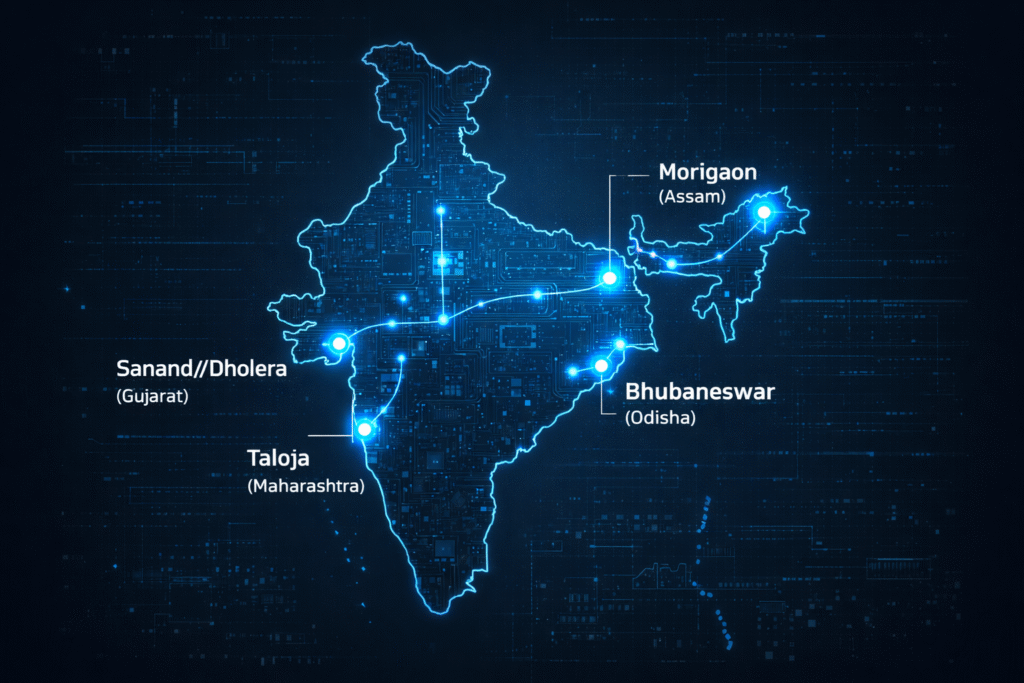
India Semiconductor Strategy 2026: Every Major Project on the Map
| Project | Investment | Tech partner | What it makes | Timeline |
| Tata Electronics — Dholera Fab | Rs 91,000 crore | PSMC (Taiwan) | 28nm logic chips, power mgmt, EV chips | 2027 (target) |
| Tata TSAT — Morigaon, Assam | Rs 27,000 crore | Indigenous | 48 million chips/day — auto, EV, telecom packaging | 2025–2026 |
| Micron — Sanand, Gujarat | $2.75B (Rs ~23,000 cr) | Micron (USA) | DRAM and NAND assembly and test | Inaugurated Feb 2026 |
| CG Power — Sanand, Gujarat | Rs 7,600 crore | Renesas (Japan) + Stars (Thailand) | Chip assembly, packaging, testing. 14.5M chips/day (G2) | G1 operational 2026 |
| Kaynes Semicon — Sanand, Gujarat | Rs 3,300 crore | Indigenous | OSAT — 6 million chips/day. First chips shipped Oct 2025. | Inaugurated Mar 31, 2026 |
| Tower-Adani — Taloja, Maharashtra | $10B (Rs ~84,000 cr) | Tower Semiconductor (Israel) | Full semiconductor fab — advanced nodes | Under planning |
| HCL-Foxconn JV | Undisclosed | Foxconn (Taiwan) | Assembly and test facility | Groundbreaking Feb 2026 |
| RIR Power — Bhubaneswar, Odisha | Rs 25,000 crore | Indigenous | India’s first Silicon Carbide (SiC) fab — EVs and renewables | 2028 (target) |
What India Has Actually Built So Far
The honest assessment of India’s semiconductor strategy 2026 is that the country has made genuine, accelerating progress on the easier end of the value chain — and has barely started on the harder end.
Assembly, Testing, Marking, and Packaging (ATMP) the downstream end of chip manufacturing that takes finished chips from overseas foundries and packages them for use is where India has moved fastest. Micron’s Sanand plant is the clearest example. Micron fabricates its DRAM and NAND chips in advanced fabs in the US, Japan, and Taiwan. The Sanand facility receives those chips and handles the packaging and testing before shipping to customers. This is valuable work it creates jobs, builds supply chain knowledge, and generates revenue. But it is not the same as making chips from scratch.
The Kaynes Semicon facility in Sanand inaugurated March 31, 2026 is similar. It ships approximately 6 million packaged chips per day. In October 2025, before full inauguration, it shipped India’s first commercially manufactured 900 multi-chip modules to Alpha & Omega Semiconductor a genuine milestone. But again, the underlying silicon wafers were made elsewhere.
The Tata Electronics TSAT facility in Morigaon, Assam is a step up: advanced packaging using flip chip and ISIP (Integrated System in Package) technologies, targeting automotive, EV, and telecommunications markets with a capacity of 48 million chips per day. This is genuinely sophisticated work. Assam is not typically associated with high-technology manufacturing, and the 15,000 direct jobs the plant creates have significant regional economic impact.
The Dholera fab, Tata Electronics + PSMC of Taiwan is where the real test lies. This is India’s first attempt at actual semiconductor fabrication: making chips at 28nm node technology from raw silicon wafers. The Rs 91,000 crore project is the largest single private investment in India’s technology sector. It is also the most difficult. PSMC is providing the technology; Tata is building the factory; the Indian government is providing 50% of the project cost plus state contributions. Target: operational by 2027.
ISM 2.0: What the Second Phase of India’s Chip Mission Targets
India Semiconductor Mission 1.0 focused on getting semiconductor manufacturing into India at any node and any stage. ISM 2.0, announced in the Budget 2026-27 with Rs 1,000 crore for FY26 and Rs 8,000 crore total outlay for the modified programme, shifts focus to three harder problems.
First, semiconductor equipment and materials. India currently imports almost all of the specialised equipment and chemicals used to make chips. The machines that deposit thin films of material, etch patterns, and inspect wafers at the atomic scale are made by ASML (Netherlands), Applied Materials (US), Tokyo Electron (Japan), and a handful of other companies. No Indian company currently makes any of this equipment. ISM 2.0 begins funding domestic development a 10-to-15-year project, not a 2-year one.
Second, chip design intellectual property. India has a large and sophisticated semiconductor design workforce tens of thousands of Indian engineers work at AMD, Qualcomm, Intel, and other companies designing chips that are then made in Taiwan or South Korea. ISM 2.0 tries to convert some of that design talent into domestic IP that Indian companies own and license. Under the Design Linked Incentive (DLI) scheme, 24 startups are now supported, 67,000 students are using EDA tools, and 16 chips have been taped out including some at 12nm node at advanced international foundries.
Third, supply chain resilience. India’s chip plants will need a reliable supply of silicon wafers, specialty gases, photoresists, and dozens of other materials. Most of these currently come from Japan, Taiwan, and the US. Building domestic supply chains for even a fraction of these inputs is a decade-long project but it starts with ISM 2.0.
The Hard Truths: What India’s Semiconductor Strategy Still Cannot Do
India’s semiconductor strategy 2026 is real, funded, and moving. But four structural challenges separate India’s current position from genuine chip-making self-sufficiency.
First, node technology. The Dholera fab targets 28nm — a mature node that represents technology from roughly 2011. Modern leading-edge chips (used in AI, advanced smartphones, and military systems) are made at 3nm and 4nm, almost exclusively by TSMC in Taiwan and Samsung in South Korea. India is not on a path to make advanced-node chips in any near-term timeframe. For most applications — automotive, IoT, defence 28nm and above is sufficient. For AI training chips and advanced communications, it is not.
Second, talent. Semiconductor fabrication requires extremely specialised process engineers people who understand the physics and chemistry of depositing films 5 atoms thick and etching patterns 10 nanometres wide. India has excellent chip designers. It has very few chip fabrication process engineers. This is being addressed through SCL Mohali (the government’s chip lab, being upgraded with Rs 4,500 crore) and through ISM 2.0’s training programmes but building this talent takes 5-10 years.
Third, water and power. Advanced chip fabs are among the most power-intensive and water-intensive industrial facilities ever built. A large fab consumes 60-80 megawatts of electricity continuously and tens of millions of litres of ultra-pure water per day. India’s infrastructure in Dholera a greenfield city is being built specifically to support the Tata fab. Whether it delivers reliably on the tight timelines the fab requires is a genuine execution risk.
Fourth, the geopolitical clock. The US-China chip war is accelerating. Export controls are tightening. Taiwan where TSMC makes 90% of the world’s most advanced chips faces continuous pressure from China. India needs to build its semiconductor capacity before geopolitical disruption forces it to. Whether India can move fast enough is the core strategic question that India’s semiconductor strategy 2026 must answer.
ThirdPol’s Take
India’s semiconductor strategy 2026 is the right strategy, executed with rare seriousness for Indian industrial policy. The Rs 76,000 crore PLI commitment, the Pax Silica alignment, the ISM 2.0 deepening — these are genuine signals that India understands semiconductors are not an industrial sector but a national security infrastructure. The gap between where India is today (ATMP facilities, one fab under construction at 28nm) and where it needs to be (domestic production of chips for defence, AI, and telecommunications) is large. That gap will take a decade to close. The question is whether India maintains political will and execution discipline over that decade — or whether, as with so many Indian industrial policy initiatives, the ambition exceeds the follow-through. The Micron inauguration, the Kaynes shipment, the Dholera groundbreaking — these are real. The harder tests are still ahead.
Pingback: India Drone Manufacturing 2026: What Operation Sindoor Changed