CAATSA India S-400: Why the US Still Hasn’t Sanctioned India
The CAATSA India S-400 situation is one of the most revealing anomalies in US foreign policy. The Countering America’s Adversaries Through Sanctions Act, passed in 2017 and signed by Trump, requires the US to sanction any country that makes a significant purchase from Russia’s defence sector. India signed a $5.43 billion deal for five S-400 air defence systems in October 2018. Three squadrons are deployed and combat-proven, having performed effectively during Operation Sindoor in May 2025. A fourth arrives this May. A fifth comes in 2027. The US sanctioned NATO ally Turkey under the exact same CAATSA provisions for buying the exact same S-400 system. India has received no sanctions and no formal waiver has ever been granted. The law remains technically in force. Understanding why the CAATSA India S-400 anomaly persists and what could finally resolve it is one of the more important questions in India-US relations.
CAATSA India S-400: The Full Timeline
| Date | Event |
| 2014 | Russia annexes Crimea. US and EU impose sanctions. India refuses to condemn. |
| Aug 2017 | US passes CAATSA. Mandatory sanctions on countries doing major defence deals with Russia, Iran, or North Korea. |
| Oct 2018 | India signs USD 5.43 billion deal for 5 S-400 regiment sets, defying US warnings. Trump says India “will find out.” No sanctions imposed. |
| Dec 2020 | US imposes CAATSA sanctions on NATO ally Turkey for buying same S-400 system. India watches carefully. |
| Nov 2021 | India begins receiving S-400 deliveries. First squadron arrives. US still has not imposed or waived sanctions. |
| Jul 2022 | US House passes Ro Khanna amendment (NDAA 2023) approving India-specific CAATSA waiver. Senate never votes separately. No president formally invokes it. |
| May 2025 | Operation Sindoor. India deploys S-400 against Pakistani aerial threats. Performs effectively. Now combat-proven in Indian service. |
| Jan 2026 | Russia confirms fourth S-400 squadron to be delivered by May 2026. Fifth squadron: 2027. |
| Feb 2026 | Trump-India trade deal. India stops buying Russian oil. CAATSA on S-400 not explicitly addressed in Joint Statement. |
| 2026 (ongoing) | Fourth S-400 squadron delivered. No sanctions ever imposed. No formal waiver granted. Strategic ambiguity continues. |
What CAATSA Is and Why It Was Designed
CAATSA was passed by the US Congress in August 2017 with an extraordinary bipartisan vote: 419-3 in the House, 98-2 in the Senate. It was enacted in the aftermath of Russia’s 2014 annexation of Crimea, its Syria intervention, and alleged interference in the 2016 US presidential election. The law creates mandatory sanctions on any person or entity engaging in a significant transaction with Russia’s defence or intelligence sectors.
CAATSA contains twelve specific types of sanctions, of which the US President must impose at least five for any qualifying transaction. The most severe include denial of US export licences, blocking access to the US financial system, and prohibition on US government procurement. As applied to Turkey in December 2020, the sanctioned country’s defence procurement agency was blacklisted from US business entirely.
The law does provide presidential waiver authority. The 2019 NDAA expanded this, allowing the President to waive sanctions against strategic partners when national interests are affected or when a partner has longstanding Russian defence relationships and compliance is unlikely. To grant a waiver, the President must certify it is in the US national interest, will not endanger US national security, and will not adversely affect counter-proliferation efforts. What no sitting US president has been willing to do is formally make that decision on India.
India vs Turkey: The Same Law, Two Completely Different Outcomes
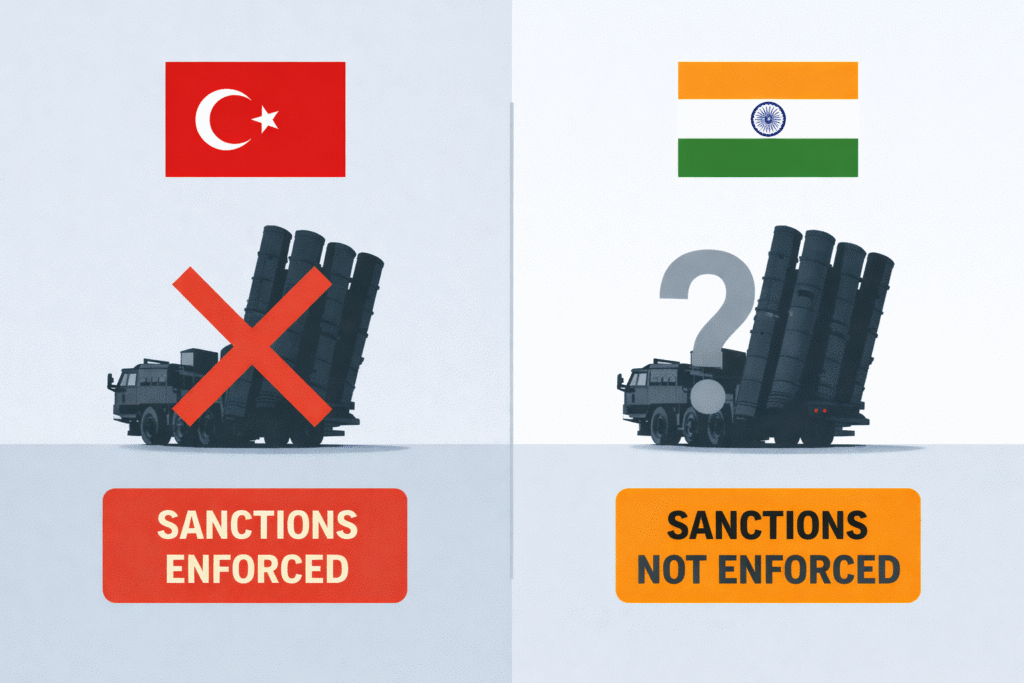
| Factor | India | Turkey |
| S-400 deal signed | Oct 2018 | Jul 2017 (delivery) |
| US treaty ally? | No (major defence partner) | Yes (NATO member) |
| CAATSA sanctions? | No — as of April 2026 | Yes — Dec 2020 |
| Sanctions target | None | SSB (defence procurement) + officials |
| F-35 programme | India never in F-35 | Removed from F-35 programme |
| US strategic interest | Critical Indo-Pacific partner vs China | NATO ally but also buying Chinese tech |
| Waiver status | House amendment 2022. Never formally invoked. | No waiver — sanctions enforced |
| Why different? | Sanctioning India destroys Indo-Pacific strategy. Russia wins at zero cost. | Turkey inside NATO — US could absorb relationship damage. |
The Turkey-India comparison exposes a fundamental flaw in CAATSA as applied to geopolitically complex situations: it was written as a Russia-punishment law but functions as a partner-punishment law depending on presidential implementation.
Turkey was sanctioned because the 2021 NDAA mandated it within 30 days, removing executive discretion. Turkey is a NATO member, meaning the US could absorb the relationship damage while making a public example. Turkey was also seen as a more manageable target: it was not simultaneously the critical US partner in the strategic rivalry with China. India is different on every dimension. Sanctioning India would push the one country the US most needs as an Indo-Pacific counterweight directly toward Russia-China alignment handing Beijing a geopolitical victory at zero cost. American defence companies would lose the Indian market permanently. The Indo-Pacific strategy would lose its most important non-allied partner.
After Operation Sindoor: Why India’s Position Only Got Stronger
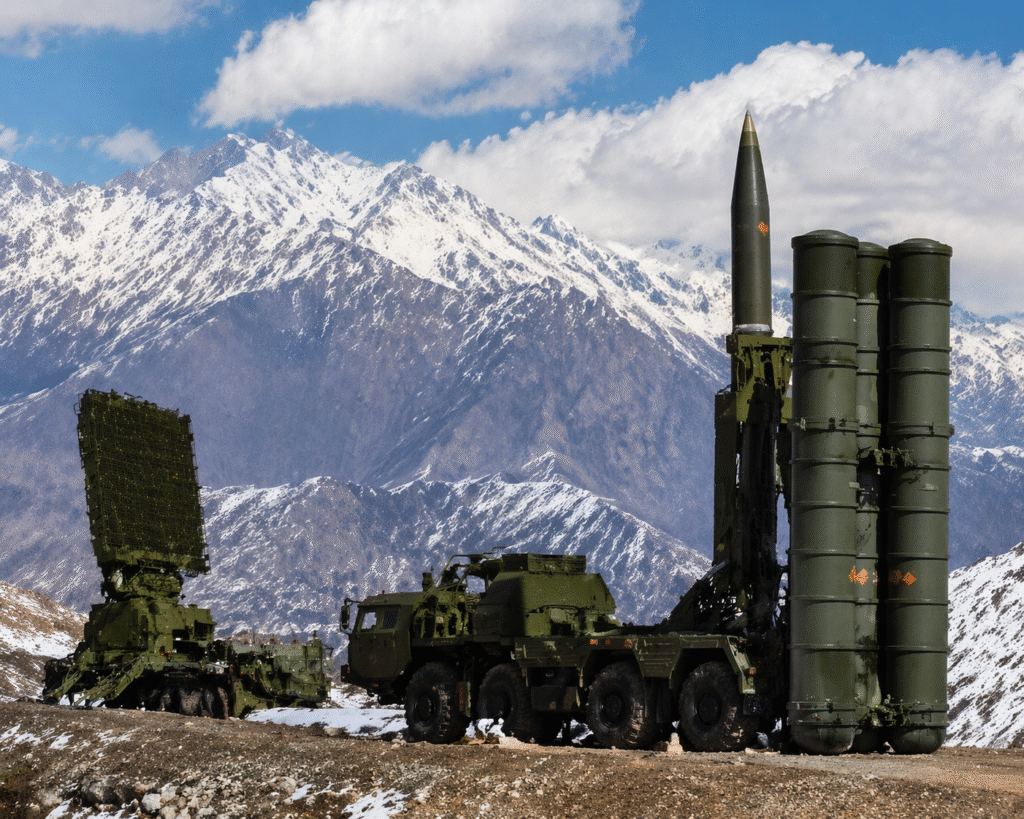
The most significant development in the CAATSA India S-400 dynamic happened not in Washington but in the skies over Kashmir and Punjab. During Operation Sindoor in May 2025, India deployed its S-400 squadrons against Pakistani aerial threats. The system performed effectively. Minister of State for Defence Sanjay Seth confirmed it publicly during a diaspora visit: the S-400 proved its worth.
This matters in two ways. First, it validates India’s argument that the S-400 is a genuine national security necessity, not a geopolitical provocation. India faces real aerial threats from both Pakistan and China simultaneously. The S-400’s 400-kilometre detection range, layered intercept capability, and ability to engage ballistic missiles, cruise missiles, and stealth aircraft makes it a force multiplier no other system in India’s inventory currently replicates. It is not a political statement about Russia. It is a capability India needed.
Second, with three squadrons deployed and combat-tested, removing the S-400 from Indian service is no longer a realistic American ask. The system is integrated into India’s air defence architecture. Indian Air Force personnel are trained on it. Indian command-and-control systems are linked to it. Telling India to return or disable the S-400 is not a policy demand it is a fantasy. The practical American choice is therefore no longer between India-with-S-400 and India-without-S-400. It is between India-with-S-400-and-a-functioning-US-partnership and India-with-S-400-and-a-broken-relationship. The first option is obviously preferable.
The February 2026 Trade Deal: Partial Resolution, Not Full Settlement
When Trump and Modi announced the February 2 trade deal, many observers assumed the CAATSA question was quietly buried alongside it. The answer is: partially, not formally.
India agreed to stop buying Russian crude oil as part of the deal, addressing one dimension of the sanctions concern. But CAATSA India S-400 is specifically about defence transactions with Russia’s defence sector, not energy purchases. The February 9 Joint Statement White House fact sheet did not mention CAATSA at all.
What the trade deal did change is the political environment. Having secured a major trade concession, a halt to Russian oil purchases, and a $500 billion US-product commitment from India, the Trump administration has less incentive than ever to activate CAATSA against New Delhi. The political cost of sanctioning a country that just gave you one of the largest trade concessions in bilateral history is prohibitive. Trump’s transactional logic if India is giving us what we want, why would we punish them works in India’s favour on CAATSA.
The fifth S-400 squadron arrives in 2027. Once all five are delivered, the CAATSA exposure is complete. The question then shifts from “will the US sanction India for buying S-400?” to “will the US sanction India for having already bought S-400 years ago?” which almost every American strategist answers with a firm no.
What Could Still Trigger CAATSA Against India
The situation has been managed through strategic ambiguity for eight years and will likely continue. But three scenarios could change that.
First, a major new Russian arms acquisition. The current tolerance is specifically for completing the pre-existing S-400 contract. A significant new Russian deal new Su-30 squadrons, frigates, submarine technology would test the US’s willingness to continue looking the other way. The implicit American ask is that India reduces Russian defence dependency over time, not that it adds to it.
Second, a dramatic change in India’s China posture. The entire argument for the CAATSA waiver rests on India’s value as a China-balancing partner. If India-China relations improved so dramatically that India’s Indo-Pacific value to the US declined, the case for tolerating S-400 weakens with it. Structurally unlikely, but worth noting as a logical dependency.
Third, Congressional action. The executive has managed CAATSA through inaction. But Congress can legislate mandates. The Turkey NDAA precedent of 2020 proves this. A more hawkish Congress — or one with specific India grievances — could remove presidential discretion on India as happened with Turkey.
ThirdPol’s Take
The CAATSA India S-400 situation is a demonstration of what happens when a law runs into geopolitical reality and loses. CAATSA was written to punish Russia. In India’s case, enforcing it would punish America. The US has therefore chosen, through five years and four S-400 deliveries, to do nothing. This is the kind of principled inconsistency every great power practices when law and strategy diverge. The more interesting question is whether India should push for a formal waiver or maintain strategic ambiguity. The argument for formalisation: legal certainty protects defence companies from third-party sanctions risk. The argument for ambiguity: a formal waiver requires India to certify it is reducing Russian arms dependency limiting future procurement flexibility. India has wisely not pushed hard for the formal waiver. The S-400 is in service. The US has not sanctioned anyone. The fifth squadron arrives in 2027. Sometimes strategic ambiguity is the most comfortable outcome available and India has mastered that art.
By Amit Mangal | ThirdPol | April, 2026