Iran War Timeline 2026: From Operation Epic Fury to Islamabad Ceasefire
The iran war timeline 2026 begins with a paradox: a deal that was nearly done, then deliberately destroyed. On February 26, Oman claimed Iran had agreed to never stockpile enriched uranium a historic concession. Peace was declared within reach. Talks were set to resume on March 2. Then, in the early hours of February 28, the United States and Israel launched Operation Epic Fury 900 strikes in 12 hours, killing Supreme Leader Ali Khamenei, triggering the closure of the Strait of Hormuz, and igniting the most consequential conflict in the Middle East since the 2003 invasion of Iraq. Forty days later, a ceasefire holds. Islamabad talks are underway. The world is waiting to see if diplomacy can accomplish what was almost accomplished before the bombs fell. Here is every major event between February 28 and today.
Iran War Timeline 2026: The Complete Chronology
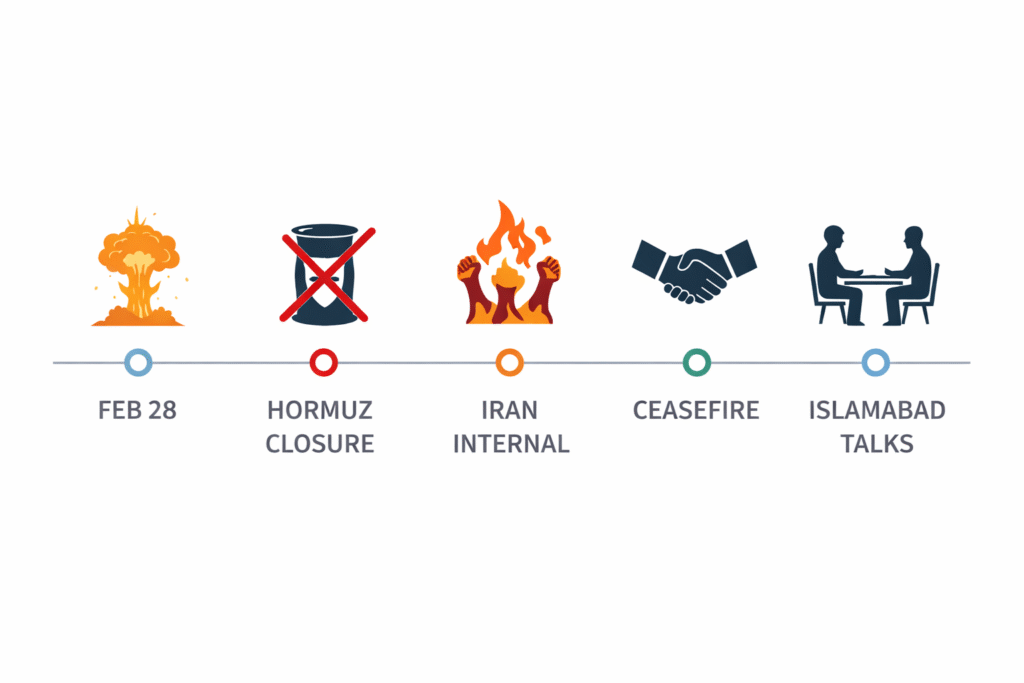
| Date | Phase | Key events |
| Jan 2026 | PRE-WAR | Three rounds of US-Iran nuclear talks in Muscat and Geneva (Feb 6, 17, 26). Iran’s FM Araghchi says historic deal is within reach. Oman claims breakthrough. Trump signals impatience. |
| Feb 27 | EVE | Omani FM Al-Busaidi announces Iran has agreed to never stockpile enriched uranium. Says peace is within reach. Talks expected to resume March 2. |
| Feb 28 | DAY 1 | Operation Epic Fury begins 06:35 UTC. 900 US-Israeli strikes in 12 hours. Supreme Leader Ali Khamenei killed at Leadership House compound. Defence Minister Nasirzadeh and IRGC Commander Pakpour killed. Iran closes Strait of Hormuz. Oil hits 09/barrel. |
| Mar 1 | DAY 2 | Iran retaliates: strikes Jebel Ali port (Dubai) and Camp Arifjan (Kuwait). Hezbollah fires missiles into northern Israel. IDF confirms 100,000 reservists mobilised. India declares energy emergency. Indian flag carrier Air India suspends Gulf routes. |
| Mar 2 | DAY 3 | Trump: We will easily win. IDF strikes IRGC Malek-Ashtar building in Tehran. Iran bombs Israeli targets. WHO identifies 13 Iranian health facilities hit. Hezbollah launches missiles from Lebanon. Pakistan PM Sharif offers to mediate. |
| Mar 3 | DAY 4 | Trump declares We have won the war. Iranian state broadcaster IRIB headquarters hit. Iran’s parliament building targeted. Qom Assembly of Experts office bombed. Oil commercial traffic through Hormuz drops 90%. |
| Mar 7-9 | WK 2 | Trump declares victory repeatedly. Iran IRGC counter-attacks continue. Iranian drone hits desalination plant in Bahrain near US naval base. Iranian missile hits neighbourhood in Beersheba, Israel. Six US service members killed. |
| Mar 16-19 | WK 3 | IDF completes Beirut encirclement. Mass anti-regime riots in Tehran. GCC ceasefire ultimatum expires without Iranian response. Armed clashes between IRGC and Iranian military factions reported inside Iran. US war cost estimated at 8B. |
| Mar 21-26 | WK 4 | Trump threatens to destroy Iran’s oil infrastructure and Kharg Island if Hormuz not reopened. IRGC Navy Commander Alireza Tangsiri killed by Israeli strike. Israel kills top nuclear scientists. US has engaged 50,000+ targets. |
| Mar 28-30 | WK 5 | Houthis formally enter war — first ballistic missile strikes on southern Israel. Iran hits Aluminium Bahrain and Emirates Global Aluminium plants. Hormuz partially reopens for approved vessels only. Iran collects transit fees. |
| Apr 1-7 | WK 6 | Pakistan’s Field Marshal Asim Munir conducts back-channel diplomacy between Tehran and Washington. China endorses Pakistan’s framework. US war cost: 8B+, Congress approves additional 00B. |
| Apr 7-8 | CEASEFIRE | Trump announces two-week ceasefire on social media. Iran confirms Khamenei-successor government approved it after nudge from China. Pakistan formally named as broker. Ceasefire begins April 8. Islamabad talks announced for April 10. |
| Apr 10-present | TALKS | Islamabad talks begin at Serena Hotel. VP JD Vance, Witkoff, Kushner lead US side. FM Araghchi and Parliament Speaker Ghalibaf lead Iran. Pakistan hosts. 15-day negotiating window. Core gaps: nuclear, Hormuz, sanctions. |
Phase 1: The Opening Strike and Iran’s Retaliation (Feb 28 — Mar 7)
The opening phase of the Iran war timeline 2026 was defined by speed, shock, and miscalculation on both sides.
Operation Epic Fury began at 06:35 UTC on February 28. US B-2 stealth bombers, B-1 Lancers, and B-52s struck ballistic missile facilities, nuclear infrastructure, and command-and-control nodes simultaneously. The Israeli Air Force, operating as Operation Roaring Lion, executed what officials later called decapitation strikes — targeting Supreme Leader Ali Khamenei and seven senior security officials at a leadership compound in Tehran. By the first morning, the Islamic Republic had lost its supreme leader, its defence minister, its IRGC commander, and its national security council secretary the entire top tier of its decision-making apparatus.
Iran’s retaliation was rapid and broader than analysts expected. Within hours, Iranian missiles struck Jebel Ali port in Dubai and Camp Arifjan in Kuwait. Ballistic missiles targeted Al Udeid airbase in Qatar and Ali Al Salem in Kuwait. A Shahed drone hit a radar installation at the US Naval Support Activity in Bahrain. Iran formally closed the Strait of Hormuz. Commercial traffic through the strait dropped over 90% within 24 hours. Brent crude hit 09 a barrel. India declared an energy emergency. Air India suspended Gulf routes.
By Day 4, Trump had declared victory three times. None of those declarations proved accurate. The IRGC, despite losing its senior leadership, remained operationally capable dispersed, decentralised, and continuing to launch missile waves. By the end of the first week, US forces had struck over 3,000 targets. Iran had struck targets in seven countries. The war was not over. It had barely begun.
Phase 2: Regional Escalation and the Hormuz Standoff (Mar 8 — Mar 21)
The second phase of the Iran war timeline 2026 saw the conflict widen beyond Iran itself, with Hezbollah opening a northern front against Israel from Lebanon and the Strait of Hormuz becoming the central economic pressure point of the war.
Hezbollah entered the conflict on March 2, launching missiles and drones from Lebanon into northern Israel. The IDF, which had been conducting daily strikes on Hezbollah infrastructure since early March, escalated to a ground assault and had encircled Beirut by March 16. The Lebanese health ministry reported over 1,100 killed in Israeli strikes by mid-March. One million people were displaced from Lebanon, according to a Time investigation.
Inside Iran, the war produced an unexpected dynamic. By mid-March, armed clashes had erupted between IRGC units and elements of Iran’s conventional military — factions divided by loyalty to the new post-Khamenei succession structure. Mass anti-regime protests broke out in Tehran. The political cohesion that Iran’s leadership had maintained for decades under Khamenei cracked under the pressure of war, economic collapse, and succession uncertainty.
The Strait of Hormuz became the war’s most consequential battlefield without a shot being fired at sea. Iran approved transit selectively — allowing vessels from neutral countries, some Iranian ships, and ships willing to pay Iranian-set transit fees. Gulf states that depended on Hormuz for water (desalination plants) and food (imports) as much as energy faced acute shortages. On March 8, an Iranian drone struck a desalination plant in Bahrain near the US Navy’s 5th Fleet headquarters. The Hudson Institute’s analysis warned that water infrastructure, not oil, might emerge as the most dangerous weapon of the conflict.
Phase 3: Diplomatic Scramble and Ceasefire (Mar 22 — Apr 8)
The third phase of the Iran war timeline 2026 opened when both sides began signalling, through back channels, that neither could sustain the conflict indefinitely.
Pakistan’s Field Marshal Asim Munir was the pivot point. His credibility with the Trump administration built during the Operation Sindoor ceasefire mediation of May 2025 — gave him a channel Washington trusted. His position as a Muslim-majority-country leader gave him a channel Tehran could accept. From late March, Munir was in continuous contact with Vance, Witkoff, and Araghchi. Pakistan’s Foreign Minister Dar visited Beijing in late March; China’s endorsement of the Pakistani framework was the factor that convinced Tehran’s successor government that engaging in talks would not appear as surrender.
Trump threatened to destroy Iran’s oil infrastructure and Kharg Island if Hormuz remained closed. On March 26, Iran partially reopened the strait for approved vessels. On April 1, Trump said the war would end in two to three weeks. On April 7-8, he announced a two-week ceasefire on social media. Moments later, Iranian officials confirmed adding that China’s last-minute nudge had been decisive. Pakistan was formally named as broker. The ceasefire took effect April 8.
The Islamabad talks began April 10. The core gaps — nuclear programme, Hormuz permanent status, sanctions relief, US military presence — remain unresolved. The ceasefire is fragile. Both sides have accused the other of violations. The Iran war timeline 2026 is not over. It is in its most uncertain chapter.
What the Iran War Timeline 2026 Means for India
India’s position in the Iran war timeline 2026 is defined by three facts: it was not consulted before the strikes, it was not invited to mediate, and it was not at the Islamabad table.
The energy impact was immediate and severe. India imports over 85% of its oil. The Hormuz closure put 20% of global oil supply at risk. The Iran war’s energy shock produced a domestic LPG crisis affecting 330 million households, drove a 40-day spike in petroleum prices, and forced an emergency switch away from discounted Russian crude (which itself was under US pressure) toward more expensive alternative suppliers.
Diplomatically, India offered to mediate and received no response. Pakistan’s success as a mediator made possible by the trust Pakistan built with Trump during the Operation Sindoor ceasefire came at India’s strategic expense. Every day Pakistan is in Islamabad hosting US and Iranian delegations is a day that Pakistan’s diplomatic standing rises and India’s relative position in the region becomes less central.
The Chabahar Port suspension and the INSTC standstill compounded India’s losses. India’s most important strategic infrastructure investment in Iran’s neighbourhood went dark during the conflict. China’s Gwadar kept operating. For the full picture of what the Iran war cost India specifically, see ThirdPol’s analysis of India and the Iran War 2026.
ThirdPol’s Take
The iran war timeline 2026 is, at its core, the story of a deal that was almost made — and then was not. On February 26, Oman announced that Iran had agreed to never stockpile enriched uranium. Two days later, 900 bombs fell on Tehran. What followed was six weeks of the most intense conflict the Middle East has seen in two decades, more than 7,650 people killed according to human rights monitors, oil at 09 a barrel, and a ceasefire brokered by Pakistan rather than any of the countries that had more obvious reasons to be involved. Whether the Islamabad talks produce a durable settlement or simply kick the hardest questions down the road depends on whether the US and Iran can close the gap on the nuclear question. CSIS analysis says Iran retains the human capital to reconstitute its programme after the guns go quiet. Israel says any deal that does not require surrender of enriched uranium is unacceptable. Those two positions are structurally incompatible. That is the iran war timeline 2026’s most important unresolved sentence — and it is still being written.
By Amit Mangal | ThirdPol | April, 2026