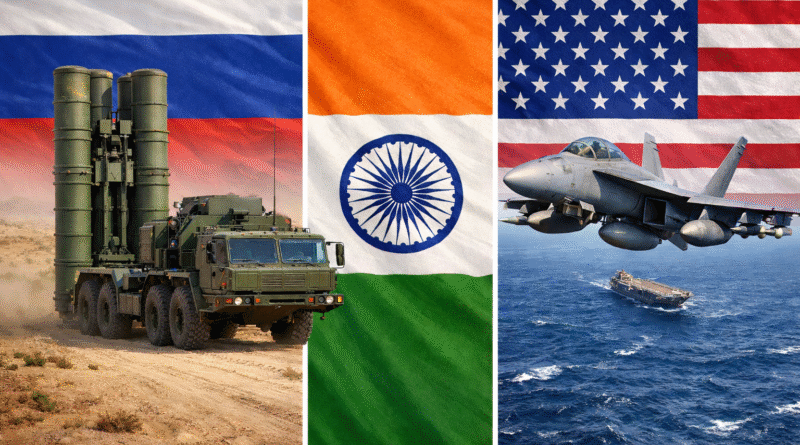
US vs Russia: The Battle for India’s Military — Who Is Winning?
India’s military is caught in a quiet tug-of-war between its past with Russia and its future with the United States. Russia supplies approximately 55 percent of India’s major weapons platforms. The United States would very much like to change that number. How that competition is playing out and who is actually winning is the real story behind the headline figures on US arms India Russia competition in 2026.
The context matters. India’s dependence on Russian defence equipment is structural and historical, not sentimental. The Soviet Union was India’s most reliable arms supplier during the Cold War, when Western countries were either aligned with Pakistan or unwilling to sell India advanced systems without conditions. That relationship created deep integration: Indian Air Force pilots trained on MiGs, Indian Navy officers know Russian submarine technology, and Indian Army artillery doctrine was written around Russian guns.
Replacing that integration takes decades, not procurement cycles.
What the US Has Been Offering
The American pitch to India has evolved considerably since 2016. The initial strategy was to designate India a Major Defence Partner a special status that allowed technology transfers not available to most non-NATO allies. The 2018 COMCASA agreement (Communications Compatibility and Security Agreement) and the 2020 BECA (Basic Exchange and Cooperation Agreement for Geo-spatial Intelligence) filled in the foundational agreements needed for deep defence cooperation.
On the hardware side, the US has made progress. India has purchased Apache attack helicopters, Chinook heavy-lift helicopters, C-17 Globemaster transport aircraft, P-8I Poseidon maritime patrol aircraft, and MH-60R naval helicopters. These are serious, capable platforms. The us arms india russia competition is real on the aerospace side, and the US has been winning it incrementally.
The game-changers that the US is now dangling include: the GE F414 engine for the Tejas Mk2 with significant technology transfer, MQ-9B Predator drones (a deal reportedly finalised in 2023), and the possibility of co-development on future unmanned systems through the initiative on Critical and Emerging Technology (iCET).
Why Russia Still Wins on Key Platforms
But us arms india russia competition does not favour Washington across the board. Russia retains decisive advantages in two categories. First, submarines: the Russian Akula-class nuclear attack submarine on lease to India, and the broader relationship around nuclear propulsion, has no American equivalent on offer. The US does not sell nuclear submarines. This keeps Russia as India’s only possible partner for the INS Chakra programme.
Second, integrated air defence: the S-400 Triumf system that India purchased in 2018 is in service and is reportedly performing well. There is no US equivalent available for purchase — the Patriot system operates at a different threat spectrum and the THAAD is not on offer. Unless the US is willing to sell THAAD or offer something equivalent, Russia retains this market.
Third, price. Russian platforms are cheaper to procure, cheaper to maintain (when spare parts are available), and come with fewer political conditions. American weapons sales involve Congress, end-user certificate requirements, ITAR controls, and periodic political volatility. Russian sales historically came with easier terms though the sanctions regime since 2022 has complicated Russian spare parts supply chains significantly.
The 2026 Moment
The us arms india russia dynamic in 2026 has a new variable: Russia’s war in Ukraine has degraded its ability to service Indian defence contracts and deliver on new ones. Indian Air Force MiG-21 and MiG-29 upgrades have been delayed. Spare parts for the Su-30MKI — India’s main air superiority fighter — have become harder to source. This is not a crisis yet, but it is creating institutional pressure within the Indian Armed Forces to diversify faster.
Washington has noticed. The iCET framework, the GE engine deal, and the Predator drone procurement are all designed to capitalise on this moment of Russian supply chain vulnerability. The question is whether the US can convert tactical advantage into structural shift or whether India will simply use the moment to accelerate its own domestic production capacity rather than deepening American dependency.
By Amit Mangal | ThirdPol | April 2026