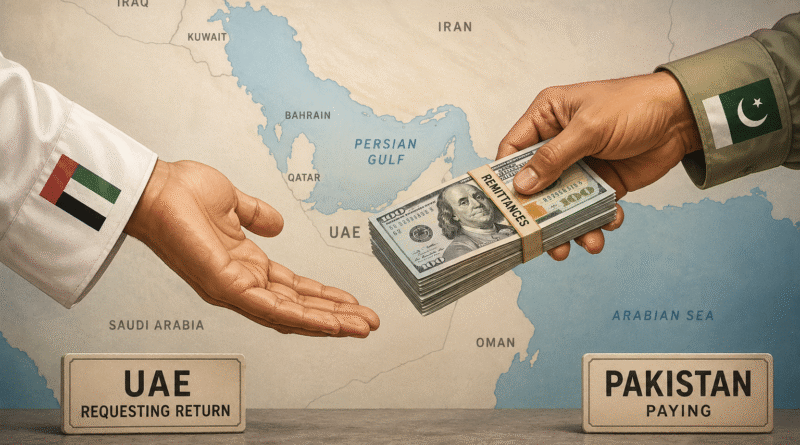
UAE Pakistan Money 2026: $3.45 Billion Trouble for Pakistan
Something happened quietly in Pakistan’s banking system last week that has large implications not just for Pakistan’s economy, but for the entire web of Gulf-South Asia financial relationships that has kept Pakistan solvent through crisis after crisis for two decades. The UAE asked for its money back. All of it. $3.45 billion. And unlike every previous time Pakistan’s deposits matured and Abu Dhabi extended them without a second thought, this time there was no automatic rollover. There was a demand, a deadline, and a scramble.
What Were These Deposits and Why Did They Exist?
To understand the UAE Pakistan money 2026 story, you need to understand what these deposits actually were. They were not a traditional loan with an interest payment schedule and a fixed repayment date. They were cash deposits money placed by the UAE government directly with Pakistan’s State Bank, sitting in Pakistan’s foreign exchange reserve account and counted as part of Pakistan’s official reserves.
Think of it like a neighbour who puts money in your safe. The money is technically yours to use, it makes your savings look larger than they really are, and your neighbour trusts you to return it when asked. Pakistan has been operating on exactly this arrangement with the UAE, Saudi Arabia, and China for years. Together these three countries had placed approximately $12.5 billion in deposits with the State Bank of Pakistan a sum that made Pakistan’s reserve position look far more comfortable than it actually was when you stripped out the borrowed components.
The UAE’s portion consisted of several tranches accumulated over years: $2 billion placed in 2018, another $1 billion in 2023 to help with a balance of payments crisis, and a $450 million facility that dated all the way back to 1996-97. Every time these deposits matured, Abu Dhabi would agree to roll them over extending the deadline, sometimes for a year, sometimes more. It was automatic enough that Pakistani policymakers built their reserve calculations around assuming the UAE deposits would always be there.
What Changed: Why the UAE Said No
The UAE Pakistan money 2026 demand did not come out of nowhere. The warning signs had been building for months. In January 2026, two separate $1 billion UAE deposits matured on January 16 and January 22. The UAE rolled them over but only for one month, and only at the old interest rate of 6.5%, rejecting Pakistan’s request for a two-year extension at 3%. That was the first signal. Rolling over for one month instead of a year is not generosity. It is a countdown.
By April, the UAE had decided it wanted the full amount returned. The reasons are layered. Economically, seven years of IMF programmes have not produced the structural reforms they were designed to enable Pakistan keeps promising to widen its tax base, cut energy subsidies, and reduce its fiscal deficit, then backtracks when political pressure builds. In April 2026 alone, Pakistan cut the tax on petrol in direct violation of its current IMF programme conditions. That kind of behaviour, observed repeatedly over years, eventually exhausts even patient creditors.
Strategically, the context of the Iran war matters. The UAE was targeted by Iranian missiles for hosting US military installations. Pakistan simultaneously served as Tehran’s ceasefire mediator, maintaining warm relations with the country that attacked the UAE. Abu Dhabi has not said this publicly Gulf states rarely make foreign policy grievances explicit in financial decisions but the timing speaks for itself. And beneath all of this lies a longer-term reorientation: the UAE is building its future around India, not Pakistan. The UAE-India Comprehensive Economic Partnership Agreement, UAE sovereign wealth fund investments in Indian infrastructure, and the UAE’s BRICS membership (with India as chair) all point toward where Abu Dhabi sees its strategic interests lying in the years ahead.
The Scramble: How Pakistan Paid
When the UAE’s demand became clear, Pakistan’s Finance Minister Muhammad Aurangzeb went straight to Bloomberg and said Pakistan was “looking at all options” bonds, bilateral loans, commercial bank borrowing. That is the language of someone who does not have the money sitting in a drawer.
What Pakistan actually did was execute a financial relay race. The UAE demanded $450 million on April 11, $2 billion on April 17, and the final $1 billion on April 23. For the April 17 tranche, Pakistan leaned heavily on Saudi Arabia, which had separately agreed to a fresh $3 billion deposit package for Pakistan. The first $2 billion from Saudi Arabia arrived on April 15 two days before the UAE payment was due. The second $1 billion from Saudi Arabia arrived on April 20 three days before the final UAE tranche was due. Pakistan also repaid $1.43 billion in other external debt including a $1.3 billion Eurobond in the same period.
In other words, Pakistan used the new Saudi money to pay back the old UAE money. The net position is not as bad as the headline number suggests Pakistan replaced $3.45 billion in UAE deposits with $3 billion in Saudi deposits plus an expected $1.3 billion IMF tranche. But the terms are different. Saudi Arabia’s new deposit comes with its own conditions and maturity dates. The IMF tranche requires passing a quarterly review that Pakistan is currently at risk of failing because of the fuel tax cut. And crucially, Pakistan’s gross foreign exchange reserves fell by nearly 18% in the week of the repayments before the Saudi inflows cushioned the fall.
What Pakistan’s Government Said and What It Did Not
Pakistan’s official response was a masterclass in understatement. Foreign Office spokesperson Tahir Andrabi called it a “routine financial transaction” under “bilateral commercial agreements” and accused media of spreading “misleading” narratives. The State Bank’s X post was clinical: “This completes the repayment of total deposits of $3.45 billion to UAE.”
What neither said: that the UAE refused to roll over for the first time in seven years. That Pakistan had requested a two-year extension at a lower interest rate and been denied. That Pakistan scrambled to borrow from Saudi Arabia to make the payments on time. That Pakistan is simultaneously in breach of its IMF programme conditions. Calling this routine is technically defensible the deposits did have contractual maturity terms. Calling it surprising would have been accurate.
What It Means Going Forward
The UAE Pakistan money 2026 episode changes three things for Pakistan’s near-term financial outlook. First, the IMF programme is now the most important thing on Pakistan’s economic calendar. The Executive Board is expected to approve the next $1.3 billion tranche by end of April or early May. If that review is delayed or conditioned because of the fuel tax cut, Pakistan’s reserve position which just absorbed a near-20% hit becomes genuinely precarious. Finance Minister Aurangzeb has said Pakistan has not yet requested programme changes, but adjustments “remain under consideration.”
Second, Pakistan cannot assume Saudi Arabia’s $3 billion rescue is unconditional. Saudi deposits come with their own maturity dates and their own rollover expectations. If Pakistan continues to breach IMF conditions, it risks losing Gulf confidence broadly, not just from the UAE. Saudi Arabia extended the existing $5 billion deposit for a longer term alongside the new $3 billion package but that generosity is not infinite.
Third, Pakistan has lost a financial cushion it had taken for granted for a decade. The UAE deposits were treated as a permanent feature of Pakistan’s reserve architecture. They are gone. Rebuilding them if Abu Dhabi ever agrees to restore the arrangement would require Pakistan to demonstrate the kind of sustained economic reform it has failed to deliver in seven consecutive IMF programmes. That is a high bar. And it is the honest answer to anyone who calls this episode routine.
ThirdPol’s Take
The UAE Pakistan money 2026 story is a small earthquake with delayed tremors. The immediate crisis was managed Pakistan paid, Saudi stepped in, reserves stabilised. But the underlying geology has shifted. The Gulf’s automatic financial support for Pakistan was never really about economics. It was about Islamic solidarity, Pakistani diaspora labour, and the strategic value of a nuclear-armed Muslim state in a volatile neighbourhood. All three of those rationales are weakening simultaneously. Diaspora labour is being replaced by automation. Islamic solidarity has a balance sheet limit. And Pakistan’s strategic value is being contested by its own positioning in the Iran war, its IMF non-compliance, and the rising alternative offered by India as a Gulf partner. The UAE did not ask for its money back because it needed the cash. It asked because the arrangement no longer made strategic sense. That is a much harder thing to fix than a balance of payments gap.
By Amit Mangal | ThirdPol | April, 2026