Inside the Islamabad Talks: The Hidden Demands of Iran and the United States
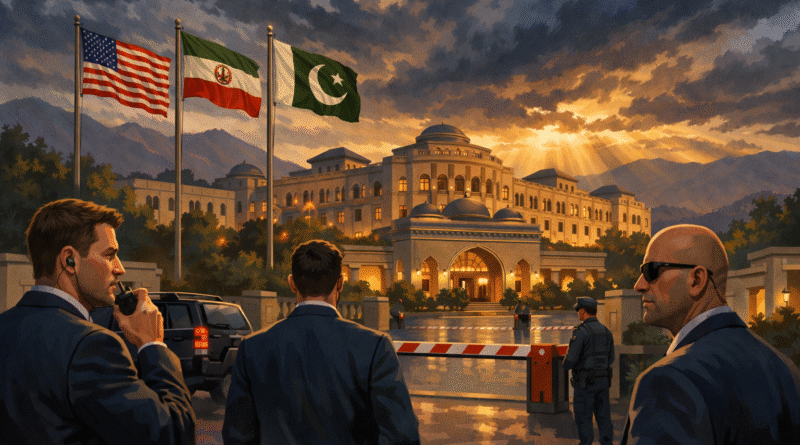
Pavements in Islamabad were freshly painted on April 9. The Serena Hotel one of the capital’s grandest properties was cleared of guests and handed over to security teams. A 30-member American security detail arrived days ahead of schedule. Today, the Islamabad talks between the United States and Iran begin: the first direct diplomatic engagement between the two countries since the 1979 Islamic Revolution and the first real attempt to turn the two-week ceasefire into something durable. US Vice President JD Vance, accompanied by envoy Steve Witkoff and Jared Kushner, leads the American delegation. Iranian Foreign Minister Abbas Araghchi and Parliament Speaker Mohammad Bagher Ghalibaf lead Tehran’s. Pakistan, the unlikely broker that made this moment possible, is the host. What the two sides actually want and how far apart those wants remain is the story that will define the next two weeks.
How the Islamabad Talks Came to Be
Six weeks ago, the Islamabad talks were unthinkable. On February 28, 2026, the United States and Israel launched Operation Epic Fury — a coordinated strike campaign on Iran that killed Supreme Leader Ali Khamenei, his top military commanders, and dozens of nuclear scientists. Iran retaliated by closing the Strait of Hormuz and launching missile and drone strikes across the Gulf. The world’s oil markets went into shock. Brent crude hit $109 a barrel.
The path to Islamabad was built by Pakistan. Asim Munir, Pakistan’s Field Marshal and Army Chief, had maintained a working channel to the Trump administration cemented during the Operation Sindoor ceasefire of May 2025, when Pakistan’s mediation gave Trump a deal he could announce as a personal victory. When the Iran war began, Iran needed a back-channel to Washington that was neither Western nor aligned with Israel. Pakistan fit. Munir spent weeks shuttling between capitals, drafting proposals, and crucially convincing both sides that the other was willing to talk.
On March 23, Pakistan formally offered to host talks. On April 7, Trump announced the two-week ceasefire. On April 8, Iran’s Supreme National Security Council confirmed: “Negotiations will begin in Islamabad on Friday, April 10.” Pakistan’s Foreign Minister Ishaq Dar also visited Beijing for talks with Wang Yi, a move analysts say was critical. China’s endorsement of the Islamabad framework reassured Iran that the process had genuine international backing, not just American pressure.
Islamabad Talks: What Iran and the US Each Want
| Issue | US position | Iran position |
| Strait of Hormuz | US: Full, unconditional reopening. No Iranian oversight. | Iran: Hormuz reopens only under Iranian military coordination. Iran collects transit fees from ships. |
| Nuclear programme | US/Israel: Complete dismantlement of enrichment. All uranium surrendered. | Iran: Right to civilian nuclear programme retained. Enrichment continues. No surrender of stockpile. |
| Sanctions | US: Sanctions remain until all demands are met. | Iran: Full sanctions relief — US, UN Security Council, and IAEA sanctions all lifted. |
| US military presence | US: Bases in Gulf states remain. No withdrawal. | Iran: Withdrawal of all US combat forces from Middle East bases. |
| Iran-backed groups (Hezbollah, Hamas) | US/Israel: Iran must end support. Hezbollah disarmed. | Iran: Ceasefire must include Lebanon. No separate Israel-Lebanon deal. |
| War damages | US: No reconstruction payment. | Iran: Full compensation for war damage to Iranian infrastructure, economy, and civilians. |
| Legal framework | US: Bilateral executive agreement. | Iran: Binding UN Security Council resolution ratifying any final deal. |
The Three Issues That Will Determine Whether the Islamabad Talks Succeed or Fail
The gap between Iran and the United States at these talks is wide. But three specific issues will determine whether the Islamabad talks produce a durable peace or simply delay a return to war.
First, the nuclear question. This is the fundamental divide. The US and Israel entered the war with the stated goal of eliminating Iran’s nuclear programme. The strikes severely damaged Iran’s facilities but CSIS analysis published in March 2026 concluded that Iran retains the human capital to reconstitute its nuclear work after the shooting stops. Iran’s position is that enrichment is a sovereign right, non-negotiable. Its 10-point plan makes no mention of surrendering its enriched uranium stockpile. Any deal that does not address the nuclear question will face Israeli opposition. Netanyahu has been explicit: he will not accept any ceasefire that leaves Iran’s nuclear infrastructure intact. If the Islamabad talks produce a deal without nuclear provisions, Israel will find ways to undermine it.
Second, the Hormuz control question. Iran’s 10-point plan demands that the Strait of Hormuz be managed under “Iranian military coordination” effectively giving Tehran oversight of one of the world’s most critical shipping lanes and the ability to collect transit fees. The US position is unconditional reopening. These are structurally incompatible. Iran knows Hormuz is its single most powerful bargaining chip — worth more closed than open. The US knows that global oil markets cannot sustain $109 crude indefinitely without political consequences. Some middle ground perhaps UN naval oversight of transit, combined with partial Iranian fee-collection rights is theoretically possible, but would require both sides to accept a compromise neither has publicly signalled.
Third, who is actually negotiating on the Iranian side. A significant complication in the Islamabad talks is that Iran’s Revolutionary Guard (IRGC) — not the Foreign Ministry — has been making operational decisions throughout the war. Individual IRGC commanders initiated strikes, decided what to target, and controlled the Hormuz blockade. The Foreign Ministry’s Araghchi can sign an agreement. Whether the IRGC will honour it is a different question. Iran’s National Security Council statement was explicit that the ceasefire “does not signify the termination of the war” and that “our hands remain upon the trigger.” Iran’s ceasefire on paper and Iran’s ceasefire in practice are not guaranteed to be the same thing.
The US Delegation: What Vance’s Presence Signals
The decision to send Vice President JD Vance not Secretary of State Rubio, not a special envoy — is the most significant signal the Trump administration has sent about how seriously it takes the Islamabad talks. Vance is the most senior US official to visit Pakistan since Joe Biden did so in 2011 as Vice President. His presence tells Iran that this is a real negotiation, not a diplomatic formality.
Vance is joined by Steve Witkoff Trump’s Middle East envoy, who played a central role in the 2025 Gaza ceasefire negotiations and Jared Kushner. The Kushner inclusion is interesting. He has no formal diplomatic role in the Trump second term, but his presence signals that Trump is personally invested in the outcome and wants someone with direct presidential access in the room.
The American delegation arrives having already made a significant concession: accepting Iran’s 10-point framework as “a workable basis for negotiation.” Iran’s state media has framed this as the US accepting Iranian terms. Trump has framed it as standard diplomacy. The gap between those two framings will shape the domestic politics around any deal on both sides.
What the Islamabad Talks Mean for India
India is not in Islamabad. It is watching. For the third consecutive major diplomatic event in the Iran war, the back-channel negotiations, the ceasefire brokering, and now the formal peace talks — India is on the outside. Pakistan is the host. China provided the critical endorsement that brought Iran to the table. The United States, Iran, and the broader international community are focused on Islamabad.
India’s interest in the outcome of the Islamabad talks is direct and substantial. If the talks succeed and produce a durable settlement, the Strait of Hormuz will reopen permanently, India’s energy crisis resolves, and the diplomatic damage of the past six weeks begins to heal. If the talks fail, the ceasefire collapses, Hormuz closes again, and India faces another round of emergency oil procurement at $109-plus a barrel.
India has called for a permanent end to the conflict and offered to facilitate dialogue. That offer has not been taken up. The most India can do at this stage is monitor the Islamabad talks closely and position itself for the post-war reconstruction phase — where its historical ties with Iran, its Chabahar port investment (now suspended), and its pharmaceutical and infrastructure capabilities give it genuine leverage. The diplomatic window was missed. The economic window may still be open.
ThirdPol’s Take
The Islamabad talks are the most consequential diplomatic event since the Iran war began. They are also the most difficult. The US and Iran enter these negotiations with fundamentally incompatible public positions on the three issues that matter most: nuclear weapons, Hormuz control, and sanctions relief. Both sides have domestic constituencies that will punish any leader who appears to capitulate. Iran’s National Security Council framed the talks as “a continuation of the battlefield” and told its population to expect victory, not compromise. Trump needs a deal that he can call a win without Israeli opposition torpedoing it. These are not easy conditions for a breakthrough. The most likely outcome of the Islamabad talks is a framework agreement that defers the hardest questions — leaving the nuclear issue and the Hormuz transit regime for a third round — while providing enough structure for both sides to extend the ceasefire. Whether that constitutes success or simply postponement depends on your timeframe. For global energy markets and for India’s economy, even a deferral of the hardest questions would be a significant improvement over another round of war.
By Amit Mangal | ThirdPol | April 10, 2026