Quad Alliance 2026: Is Trump Killing the Indo-Pacific’s Most Important Security Group?
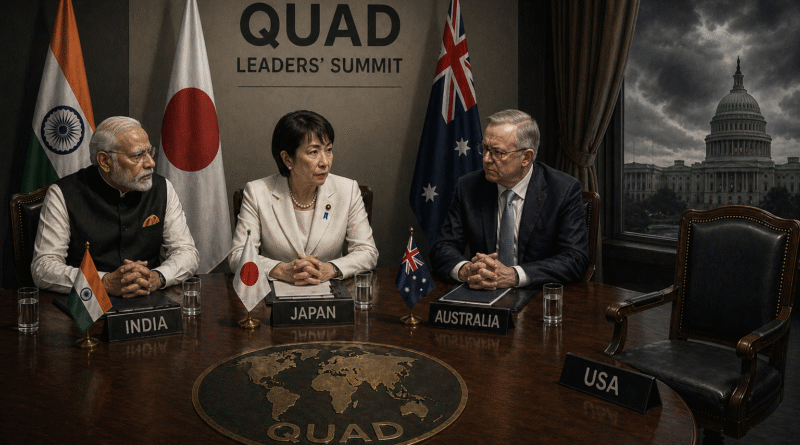
The Quad alliance 2026 is in the deepest crisis of its existence and the person responsible is the same person who resurrected it in 2017. Donald Trump, who rebuilt the Quad from near-extinction during his first term as a cornerstone of his Indo-Pacific strategy, has in his second term refused to attend a single leaders’ summit, declined to visit India as promised, planned a high-profile trip to China instead, and watched the alliance fracture under the weight of his tariffs, his embrace of Pakistan, and his profoundly transactional attitude toward American alliances. Foreign Policy published a major analysis on April 23 concluding that Trump is pushing the Quad to the brink of extinction. ThePrint confirmed that India still the rotating chair has sent zero invitations to Trump, Morrison, or Takaichi for a leaders’ summit. The question for India, Japan, and Australia is no longer whether the Quad can hold a summit. It is whether the Quad can survive as a meaningful security grouping if the United States is no longer committed to leading it.
What the Quad Is and Why It Matters
The Quadrilateral Security Dialogue the Quad is a strategic grouping of Australia, India, Japan, and the United States, first proposed by Japan’s Shinzo Abe in 2007 and immediately allowed to wither when Australia’s Kevin Rudd withdrew in 2008, concerned about antagonising China. It was revived by Trump in 2017 and elevated by Biden to annual leaders’ summits beginning in 2021. Between 2021 and 2024, Quad heads of government met six times, including twice virtually. The last leaders’ summit was hosted by Biden in Wilmington, Delaware, on September 21, 2024, where it was agreed that India would host the next one.
The Quad is not a treaty alliance it has no Article 5, no mutual defence commitment, no formal secretariat. What it has is a shared strategic orientation: that a free and open Indo-Pacific, with freedom of navigation, rules-based order, and no single dominant power controlling regional seas, is in the interests of all four members. The Quad has working groups on vaccine distribution, climate, maritime domain awareness, cyber security, critical and emerging technologies, and humanitarian assistance. At its 2024 Wilmington summit it launched Quad-at-Sea Ship Observer Mission, IPMDA (Indo-Pacific Maritime Domain Awareness), and the Quad Cancer Moonshot. None of these initiatives requires a leaders’ summit to function. But the leaders’ summit is the political signal that gives the grouping strategic credibility.
What Went Wrong: The Five Fractures
The Quad alliance 2026 crisis did not happen overnight. It is the accumulated result of five fractures that opened through 2025 and have not been repaired.
The first fracture is the most personal. Trump claimed credit for ending Operation Sindoor the India-Pakistan conflict of May 2025 calling it a historic diplomatic achievement brokered by his administration. India flatly denied this. Foreign Secretary Vikram Misri publicly stated that at no point during the days following Operation Sindoor was there any discussion, at any level, on an India-US trade deal or any US mediation between India and Pakistan. When Trump called Modi for a 35-minute conversation on June 17, 2025, Modi clearly conveyed this. Trump responded by saying Pakistan was going to nominate him for the Nobel Peace Prize — an implicit endorsement of Pakistan over India’s narrative. The personal rapport between Trump and Modi, which had been warmly cultivated through the Howdy Modi rally and subsequent meetings, fractured in that phone call.
The second fracture is economic. Trump imposed tariffs of up to 50% on India in 2025, targeting India’s trade surplus and demanding it stop buying Russian oil. The New York Times described this as causing New Delhi’s trust in the United States to “vaporize.” At the Shanghai Cooperation Organisation summit in Tianjin, Modi was photographed conspicuously warm with Xi Jinping and Putin a direct visual rebuke of the image of India as a US-aligned partner. India then negotiated the February 2026 trade deal that reduced tariffs to 18%, but the trust damage lingered.
The third fracture is Pakistan. Trump’s repeated praise of Field Marshal Asim Munir calling him a great leader, crediting Pakistan with the Iran ceasefire, naming him personally in Truth Social posts has been received in India as an active endorsement of the country that enabled Pahalgam. Quad alliance 2026 credibility depends on the US being a reliable partner for India. A US that publicly elevates Pakistan over India on security questions is a US whose Quad commitments India must treat with scepticism.
The fourth fracture is China. Trump’s planned visit to Beijing next month — which will take him past India without stopping is the most symbolically damaging development for the Quad alliance 2026 since Biden’s departure. The entire strategic logic of the Quad rests on the US serving as the anchor against Chinese regional dominance. A US president who visits Beijing for what could be a trade accommodation, skipping the Quad summit in India on the way, sends exactly the signal Australia, India, and Japan have feared: that Trump’s China policy is transactional enough to abandon the Indo-Pacific security architecture when a deal is on offer.
The fifth fracture is Australia. Canberra has its own grievances. Trump imposed a 10% tariff on Australia despite the US running a trade surplus with Australia a move that Australian Trade Minister Don Farrell called “unjustified.” Australia is also watching its AUKUS investment which was designed in part as a hedge against precisely this kind of US reliability question with anxiety. If Trump abandons the Quad, AUKUS becomes even more important. But AUKUS requires sustained US commitment too.
The Lipstick on a Pig: What India Is Actually Planning
With no leaders’ summit on the horizon, India is attempting a diplomatic face-saving manoeuvre that has been received with barely concealed contempt by analysts. The plan: host a Quad foreign ministers’ meeting around the time of Rubio’s planned May 26 visit, and frame it as a high-level event that keeps the grouping alive without requiring Trump to show up.
Sourabh Gupta of the Institute for China-America Studies in Washington did not mince words: “It’s akin to putting lipstick on a pig. The outcomes in practice will not be worth the paper on which they are written.” Lisa Curtis, who served as deputy assistant to the president for South and Central Asia in Trump’s first term, was similarly blunt: trying to label a foreign ministers’ meeting as a leader-level event “would only draw attention to the fact that the leaders are, in fact, not present.” Sarang Shidore of the Quincy Institute described it as a “de-leaderisation process” a blunt message from Washington that the Quad is being downgraded in the US’s strategic priorities.
Rubio’s India visit, meanwhile, faces its own awkwardness. Without a US-India trade agreement as a deliverable which analysts say is unlikely by May the visit will pale in comparison to Trump’s Beijing summit. Gupta put it directly: “With Pakistan and Munir deep in the weeds on Iran war-related peace brokership, the India stopover will look like a cheap consolation prize too.”
Is the Quad Dead or Just Transforming?
The honest answer is that the Quad alliance 2026 is not dead but is in the process of being structurally demoted from a leaders’ strategic forum to a ministerial coordination mechanism. That demotion matters because the Quad’s deterrent value to China has always rested on the leaders’ summit signal: four democratically elected leaders standing together and explicitly framing their cooperation as a response to Chinese regional behaviour. A foreign ministers’ meeting does not carry the same signal.
There is a scenario in which the Quad survives this crisis and emerges stronger. If Trump’s Beijing visit produces visible tensions rather than accommodation if Xi’s demands on Taiwan or trade are too steep and Trump leaves without a deal Trump may recalibrate back toward the Quad as his preferred Indo-Pacific instrument. If Australia hosts the 2026 leaders’ summit and Trump attends to reassert the alliance after a failed China trip, the damage is repairable. The Quad has died and been revived before — in 2008 and 2017. A second revival is possible.
There is also a scenario in which the Quad’s functional working groups maritime domain awareness, critical technology, vaccine cooperation, cyber security continue to operate effectively at the officials’ level regardless of what happens at the leaders’ level. This is the “Quad lives in the institutions” argument. It is not wrong. The IPMDA, the Cancer Moonshot, the undersea cable work all of these can proceed without Modi and Trump shaking hands for a photo. But they do so with significantly reduced political visibility and strategic credibility.
What cannot survive is the current limbo a Quad that is neither meeting at leaders’ level nor formally dissolved, drifting through ministerial meetings while Trump visits Beijing and Pakistan’s military chief gets named in Trump’s Truth Social posts. That limbo is more damaging than either a formal dissolution or a genuine leaders’ summit, because it signals to every country in the Indo-Pacific that they cannot rely on the Quad as the anchor of regional security architecture.
What US Audiences Need to Understand
American commentary on the Quad’s troubles tends to focus on Trump’s personal relationship with Modi, or on the specific tariff disputes, or on the Pakistan factor. All of these are relevant. But the deeper issue is structural: Trump’s “America First” foreign policy is fundamentally incompatible with the alliance management that the Quad requires.
The Quad is not a transactional arrangement. It is a strategic bet by four democracies that their long-term security interests are best served by coordinated action in the Indo-Pacific. That bet requires the US to be a reliable partner to show up for summits, to not impose punitive tariffs on allies, to not publicly elevate adversaries of Quad members, and to not plan Beijing visits that signal US-China accommodation. None of these are things Trump’s foreign policy instinctively does.
The China dimension is the one that matters most for American audiences. The entire case for the Quad rests on the proposition that a US-anchored Indo-Pacific is better than a China-dominated one. If Trump’s Beijing visit produces a grand bargain on trade that implicitly accepts Chinese regional dominance in exchange for economic concessions, the Quad becomes strategically irrelevant. The countries of the Indo-Pacific will draw their own conclusions about whether American security commitments are worth building around. Australia has AUKUS as a hedge. Japan has its bilateral treaty. India has strategic autonomy. None of them has an alternative to the US as an anchor but all of them are watching this moment and preparing for the possibility that the anchor is no longer reliable.
ThirdPol’s Take
The Quad alliance 2026 crisis is a microcosm of the broader question facing every US ally: what does American leadership mean when the leader is transactional, when alliances are treated as cost centres rather than strategic investments, and when adversaries are engaged warmly while partners are hit with tariffs? India’s response to this question has been strategically rational deepen the bilateral relationship with the US on trade, maintain the Quad at ministerial level to preserve optionality, and quietly accelerate alternative architectures (I2U2, BRICS, IMEC, bilateral defence partnerships) that do not depend on US reliability. Japan has done the same. Australia has AUKUS. The Quad is not dying because India, Japan, or Australia have lost faith in the idea. It is struggling because the United States under Trump does not want to lead a rules-based Indo-Pacific security architecture it wants to make deals. Those are different projects. The foreign ministers’ meeting in May will tell you whether the Quad can survive as a coordination mechanism without US strategic leadership. The Beijing summit will tell you whether there is a US strategic vision for the Indo-Pacific at all.