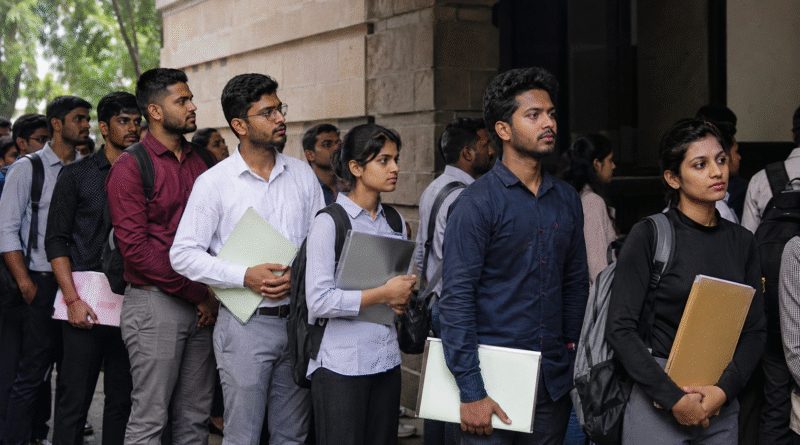
India Youth Unemployment Crisis: Beyond The Protests
Every few months, the India youth unemployment crisis breaks through as a news cycle. A protest, a viral video, an angry hashtag, and then it fades until the next flashpoint. The recent wave of demonstrations under the banner of the so-called Cockroach Janta Party, sparked after a Chief Justice’s remark comparing unemployed youth to cockroaches, is only the latest eruption of something that has been building quietly for years. Protests are loud and visible. The underlying numbers are the real story, and they are far more sobering than any single slogan.
The India Youth Unemployment Crisis, In Numbers
Start with what the government’s own data says. The Periodic Labour Force Survey for 2024-25 puts the overall unemployment rate at 3.2 percent for those aged 15 and above, a number that sounds almost healthy. But that headline figure hides the real pressure point. Youth unemployment, for the 15 to 29 age bracket, was recently measured at 9.9 percent, roughly three times the general rate. In urban India the gap widens further. Urban youth unemployment reached 13.6 percent in the annual data, and monthly PLFS bulletins from mid-2026 put urban youth joblessness as high as 18.2 percent, with young women facing rates above 25 percent.
Education does not close this gap the way it should. Graduate unemployment has consistently run around 13 percent, well above the rate for those with only secondary schooling. That is not a small statistical quirk. It means an Indian family that spends years and savings pushing a child through college is, on average, buying that child a higher chance of unemployment than if they had stopped after school. Independent trackers like CMIE have long reported unemployment figures running several points above the official PLFS numbers, and while the two surveys measure things differently, the gap itself signals how contested and uncertain the real picture is.
Why This Keeps Happening: Three Structural Causes
The first cause is what economists call jobless growth. India’s GDP has expanded steadily for most of the past decade, but the employment created per unit of growth has shrunk. Manufacturing and services have both become more capital-intensive and automation-heavy, which means a factory or an IT firm today can produce more output with fewer new hires than it needed ten years ago. Add artificial intelligence tools now reshaping entry-level software and back-office work, and the traditional escalator from a degree to a desk job is moving slower than the number of graduates stepping onto it.
The second cause is the education-to-employability gap. India produces a very large number of graduates every year, but employer surveys consistently find that a majority of them are not considered job-ready in the skills employers actually need. This is not simply about degrees being worthless. It is about a curriculum and examination system built for rote recall in an economy that increasingly wants applied, practical skill. Vocational training exists on paper through schemes like Skill India, but enrollment and completion numbers have repeatedly fallen short of targets, and placement rates after training remain patchy across states.
The third cause is the shrinking pull of two traditional shock absorbers: government jobs and the armed forces. Government vacancies have long been the most sought-after and stable form of employment for lower-middle and rural households, but recruitment has not kept pace with applicant numbers, leading to enormous applicant-to-post ratios for even entry-level government posts. The armed forces, another major traditional employer for youth from states like Uttar Pradesh, Bihar, Haryana, and Punjab, underwent a structural change with the Agnipath scheme in 2022, which replaced a large share of permanent recruitment with four-year contracts, retaining only about 25 percent of each batch afterward. Whatever the scheme’s stated fiscal and force-modernisation logic, its practical effect was to shrink the number of stable, long-term jobs available through a route that many rural youth had built their futures around, and it triggered visible unrest in several states when it was announced.
A Decade Of Fixes That Did Not Fix It
India has not lacked for employment schemes. What it has lacked is follow-through at the scale the problem demands. Skill India, launched in 2015, aimed to train 400 million people by 2022 but has trained a fraction of that number, with independent audits repeatedly flagging weak placement outcomes. The Make in India push, also from 2014, aimed to lift manufacturing’s share of GDP and create millions of factory jobs, but manufacturing’s share of output has stayed roughly flat for a decade rather than rising toward the original target. The Production Linked Incentive scheme, rolled out in 2020, has done better at attracting large manufacturers into electronics and a handful of other sectors, but even its supporters acknowledge the direct job numbers created so far are modest relative to the size of the youth workforce entering the market every year, estimated at around 12 million new entrants annually.
Startup India and the MUDRA loan scheme both aimed to turn young people into job creators rather than job seekers, and both have had genuine successes at the margins, particularly MUDRA’s reach into small self-employment. But self-employment through a small loan is a very different thing from stable salaried work, and survey data consistently shows that the majority of young jobseekers, when asked, still prefer a stable salaried position over entrepreneurship, which they associate with risk in the absence of a social safety net. None of this is a story of one government failing where another succeeded. Both the UPA years and the NDA years produced ambitious employment schemes, and both saw those schemes fall short of their own stated targets by wide margins. The pattern is consistent enough across different political leaderships that it points to something structural rather than a failure of any single administration’s intent.
What Responsibility Looks Like Beyond Government
It is tempting, especially in the heat of a protest cycle, to frame this entirely as a government failure. Government policy carries the largest share of responsibility, since it sets the incentives, funds the training infrastructure, and shapes the broader economic environment. But the crisis also has a demand-side and an individual-choice dimension that gets less attention. Parents and students alike have historically over-indexed on a narrow set of degrees, particularly general arts and commerce courses, and government job preparation, partly because these paths carry more perceived social status than vocational or trade skills, even when the job market signals otherwise. Employers, for their part, have been slow to invest in structured apprenticeship and on-the-job training pipelines of the kind that make Germany’s vocational system work, often preferring to poach already-trained talent rather than build it, which starves the system of the very entry-level positions freshers need most.
None of this excuses weak policy delivery. But a crisis this large rarely has a single actor to blame, and treating it as purely a government failing, or purely an individual failing to reskill fast enough, misses the way these pressures reinforce each other. Fixing it will require families reconsidering some inherited assumptions about which degrees carry value, employers rebuilding entry-level training pipelines they have let atrophy, and government policy finally being funded and monitored at the scale its own targets have always promised.
What Policy Options Are Actually On The Table
Three directions come up most often among economists studying this problem. The first is treating vocational and apprenticeship training as seriously as college education, with real funding, real employer partnerships, and real accreditation, rather than as a lower-status fallback option. The second is targeted support for labour-intensive manufacturing sectors like textiles, footwear, and food processing, which create far more jobs per rupee of investment than capital-intensive sectors, even if they generate less impressive headline growth numbers. The third is fixing the data problem itself: India still relies on survey-based employment data that arrives with significant lag and measurement disputes between official and independent sources, which makes it harder for policymakers to react quickly to worsening trends in real time.
None of these fixes are fast, and none of them make for a good slogan at a protest. But the India youth unemployment crisis was not built in one budget cycle, and it will not be solved in one either. The louder the protests get, the more tempting it becomes to look for a single culprit or a single fix. The data suggests something less satisfying and more honest: this is a structural problem, a decade in the making, that will need sustained, unglamorous policy work across several governments to actually close.
Key Points
- PLFS 2024-25: overall unemployment rate 3.2% (15+ age group); youth (15-29) unemployment at 9.9%.
- Urban youth unemployment: 13.6% annually; monthly PLFS bulletin (June 2026) put it as high as 18.2%, with young women above 25%.
- Graduate unemployment (~13%) exceeds unemployment among those with only secondary education — a persisting skill-mismatch signal.
- CMIE estimates typically run several points higher than official NSO/PLFS figures due to differing survey methodology.
- Key schemes and targets: Skill India (2015, target 400 million trained by 2022 — significant shortfall); Make in India (2014, manufacturing GDP share target largely unmet); PLI Scheme (2020); MUDRA and Startup India (self-employment focus).
- Agnipath Scheme (June 2022): 4-year military recruitment, ~25% retention after tenure; triggered protests in Bihar, UP, Haryana, Punjab and other states.
- India adds an estimated 12 million new workforce entrants annually.
- Structural causes cited by economists: jobless growth, education-employability mismatch, shrinking government/defence recruitment absorption.
- Policy options discussed: apprenticeship-based vocational training, support for labour-intensive manufacturing (textiles, footwear, food processing), improved real-time labour data systems.
By Amit Mangal | ThirdPol | July, 2026