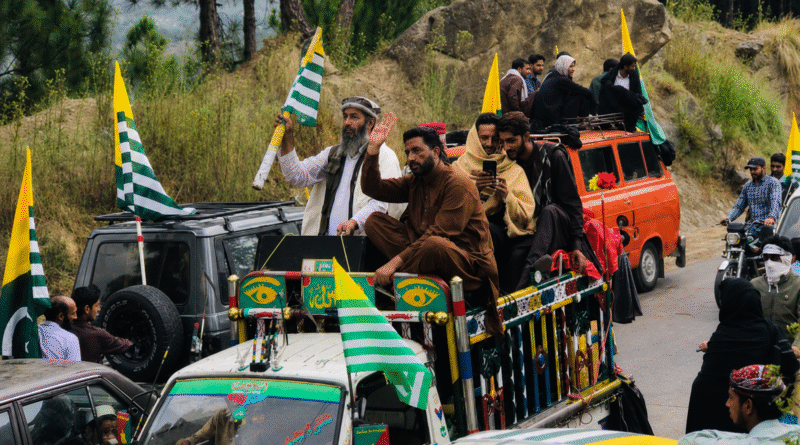
Pakistan Occupied Kashmir Protests: A Crackdown Exposed
For decades, Pakistan has built its entire international case on Kashmir around one claim: that it speaks for the human rights of Kashmiris against Indian repression. The Pakistan occupied Kashmir protests that have swept the region since June 2026 have quietly dismantled that claim, using nothing but Pakistan’s own actions as evidence. Over the summer, demonstrators across Pakistan occupied Kashmir took to the streets over inflation, electricity prices, and political representation. Pakistan’s response was not dialogue. It was gunfire, an internet blackout, a banned organisation, and a detained journalist.
The Pakistan Occupied Kashmir Protests, What Actually Happened
The unrest began on June 7, 2026, organised by the Jammu Kashmir Joint Awami Action Committee, a grassroots coalition of traders, transporters, students and lawyers known as JKJAAC. The group presented a 38-point charter of demands to the Government of Kashmir, centred on opposition to 12 seats reserved in the 53-seat Legislative Assembly for refugees living elsewhere in Pakistan, alongside long-standing complaints about wheat and flour subsidies, electricity tariffs, and chronic underinvestment in education and housing. These are not new grievances. Nearly identical protests broke out in 2023, 2024, and again in 2025, with the government each time promising reforms that were never fully delivered.
What made 2026 different was the scale of the response. On June 8, clashes after a court upheld the reserved refugee seats left seven dead. The next day, Pakistan designated JKJAAC a proscribed organisation under the Jammu and Kashmir Anti-Terrorism Act, effectively criminalising the very group representing the protesters’ demands. Days later, violence in Rawalakot and Mirpur left 19 dead and dozens injured, among the deadliest crackdowns the region has seen. Authorities deployed federal paramilitary troops, issued travel advisories, and pushed ahead with mass arrests even as international rights groups sounded alarm.
Silencing The Story While It Was Happening
Pakistan did not just crack down on protesters. It cracked down on anyone documenting the crackdown. Internet and mobile services were suspended across the region during the worst of the violence, a now-familiar tactic used to prevent images and video from reaching the outside world in real time. Al Jazeera’s broadcast was restricted. Journalist Syed Farhad Ali Shah was detained without charge specifically over his coverage of the protests, according to the Committee to Protect Journalists. Amnesty International did not mince words, describing the terrorism designation of JKJAAC as a dangerous escalation and condemning what it called a sweeping crackdown involving an internet shutdown and mass arbitrary arrests.
Pakistan’s own political class struggled to defend the response. Defence Minister Khawaja Asif drew immediate backlash, including criticism from within Pakistan’s own National Assembly, after reportedly comparing occupied Kashmir protesters to enemies of the state, a comment that laid bare how Islamabad actually views dissent in the territory it claims to be liberating on Kashmiris’ behalf.
The Argument This Destroys
This is the part Pakistan’s diplomats least want discussed. For years, Islamabad has used every available international forum, the United Nations Human Rights Council among them, to accuse New Delhi of repression in Jammu and Kashmir. A Middle East Media Research Institute analysis published this month put it plainly: the scale of these protests, and Pakistan’s response to them, has undercut the very rationale Islamabad has relied on to attack India’s record in the region it actually administers. It is difficult to credibly claim to champion Kashmiri rights in one breath while banning a civil rights coalition as terrorists, shutting down the internet, and opening fire on protesters demanding subsidised flour, in the next.
India’s own reaction has been pointed but restrained, consistent with its long-standing position that Pakistan occupied Kashmir is Indian territory under illegal occupation. External Affairs Minister S Jaishankar has previously reiterated that returning PoK to India remains a matter of cross-party consensus, backed by a parliamentary resolution dating back decades. New Delhi has used the 2026 unrest to reinforce that argument internationally, pointing to the protests as living evidence of the governance failures and repression Pakistan has presided over in the territory since 1947.
A Pattern, Not An Incident
None of this is new for the region, which is precisely the point. Protests over the same basic grievances, cheap electricity, subsidised wheat, an end to the refugee quota system, recurred in 2023, escalated in 2024 with at least three protester deaths, and returned again in September and October 2025, when at least 12 more civilians were killed over a single three-day stretch of unrest in Muzaffarabad, Drikot, and Mirpur. Each round ended the same way: promises from Islamabad, partial or unfulfilled implementation, and a fresh outbreak within a year. The 2026 protests are simply the bloodiest and most internationally visible chapter of a cycle that has repeated for years with no structural resolution in sight.
What the Pakistan occupied Kashmir protests ultimately reveal is not a single bad summer of unrest. It is a governance model that has consistently treated the territory’s own residents as a population to be managed and, when necessary, suppressed, rather than a population whose grievances warrant lasting reform. Every time Islamabad reaches for banned-organisation designations, internet blackouts, and paramilitary deployments to answer demands for cheaper flour and fair representation, it makes New Delhi’s argument for it: that Pakistan’s claim to speak for Kashmiri self-determination has never extended to the Kashmiris actually living under its own administration.
Key Points
- 2026 Pakistan Occupied Kashmir (PoK) protests began June 7, 2026, led by the Jammu Kashmir Joint Awami Action Committee (JKJAAC).
- 38-point charter of demands: opposition to 12 refugee-reserved seats in the 53-seat AJK Legislative Assembly, plus wheat/flour subsidies, electricity tariffs, education and housing investment.
- June 8, 2026: 7 killed in clashes after a court upheld the reserved refugee legislative seats.
- June 9, 2026: Pakistan designated JKJAAC a “proscribed organisation” under the AJK Anti-Terrorism Act (2014).
- Rawalakot and Mirpur violence: 19 killed, dozens injured — among the deadliest crackdowns in the region’s protest history.
- Internet/mobile shutdown imposed; Al Jazeera coverage restricted; journalist Syed Farhad Ali Shah detained without charge (per CPJ).
- Amnesty International (June 9, 2026) condemned the JKJAAC terrorism designation as a “dangerous escalation.”
- Defence Minister Khawaja Asif drew backlash (including from Pakistan’s own National Assembly) over remarks likening protesters to India.
- Pattern: similar protests recurred in 2023, 2024 (3+ deaths), and Sept-Oct 2025 (12+ deaths in a 3-day span) — recurring grievances, no lasting resolution.
- India’s official position: PoK is Indian territory under illegal occupation, per a longstanding parliamentary resolution and cross-party consensus reaffirmed by EAM S. Jaishankar.
By Amit Mangal | ThirdPol | August, 2026