India Bangladesh Relations 2026: After 18 Months of Strain, Is the Reset Real?
India Bangladesh relations 2026 arrived at their most important inflection point in years this week, when Bangladesh’s new Foreign Minister Khalilur Rahman visited New Delhi and met External Affairs Minister S. Jaishankar, NSA Ajit Doval, Commerce Minister Piyush Goyal, and Petroleum Minister Hardeep Puri in rapid succession. The two countries “vowed to normalise” ties after more than 18 months of unprecedented strain, a formulation that sounds clean but conceals a stack of unresolved disputes that will test whether this reset holds. Sheikh Hasina remains in India with a death sentence hanging over her in Dhaka. The Ganga Water Treaty expires in December 2026. The Teesta river deal has been blocked for 15 years. Pakistan’s ISI made its first high-level visit to Bangladesh last January. The reset in India Bangladesh relations 2026 is real. Whether it is durable is a different question entirely.
How India-Bangladesh Relations Got This Bad
For most of the Sheikh Hasina era (2009-2024), India-Bangladesh ties were one of South Asia’s relative success stories. Hasina’s Awami League was deeply aligned with India on security. Bangladesh’s territory was not used by insurgents targeting India’s northeast, border management improved, and energy and trade links deepened substantially. India extended $6.5 billion in Lines of Credit. The Bangladesh-India Friendship Pipeline began supplying diesel from Assam. The relationship had its frictions, but its foundation was solid.
That foundation cracked in August 2024 when Hasina’s government was brought down by a student-led mass protest over a controversial jobs quota for descendants of 1971 freedom fighters. The crackdown killed hundreds. Hasina fled to India in a helicopter. An interim government under Nobel laureate Muhammad Yunus took over, and Bangladesh’s foreign policy shifted sharply. Anti-India sentiment always present in Islamist and BNP circles surged. Bangladesh’s ICT sentenced Hasina to death in absentia in November 2025. Dhaka formally demanded extradition. Pakistan’s ISI made a high-level visit to Dhaka in January 2025 a development that alarmed New Delhi more than almost anything else during the 18-month freeze.
Timeline: The Breakdown and the Reset
| Date | Event |
| Aug 2024 | Sheikh Hasina government collapses under student protests. Hasina flees to India. Muhammad Yunus leads interim government. India-Bangladesh ties enter 18-month freeze. |
| Jan 2025 | Pakistan ISI delegation visits Bangladesh — first high-level Pakistan-Bangladesh intelligence contact in years. India alarmed. |
| Nov 2025 | Bangladesh International Crimes Tribunal sentences Hasina to death in absentia for 2024 crackdown. Dhaka demands extradition from India. |
| Feb 12, 2026 | Bangladesh elections: BNP wins landslide. Tarique Rahman becomes PM. |
| Feb 17, 2026 | India sends Lok Sabha Speaker Om Birla and Foreign Secretary Vikram Misri to Tarique Rahman inauguration. Modi sends personal invitation letter. |
| Mar 2026 | India supplies 5,000 tonnes diesel to Bangladesh via Friendship Pipeline. First major goodwill gesture to new government. |
| Apr 6, 2026 | Indian High Commissioner Pranay Verma meets PM Tarique Rahman in Dhaka. Offers “forward-looking” reset based on “mutual benefit.” |
| Apr 7-9, 2026 | Bangladesh FM Khalilur Rahman visits New Delhi. Meets NSA Doval, EAM Jaishankar, Ministers Goyal and Puri. Both sides agree to normalise relations. |
India Bangladesh Relations 2026: The Full Agenda
| Issue | Bangladesh wants | India position | Status |
| Hasina extradition | Bangladesh demands under 2013 treaty. Death sentence in absentia. | India has not complied. Will not. Issue deferred. | Unresolved — deferred |
| Ganga Water Treaty | Favourable renewal before Dec 2026 expiry. | Will negotiate. West Bengal politics complicates. | Active — high stakes |
| Teesta river | Urgent water deal for northern Bangladesh agriculture. | Willing nationally. Blocked by Mamata Banerjee since 2011. | Structurally blocked |
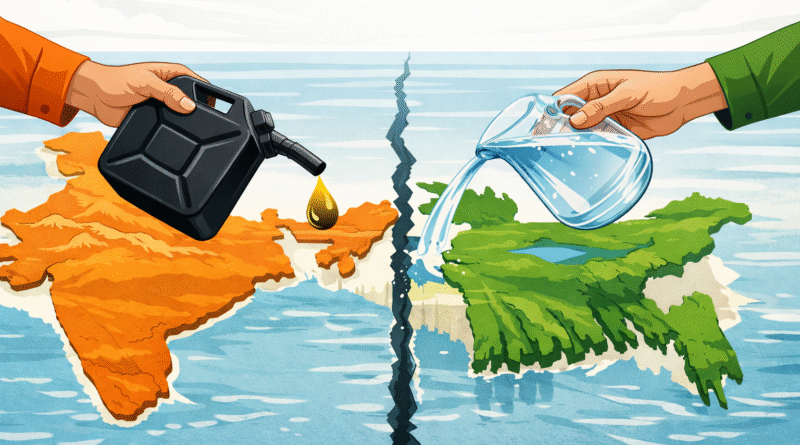
| Diesel & fertiliser | Increased supply via Friendship Pipeline. | India said yes. March 2026: 5,000 tonnes supplied. | Progressing |
| Visa restrictions | Ease tourist and business visa rules. | Easing for BNP government. | Improving |
| Pakistan-BD security ties | ISI visited Dhaka Jan 2025. BNP reassures India. | No security arrangements with China, Pakistan, or US. | Reassurance given |
| Trade & connectivity | Preferential port access, rail links, reduced barriers. | $6.5B in LoC extended. Connectivity framework in place. | Framework set — slow implementation |
The Hasina Question: The Elephant That Will Always Be in the Room
Bangladesh’s request for the extradition of Sheikh Hasina convicted and sentenced to death in absentia by the ICT is the most politically sensitive item in India Bangladesh relations 2026. India and Bangladesh have a 2013 bilateral extradition treaty. India is legally obligated to consider the request. But extradition is discretionary for political offences, cases involving national interest, and pending appeals all of which apply to Hasina.
India has not extradited her and will not. The MEA said after the April meetings that the issue “should not hold bilateral ties hostage” diplomatic shorthand for: we acknowledge the request, we are not acting on it, let’s move on. Bangladesh’s BNP government accepted this publicly while keeping the demand formally alive.
The BNP calculation is shrewd. Tarique Rahman himself was convicted in absentia in Bangladesh on corruption charges while in London exile and came back through elections. He understands the diplomacy of extradition demands better than most. The BNP’s public demand for Hasina is real. Its private expectation of delivery is much lower. What this means for India Bangladesh relations 2026 is that the Hasina file stays open permanently a pressure point either side can activate, and that both will quietly agree to leave dormant when the broader relationship needs room to breathe.
Water, Water Everywhere: Ganga Treaty and the Teesta Deadlock
Two water disputes define the structural difficulty of India Bangladesh relations 2026 more than any political disagreement.
The Ganga Water Treaty of 1996 governing Ganges water sharing at the Farakka Barrage expires in December 2026. The treaty has broadly worked across its 30 years, giving Bangladesh a minimum dry-season allocation critical to its northwest agriculture. Renewal negotiations begin this year. India’s position is complicated by climate change (the Ganges carries less water than in 1996) and by West Bengal politics — any deal that appears to give Bangladesh too much water can be weaponised against the ruling party there.
The Teesta deal is the older and harder dispute. A deal was ready in 2011 but was blocked at the last minute by West Bengal Chief Minister Mamata Banerjee, who argued it left her state short of water. Every Indian government since has wanted to sign Teesta. Mamata has blocked every attempt. The BNP government like every Bangladeshi government before it considers Teesta critical enough to domestic politics in northern Bangladesh that it cannot drop the demand. India at the national level sympathises. India at the state level cannot override Mamata. Both water disputes illustrate a structural weakness in Indian foreign policy: when key decisions require coordination with state governments, New Delhi’s ability to follow through on diplomatic commitments is constrained by its own federal politics.
The China Factor: Why India Cannot Afford to Lose Bangladesh
India’s urgency in resetting India Bangladesh relations 2026 is not primarily about bilateral trade. It is about China.
China is Bangladesh’s largest import source. Chinese investment in Bangladesh’s infrastructure, the Padma Bridge, multiple power plants is substantial and growing. Bangladesh has not joined the BRI formally, but it operates close to its gravitational pull. The ISI visit to Dhaka in January 2025 widely seen as Pakistan brokering deeper Pakistan-Bangladesh strategic ties spooked India significantly. A Bangladesh aligned with both Pakistan and China on its eastern flank is a security problem that no amount of border fencing resolves.
The BNP government under Tarique Rahman has, for now, offered reassurances. Bangladesh’s FM explicitly told India the new government will not pursue security arrangements with China, Pakistan, or the United States. But reassurances are not permanent policy, and Bangladesh’s “Bangladesh First” doctrine means every major power will continue competing for influence in Dhaka regardless.
India’s best insurance against losing Bangladesh is making itself concretely useful — delivering diesel when the country needs it, offering trade concessions, and eventually signing Teesta. The Friendship Pipeline kept Bangladesh’s fuel supply stable during the Iran war’s energy shock in March 2026. That kind of concrete reliability is what durable bilateral relationships are built on not diplomatic communiques.
ThirdPol’s Take
The India Bangladesh relations 2026 reset is real but fragile. The BNP government needs India: diesel, fertiliser, trade access, diplomatic cover. India needs this to work: a hostile or China-aligned Bangladesh on its eastern flank is a security problem that compounds every other strategic challenge India faces. Both sides understand this. What makes the relationship hard is not goodwill — it is the list of structural problems neither side can fully solve. Hasina sits in India indefinitely. Teesta stays blocked by Mamata. The Ganga Treaty renews on uncomfortable terms. And China keeps investing in Bangladesh regardless of what Jaishankar and Rahman say in New Delhi. The realistic ambition for India Bangladesh relations 2026 is not a breakthrough. It is a managed, functional relationship that prevents the worst — Bangladesh drifting toward Pakistan-China alignment — while building the economic ties that make the relationship resilient to the political turbulence that will inevitably come again.
By Amit Mangal | ThirdPol | April 10, 2026