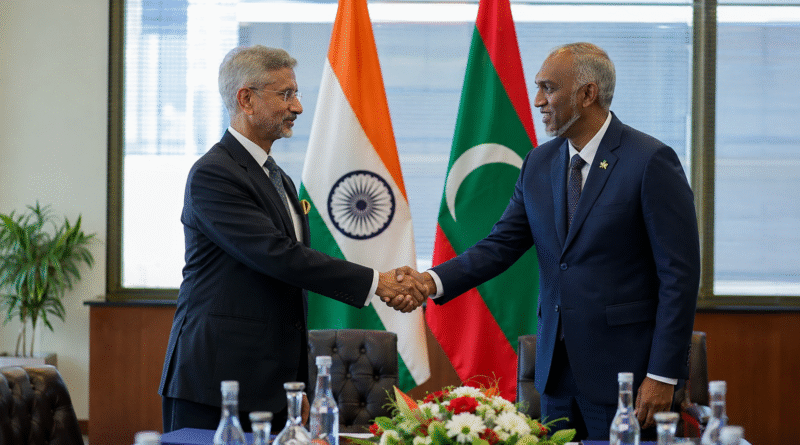
India Maldives FTA Talks: What Round One Just Delivered
The India Maldives FTA talks just cleared their first real hurdle. Negotiating teams from both countries met virtually between June 29 and July 7, and on July 14 the Indian government confirmed the round had closed with what officials called substantive progress. It sounds like routine trade language, but the timing is not routine at all. This is happening as India and the Maldives mark 60 years of diplomatic relations, and less than two years after ties between the two countries hit one of their lowest points in decades.
A Quick Recap: Why This FTA Exists
The idea for this agreement was first announced in 2024, during President Mohamed Muizzu’s visit to India. That visit itself was notable, since Muizzu had come to power on an “India Out” campaign and his early months in office were marked by public friction with New Delhi. Since then, ties have steadily warmed, and this proposed India Maldives FTA is one of the clearest signs of that shift. The goal, according to Maldivian trade minister Mohamed Saeed, is to help the islands diversify an economy that leans heavily on tourism and reduce dependence on any single sector.
What The India Maldives FTA Talks Actually Covered
Round one was entirely virtual and ran across eight technical sessions covering eight separate policy areas. India’s delegation was led by Chief Negotiator Ujjwal Kumar Ghosh, Joint Secretary in the Department of Commerce, and the Maldivian side was led by Chief Negotiator Yusuf Riza. Both governments described the discussions as text-based, meaning negotiators were already working off draft treaty language rather than general principles, which is usually a sign talks are moving faster than they look from the outside.
On July 8, a day after the round closed, Union Commerce and Industry Minister Piyush Goyal met his Maldivian counterpart Mohamed Saeed to review progress. The two ministers reaffirmed plans to also speed up a related Bilateral Investment Treaty, running on a parallel track alongside the FTA. Officials on both sides say the aim is a full agreement by the end of 2026, an ambitious but not unrealistic timeline given how compact the Maldivian economy is compared to India’s other trade partners.
The Numbers Behind The India Maldives FTA Talks
Bilateral trade between the two countries reached 771.76 million US dollars in 2025-26, up 13.54 percent from 679.70 million US dollars the year before. India remains the Maldives’ second-largest trading partner. Those numbers are modest by the standards of India’s other FTAs, but they undersell how much the relationship matters strategically. The Maldives sits directly across some of the busiest shipping lanes in the Indian Ocean, and Indian planners have long treated the islands as a frontline in maintaining maritime security in the region.
Beyond tariffs, the two governments also agreed to deepen cooperation in tourism, startups, digital payments, and micro, small and medium enterprises. These are areas where India has scale to offer and the Maldives has a genuine gap, particularly in digital payments infrastructure, where Indian systems like UPI have already begun expanding into the islands over the past two years.
Why This Matters Beyond Trade Numbers
It is worth stepping back from the tariff schedules for a moment. An FTA with the Maldives is not going to move India’s trade statistics in any meaningful way. What it does is lock in the diplomatic recovery of the last two years in something more durable than goodwill visits and joint statements. Trade agreements are slow to negotiate and even slower to unwind, which is exactly why India tends to pursue them with neighbours it wants a long-term anchor with, not just a friendly headline with.
For India watchers, the more interesting story here is sequencing. This is not an isolated Maldives story. It sits inside a broader pattern this year of India using economic instruments, FTAs, investment treaties, and payment system tie-ups, to do the quieter, slower work of consolidating its position in the Indian Ocean neighbourhood, at the same time it has been more visibly active further east through summits and multi-country tours.
What Comes Next
The next round of India Maldives FTA talks has not been officially scheduled yet, though both sides have signalled they want to move quickly given the end-of-2026 target. Watch for two things in the coming weeks: whether round two moves from virtual to in-person, which usually signals negotiators are closing in on harder chapters like rules of origin and tariff schedules, and whether the parallel Bilateral Investment Treaty gets its own separate announcement, since investment protections often unlock the political will needed to finish the trade side faster.
For now, the message from both capitals is consistent. Sixty years in, and two years removed from open friction, India and the Maldives are choosing to bet on economic interdependence as the more durable foundation for the relationship, rather than leaving it to political cycles on either side.
Key Points
- First round of India-Maldives FTA talks held virtually, June 29 to July 7, 2026.
- India’s negotiator: Ujjwal Kumar Ghosh (Joint Secretary, Dept. of Commerce). Maldives negotiator: Yusuf Riza.
- Talks covered 8 technical sessions across 8 policy areas; text-based discussions.
- Runs parallel to a Bilateral Investment Treaty (BIT) negotiation track.
- FTA idea first announced in 2024 during President Mohamed Muizzu’s visit to India.
- 2025-26 bilateral trade: USD 771.76 million, up 13.54% from USD 679.70 million in 2024-25.
- India is the Maldives’ second-largest trading partner.
- 2026 marks 60 years of India-Maldives diplomatic relations.
- Target: conclude the FTA by end of 2026.