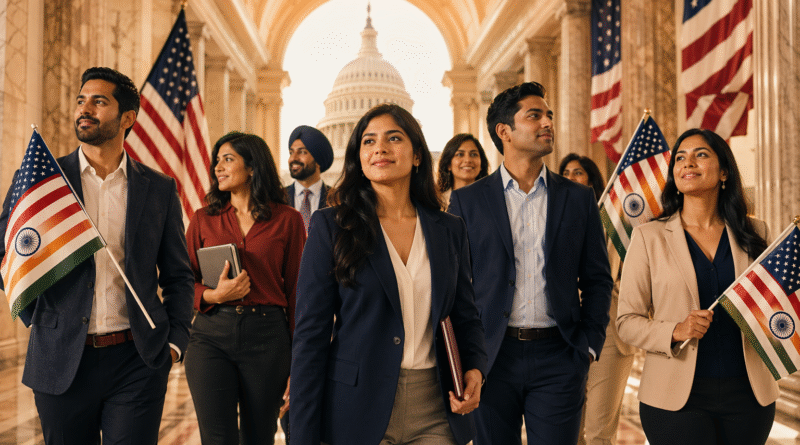
Indian Diaspora US Politics: How NRIs Are Shifting American Elections and Foreign Policy
The Indian-American community is the most politically anomalous immigrant group in the United States. It is the highest-earning ethnic group in America, the most educated, and disproportionately represented in the tech, medical, and financial industries. It votes but not in a uniform direction. And in 2026, its collective political weight has reached a scale that both parties are actively courting.
Indian diaspora us politics is no longer a niche interest story. With an estimated 4.5 million people of Indian origin in the United States a number that has grown 40 percent in a decade, driven partly by H-1B visa holders converting to permanent residency and citizenship the community has become a meaningful electoral factor in states including New Jersey, California, Texas, and increasingly Georgia, Michigan, and Virginia.
The Kamala Moment and Its Aftermath
Kamala Harris’s selection as Vice President in 2020 and her presidential run in 2024 put the Indian-American community’s political significance in sharp relief. Harris’s Tamil roots made her a figure of pride for South Indians in particular, though the community was split significant numbers of Hindu Americans voted Republican in 2024 citing concerns about trade policy, H-1B visa uncertainty under Biden’s immigration approach, and perceptions of anti-Hindu bias in Democratic coalition politics.
The split reveals something important about indian diaspora us politics: the community is not monolithic. First-generation immigrants on H-1B and green card waiting lists care intensely about immigration processing times and employer-sponsored visa rules. Second-generation Indian-Americans are politically diverse, with many aligning on racial justice, climate, or economic issues rather than “India-related” concerns. Indian-American business owners in red states often vote Republican on tax and regulation grounds.
How the Diaspora Shapes US-India Relations
The influence runs in both directions. Indian-American political donors and lobbyists have been effective advocates for US-India policy priorities in Washington. The US India Political Action Committee (USINPAC) has grown significantly in the past decade. Several key Congressional champions of the US-India relationship ncluding in the committees that handle defence authorisation and foreign affairs have significant Indian-American constituencies or donors.
This lobbying infrastructure helped shape the political environment in which the US-India trade deal of 2026 became possible. It has also been a factor in moderating Congressional criticism of India on human rights and press freedom issues criticism that would otherwise find more traction given India’s declining rankings on several global indices.
For the Indian government, the indian diaspora us politics dynamic is a soft power asset. New Delhi has been deliberately cultivating it Pravasi Bharatiya Divas (the diaspora conference) has been elevated in importance, Indian consulates have expanded community outreach, and Modi’s visits to the US have included mass rallies of Indian-Americans in Houston and New York that serve as both domestic political signals and diplomatic theatre.
The H-1B Pressure Point
The most acute political issue for the Indian-American community in 2026 remains the H-1B visa. Indian nationals account for approximately 70 percent of H-1B applications. The backlog for Indian-born workers seeking green cards is estimated at over one million, with wait times exceeding several decades for some categories. This is a genuine injustice a product of per-country caps on employment-based green cards that were designed for a different era of immigration.
The Trump administration’s 2026 H-1B posture has been mixed: rhetorically supportive of “merit-based” immigration in the abstract, but also restrictive in implementation, with increased scrutiny on applications and continuation of country caps. The indian diaspora us politics story in 2026 includes the tension within the Republican coalition between those who see Indian tech workers as economic assets and those who see them as competition for American workers.
Both parties know they cannot ignore a community this economically powerful. The question is how to translate political attention into policy change and whether the community itself can speak with enough political coherence to extract that change.
By Amit Mangal | ThirdPol | April, 2026