H-1B Visa India 2026: What Trump’s Programme Review Means for Indian Tech Workers
The H-1B visa India 2026 story is playing out simultaneously in three different rooms: in Washington, where the Trump administration is reviewing the H-1B programme for the second time in a decade; in Silicon Valley, where Indian-origin engineers dominate technical leadership at every major company; and in cities like Hyderabad, Bengaluru, and Pune, where the H-1B pipeline feeds both Indian IT exports and the ambitions of hundreds of thousands of Indian professionals dreaming of American careers. Indians receive approximately 72% of all H-1B approvals issued by the US Citizenship and Immigration Services every year a dominance so complete that the H-1B programme is, in practical terms, primarily an India-US labour mobility mechanism dressed in the language of American skills shortage policy. What Trump’s current review of the programme means, what is likely to change, what is not, and what Indian workers should be doing right now is the subject of this article.
What the H-1B Visa Actually Is
The H-1B is a non-immigrant visa that allows US employers to hire foreign workers in “speciality occupations” jobs that require at least a bachelor’s degree in a specialised field. Created in 1990 as part of the Immigration Act, it was designed to allow American companies to fill technical roles they could not fill domestically. The annual cap is 65,000 visas, with an additional 20,000 reserved for workers with US master’s degrees or higher making the effective cap 85,000 per year. In years with high demand, USCIS conducts a lottery among all eligible applicants, meaning even a qualified candidate with a job offer in hand may not receive a visa simply because of random selection.
The dominance of Indian nationals in the H-1B system is structural, not coincidental. India produces the largest number of STEM graduates who qualify for H-1B petitions. Indian IT companies Infosys, Wipro, Tata Consultancy Services, HCL have built entire business models around placing Indian engineers at US client sites on H-1B visas. And the Indian-American tech community, now spanning second and third generations, has created a recruitment network and cultural infrastructure that continues to pull talented Indians into the American tech pipeline.
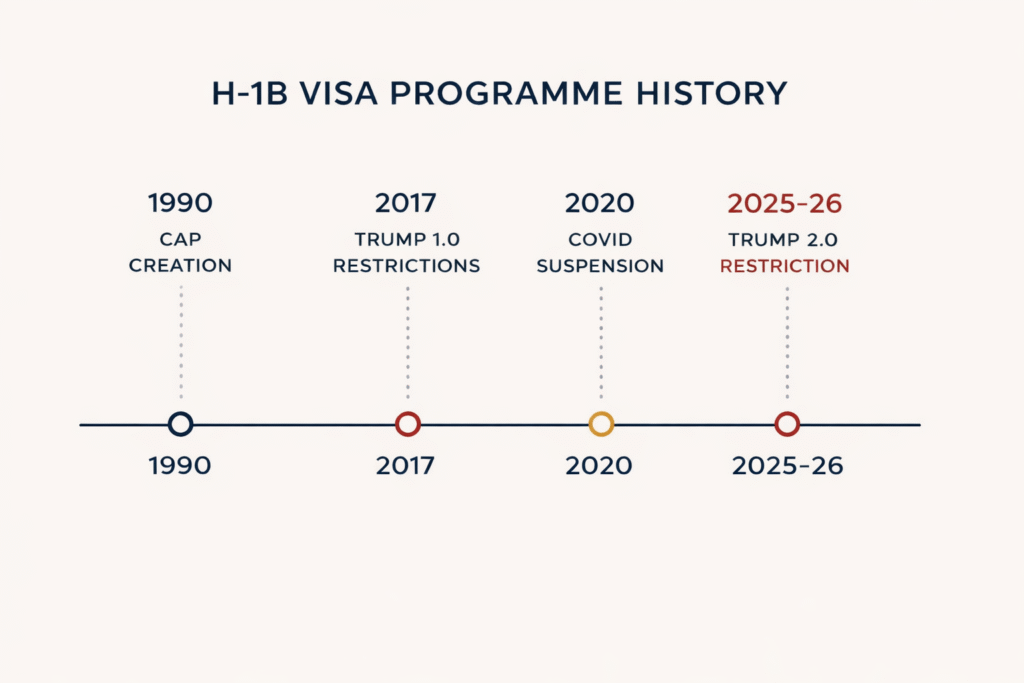
H-1B Visa India 2026: The Full Timeline
| Year | Event | Impact on India |
| 1990 | H-1B visa programme created. Annual cap: 65,000. | India becomes dominant beneficiary as IT outsourcing grows. |
| 2004 | Cap reached within days of opening. Wait lists emerge. | Indian IT firms (Infosys, Wipro, TCS) begin lottery strategies. |
| 2017 (Trump 1.0) | “Buy American, Hire American” executive order. RFE rate spikes to 40%+. | Indian applicants face significantly higher rejection rates. Wage requirements tighten. |
| 2020 (COVID) | Trump suspends H-1B via executive order (June 2020). Courts partially block. | Indian tech workers in pipeline face uncertainty. Some return to India. |
| 2021 (Biden) | H-1B suspensions lifted. USCIS backlogs clear slowly. Lottery system reformed. | India-born workers dominate approvals — ~72% of all H-1B petitions. |
| 2024 (Biden final year) | H-1B modernisation rule published. Wage-based selection proposed then dropped. | Indian IT workers benefit from maintaining lottery system over wage-tiering. |
| 2025 (Trump 2.0 begins) | DOGE reviews H-1B programme. Debate inside MAGA: tech lobby vs restrictionists. | Indian tech community watches closely. Elon Musk publicly defends H-1B. |
| 2026 (current) | Trump administration reviewing H-1B cap increase for “strategic sectors.” Wage floor proposals being debated. No new legislation yet. | India-born workers still ~72% of approvals. Premium processing delays increased. Uncertainty high. |
What Trump 2.0 Is Actually Doing
The current Trump administration’s approach to H-1B is notably more complicated than his first term. In Trump 1.0, the hostility was relatively clear: “Buy American, Hire American” executive orders, spiking rejection rates, and a 2020 suspension that the courts partially blocked. In Trump 2.0, there is a genuine internal fight inside the MAGA coalition.
On one side are the traditional restrictionists immigration hardliners who see H-1B as a mechanism to suppress American worker wages and displace domestic talent. On the other side are the tech libertarians, led most visibly by Elon Musk, who publicly and forcefully defended H-1B in late 2024 when the internal MAGA fight became public. Musk’s argument: American universities are not producing enough engineers at the required quality and speed; cutting H-1B would directly damage the competitiveness of the US tech sector against China.
Trump himself has been characteristically transactional. In the February 2026 trade deal with India, which extracted $500 billion in US purchase commitments and a halt to Russian oil buying, mobility of Indian professionals was one of India’s asks. The US did not grant formal H-1B cap increases, but the political signal that H-1B is part of the India-US bargaining has raised hopes in New Delhi and Indian tech circles that the programme will be protected rather than restricted under the current administration.
What the 2026 review is actually considering: a potential cap increase for workers in specifically designated “strategic sectors” (AI, semiconductors, quantum computing, defence technology), tighter wage floor requirements to prevent low-wage substitution, and faster premium processing timelines. None of these has been enacted as legislation as of April 2026.
Where Indian H-1B Workers Actually Live in America
| State | Indian H-1B workers (est.) | Key employers | Political dynamics |
| California | 180,000+ | Google, Apple, Meta, Nvidia, Salesforce, hundreds of startups | Democrat-dominated. Tech lobby strongly defends H-1B. Gavin Newsom has spoken for programme. |
| Texas | 90,000+ | Dell, AT&T, American Airlines, TCS, Infosys delivery centres | Republican state but tech corridor (Austin, Dallas) opposes cuts. Split Republican politics. |
| New Jersey | 70,000+ | Pharma (J&J, Merck, Novartis), finance, IT services | High Indian-American voter concentration. Both parties compete for this demographic. |
| Washington | 60,000+ | Microsoft, Amazon, Boeing, T-Mobile | Microsoft and Amazon are the loudest H-1B defenders. Bill Gates has historically lobbied for expansion. |
| New York | 50,000+ | Wall Street tech, Citibank, Goldman Sachs, media | Finance sector depends heavily on Indian quants and technologists. |
What US Audiences Need to Understand About This
American media coverage of H-1B tends to frame it as either a displacement mechanism (the restrictionist view) or an economic necessity (the tech lobby view). Both frames miss what the programme actually represents from the Indian side, and why understanding that matters for US policy.
India produces approximately 1.5 million engineering graduates per year. The US absorbs roughly 70,000-85,000 of them annually via H-1B. This flow is not random: it is the output of a deliberate 40-year investment by the Indian middle class in STEM education specifically calibrated to the requirements of the US tech sector. Indian families spend their life savings on engineering degrees, often at IITs and NITs that function as feeder institutions to the H-1B pipeline. When the US restricts or threatens H-1B, it does not just affect individual careers it disrupts a multigenerational social contract that has produced significant human capital for American industry.
The second thing US audiences miss: the H-1B to Green Card pipeline is broken in ways that harm both Indian workers and American interests. Due to per-country caps on employment-based green cards, Indian nationals face wait times of 50-80 years for a green card despite having legal H-1B status. This means the US is capturing Indian talent on a temporary basis, benefiting from their work, and then either keeping them in limbo indefinitely or losing them to Canada, UK, or Australia countries that have created faster permanent residency pathways. The backlog currently affects over 800,000 Indian-born workers. Fixing H-1B without fixing the green card backlog is not a solution.
What Indian Workers Should Know Right Now
Premium processing remains available for H-1B petitions and is the most reliable way to get a decision within 15 business days rather than 4-6 months. Workers already on H-1B should ensure their employer files extensions well before expiration, as USCIS processing times have lengthened in 2026. Workers on H-4 EADs (spouses of H-1B holders who can work) should note that the H-4 EAD rule remains in effect it has survived multiple challenges and the Trump 2.0 administration has not moved to revoke it as of April 2026.
For workers in the H-1B lottery backlog: Canada’s Express Entry system and the UK’s Global Talent Visa are both actively recruiting Indian tech professionals and offer faster pathways to permanent residency. The Indian government’s own initiatives the iCET framework, the PLI scheme for electronics, and the semiconductor policy are creating a credible domestic alternative that is drawing back some talent that would previously have stayed in the US indefinitely.
ThirdPol’s Take
The H-1B visa India 2026 debate will be resolved, as it always is, by the tension between two American imperatives that are genuinely in conflict: the desire to protect American workers and the desire to win the technology competition with China. Those two imperatives point in opposite directions on H-1B. Restricting the programme protects some American workers in the short run. Expanding it accelerates American technological competitiveness in the long run. Trump’s instincts are transactional: if India is giving the US what it wants on trade and oil, the H-1B programme will be protected or expanded for Indians. The February trade deal was partly about exactly this implicit bargain. What India should be doing is making that bargain explicit pushing for a dedicated India-US skilled worker mobility framework as a formal part of the trade architecture, rather than leaving Indian tech workers exposed to the arbitrary swings of American domestic immigration politics every four years.
By Amit Mangal | ThirdPol | April, 2026