India US Iran 2026: How New Delhi Survives When Its Two Partners Go to War
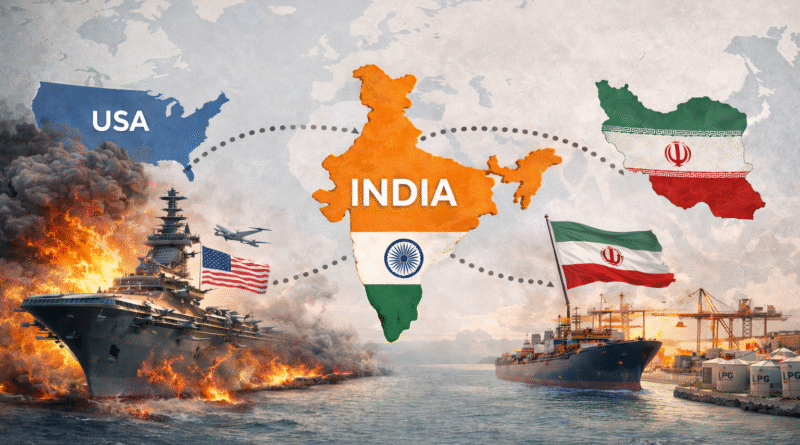
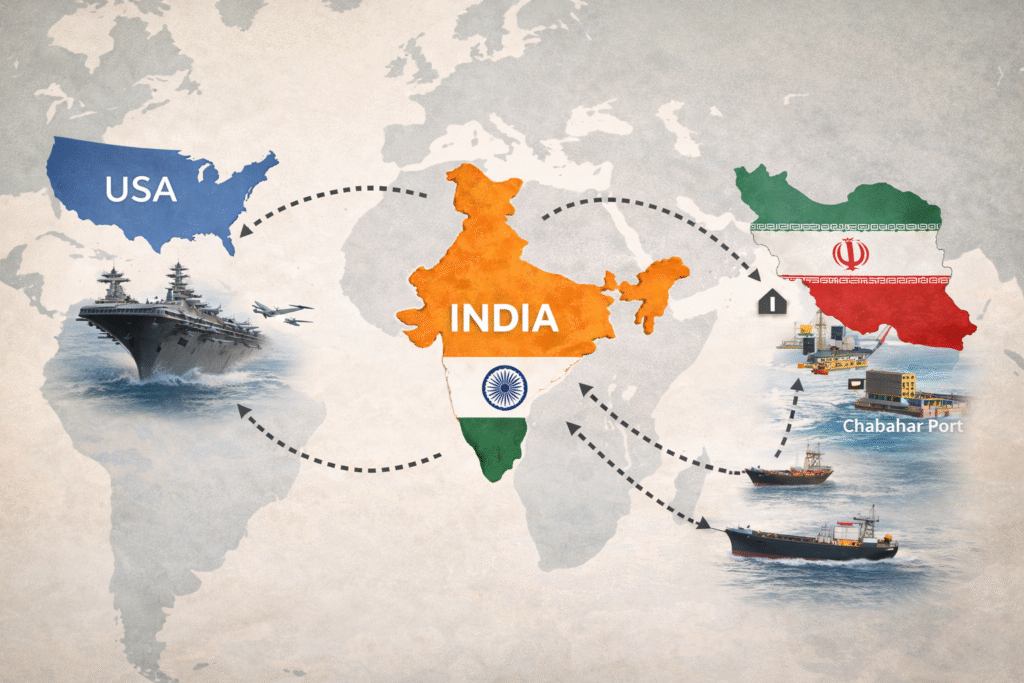
The India US Iran 2026 triangle is the most difficult foreign policy position India has occupied in decades. On one side: the United States India’s most important strategic partner, its largest export market, the country that just signed a landmark trade deal with India in February, and the country whose military is now bombing Iran and blockading the Strait of Hormuz. On the other side Iran the country that hosts India’s $500 million Chabahar port investment, the country through which India’s entire Central Asia connectivity strategy runs, and the country whose Hormuz control shut off LPG supplies to 330 million Indian households for weeks in March 2026. India cannot afford to lose either relationship. It has no vote on whether they go to war with each other. And the war they are fighting is directly damaging India’s energy security, strategic connectivity, and economic stability without India having any formal seat at the table where it could end.
India US Iran 2026: What India Has at Stake
| India stake | What is at risk | Scale | India’s ability to influence |
| Chabahar Port | India’s $500M investment in Iran’s Chabahar port — its only access route to Afghanistan, Central Asia, and the INSTC corridor — is suspended under US secondary sanctions risk. | Strategic — entire Central Asia connectivity strategy | Medium. Can lobby US for Chabahar exemption as in 2018-2024. |
| Oil supply | Iran supplied ~5-10% of India’s oil under discounted pricing before JCPOA collapse. India stopped buying Russian oil under Feb 2026 Trump deal. Now buying costlier alternatives. | High — energy inflation directly feeds CPI | Low. Price-taker in global oil market. |
| LPG / cooking gas | 330 million Indian households depend on LPG. Hormuz closure disrupts Gulf LPG exports. India faced emergency shortages in March 2026. | Critical — political and humanitarian | Low. Cannot reopen Hormuz unilaterally. |
| INSTC (North-South corridor) | International North-South Transport Corridor — India-Iran-Russia trade route — is fully stalled while Iran is under war conditions and sanctions. | Long-term strategic — reduces China’s CPEC advantage | Low during active conflict. |
| Indian diaspora in Gulf | Over 8 million Indians live in UAE, Saudi Arabia, Kuwait, Qatar, Oman. Hormuz instability directly threatens their employment and remittances ($50B+ per year). | Very high — direct human impact | None on conflict. Can activate consular protection. |
| India-US trade deal | India signed trade deal with US in Feb 2026 agreeing to stop Russian oil purchases. If Iran war resumes and oil spikes, India faces pressure to source oil at higher cost while unable to go back to Russia. | High — macroeconomic | Can renegotiate terms but at political cost. |
How India Got Here: The Strategic Autonomy Trap
India’s relationship with both the US and Iran has been managed through deliberate ambiguity for years. On Iran, India voted alongside the US at the IAEA in 2005 and 2006 to report Iran to the UN Security Council a decision that damaged India-Iran trust for a decade. India then resumed oil purchases from Iran under the JCPOA, built the Chabahar port as a strategic alternative to Chinese-dominated CPEC routes, and quietly secured sanctions exemptions from the Trump 1.0 administration to continue Chabahar construction.
When the JCPOA collapsed in 2018 and US secondary sanctions resumed, India was forced to stop buying Iranian oil entirely. It lost the discounted crude, the rupee payment arrangement, and the strategic leverage that came with being Iran’s largest Asian oil customer. Chabahar survived only because successive US administrations including Trump 1.0 recognised its strategic value as a non-Pakistani route to Afghanistan and Central Asia and carved it out from secondary sanctions.
Now, in 2026, that careful management has run into its structural limits. The US is not just sanctioning Iran it is at war with Iran. Chabahar cannot operate when the country it is in is under active US military attack. INSTC cannot function when Iran’s ports are blockaded. India cannot buy Iranian oil in any form. And the February 2026 trade deal with Trump has locked India out of Russian oil as well, leaving India paying market rates for Gulf and US crude at precisely the moment the Gulf is most disrupted.
What India Has Said and What It Has Not
India’s official response to the Iran war has been consistent and carefully worded: calls for “restraint,” support for “dialogue and diplomacy,” and expressions of concern about the humanitarian situation in the region. External Affairs Minister Jaishankar issued statements after the February 28 strikes. India abstained on the UNSC resolution condemning the US strikes consistent with its Ukraine abstention pattern.
What India has not said is equally important. India has not endorsed the US strikes. It has not called the strikes illegal. It has not demanded an Iranian nuclear deal on US terms. It has not condemned the Iranian Hormuz closure as a violation of international law (though it is). And it has not publicly supported the US Hormuz blockade notably, neither the UK nor Spain joined the US blockade, and India is in similarly non-participating company.
Behind the public silence, India has been active. EAM Jaishankar has spoken to both US Secretary of State Rubio and Iranian FM Araghchi during the conflict. India has lobbied Washington on Chabahar through diplomatic channels. India has expressed concern about the humanitarian situation in Iran while being careful not to characterise the conflict as US aggression.
India’s Five Options and Their Costs
| Option | What it means | Precedent | Risk for India |
| Public neutrality (current posture) | India calls for “dialogue and diplomacy.” Does not endorse US blockade. Does not condemn Iranian Hormuz control. No public position on who is right. | India’s standard posture on all US military operations — maintained through Iraq 2003, Libya 2011, Syria, Ukraine. | Low political risk. Zero influence on outcome. Misses opportunity to shape a deal that serves Indian interests. |
| Back-channel pressure on US for Chabahar exemption | India quietly lobbies Washington to carve out Chabahar from secondary sanctions, as it did successfully 2018-2024. Trade deal goodwill makes this ask easier. | US granted Chabahar sanctions exemption explicitly in 2018 NDAA. Biden extended it. Can be requested again. | Requires India to formally acknowledge Chabahar is strategically critical — which it already has publicly. |
| Back-channel to Tehran via Oman/Pakistan | India uses its independent relationship with Iran to relay messages that a narrow deal (Hormuz + nuclear freeze, not dismantlement) is the optimal outcome for all parties. | India-Iran relationship is warm despite US pressure. EAM Jaishankar visited Tehran in 2023. India is trusted by both sides. | If leaked, could irritate Washington. India must be careful about optics. |
| Join France-UK multinational Hormuz mission | France and UK are organising a multinational defensive mission to ensure Hormuz freedom of navigation. India’s Navy has assets nearby. | India has participated in anti-piracy coalitions in Gulf of Aden. Naval presence in Indian Ocean is routine. | High — would be read as taking sides against Iran. Incompatible with Chabahar strategy. |
| Push for UNSC resolution | India as non-permanent UNSC member can sponsor or back a resolution calling for ceasefire and Hormuz reopening under international law framework. | India used UNSC platform on Ukraine to call for dialogue without condemning Russia. | Medium — US would want India to back its position specifically; a neutral resolution may frustrate both sides. |
The Islamabad Talks and What a Deal Would Mean for India
The Islamabad talks lasted 21 hours across three rounds — the first indirect, the second and third direct. The two sides agreed on most of a ten-point ceasefire framework. The two issues that broke the deal were the Strait of Hormuz and Iran’s nuclear programme. Iran wanted the right to charge ships transiting Hormuz; the US wanted unconditional freedom of navigation. On nuclear, the US demanded Iran commit to never seeking nuclear weapons; Iran rejected any formula that permanently foreclosed the nuclear option.
Trump’s subsequent announcement of a naval blockade is calibrated differently from Iran’s original Hormuz blockade. CENTCOM clarified that the US blockade targets ships entering or leaving Iranian ports not all Hormuz transit. Ships going to UAE, Saudi Arabia, Kuwait, Qatar, Oman, or any non-Iranian destination can still pass through Hormuz freely. This matters for India: it means India’s Gulf LPG imports are theoretically not blocked by the US action, only by any Iranian counter-response.
The critical news from April 14 is that Pakistan is seeking a second round of Islamabad talks, and US and Iranian teams may be returning to Islamabad this week. If those talks produce even a partial framework Hormuz reopening in exchange for nuclear consultations rather than full dismantlement India benefits immediately and substantially. Chabahar exemption becomes easier to restore. LPG supplies normalise. INSTC can restart planning. India should be making it privately known to both Islamabad and Washington that a narrow deal is strongly in India’s interest.
What the US Audience Needs to Understand About India’s Position
American commentary on India’s Iran stance frequently misreads it as fence-sitting or moral cowardice. It is neither. India’s position is structurally rational given its interests, and it is consistent with the position of every US ally that has refused to join the Hormuz blockade the UK, France, Spain, Germany.
The difference is that India’s exposure to Iran is uniquely deep. No NATO country has invested $500 million in Iranian port infrastructure. No NATO country’s cooking gas supply for a third of a billion people runs through Hormuz. No NATO country has a Central Asia connectivity strategy that depends on Iranian transit. India is not being irresponsible. It is being honest about the cost structure of a conflict it did not choose and cannot control.
What the US should understand is that India’s restraint is precisely what makes it a more valuable long-term partner than countries that mechanically follow Washington’s lead. An India that burns its Iran relationship entirely at US request becomes less capable of acting as a bridge, a mediator, or an alternative channel when the US needs one. The Chabahar exemption that every US administration since 2018 has maintained exists because American strategists understood this logic. That logic has not changed because the war escalated.
ThirdPol’s Take
The India US Iran 2026 triangle exposes something important about strategic autonomy as a foreign policy doctrine: it works until the countries you are being autonomous between go to war with each other. India has managed the US-Iran tension successfully for 20 years by being useful to both sides and refusing to be captured by either. That management is now under its most severe stress test. The narrow deal scenario Hormuz reopening against nuclear freeze, not dismantlement is the outcome India should be privately advocating for, loudly enough that both sides hear it, quietly enough that neither feels publicly pressured. India cannot end this war. It can shape the terms of the deal that ends it. The Chabahar exemption lobbying is the right tactic. The UNSC restraint language is the right cover. And the willingness to host a future India-mediated dialogue, if the Islamabad process fails, is the card India should be quietly preparing. India was not invited to Islamabad. That does not mean it has no role. It means the role must be played through other channels and India has those channels.
By Amit Mangal | ThirdPol | April, 2026