Lashkar-e-Taiba India 2026: The Group Behind Pahalgam, Sindoor and What Comes Next
Lashkar-e-Taiba India 2026 remains one of the most consequential security relationships in South Asia and one of the most deliberately obscured. The group, whose name translates as Army of the Pure, was founded in the mid-1980s with ISI support and Osama bin Laden funding during the Soviet-Afghan war. It has carried out more major attacks on Indian soil than any other Pakistan-based militant organisation, including the 2008 Mumbai attacks that killed 175 people across four days. Its proxy, The Resistance Front, claimed responsibility for the April 22, 2025 Pahalgam massacre that killed 26 tourists in Kashmir and triggered Operation Sindoor. India struck LeT’s headquarters at Muridke, Pakistan in May 2025. The Pahalgam attack mastermind, Hashim Moosa, was killed in India in July 2025. LeT’s founder Hafiz Saeed remains in nominal Pakistani custody. And as the Islamabad talks continue in April 2026, LeT commanders are making fresh public statements about Kashmir. Understanding Lashkar-e-Taiba India 2026 is not a historical exercise. It is an active intelligence requirement.
Origins: How Pakistan’s State Created Lashkar-e-Taiba
Lashkar-e-Taiba was founded in 1985-86 in the Kunar province of Afghanistan, initially as the militant wing of Markaz-ud-Dawa-wal-Irshad — an Islamist organisation aligned with the Ahl-e-Hadith school of Sunni Islam. Its founders included Hafiz Muhammad Saeed and Abdullah Azzam (who later co-founded al-Qaeda with Osama bin Laden). Early funding came from Osama bin Laden himself, and the organisation built its capabilities fighting Soviet forces in Afghanistan alongside the CIA-ISI-backed mujahideen coalition.
After the Soviet withdrawal, LeT shifted its operational focus to Kashmir. Pakistan’s ISI, which had been directing the Afghan jihad, saw LeT as a useful instrument for prosecuting a low-intensity war against India in Kashmir without triggering full interstate conflict. LeT was provided safe houses, training infrastructure, logistics, and intelligence support. Its headquarters at Muridke, near Lahore spread over 200 acres became one of the largest militant training complexes in South Asia, housing a madrassa, hospital, market, residences, and agricultural land.
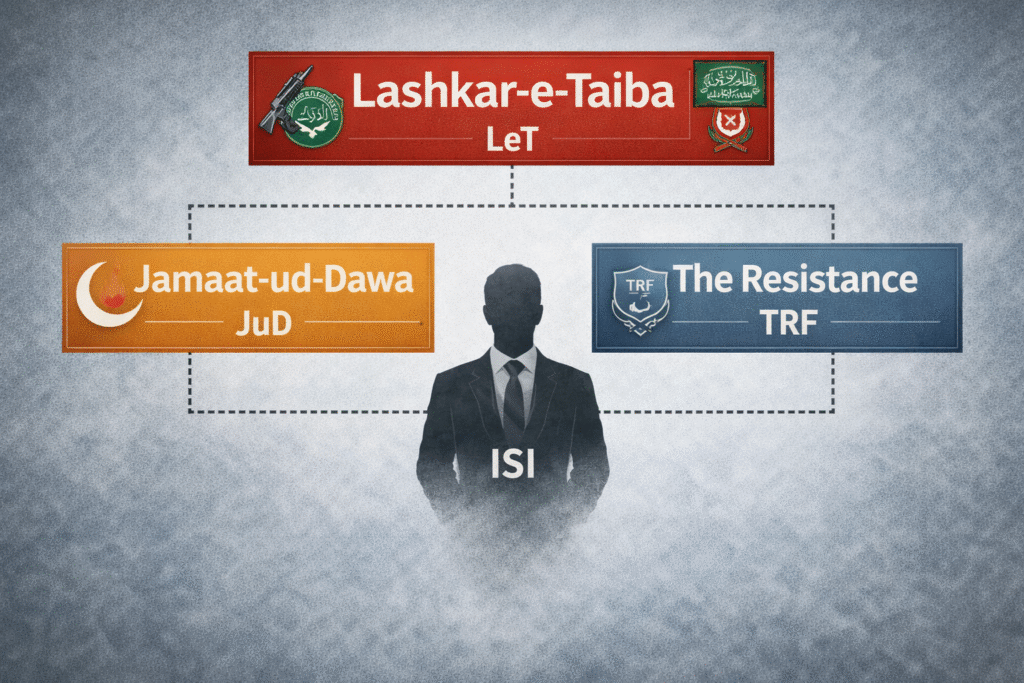
The ISI-LeT relationship is one of the most extensively documented cases of state-sponsored terrorism in modern history. Indian intelligence agencies, the US State Department, the United Nations, and multiple independent investigations have all concluded that Pakistan’s intelligence apparatus not only tolerated LeT but actively enabled it. The organisation’s political front, Jamaat-ud-Dawa, operated openly in Pakistan running flood relief operations, recruiting members through charitable work, and providing cover for fundraising. Pakistan has formally banned both LeT and JuD multiple times under international pressure. The bans have consistently not been enforced.
Lashkar-e-Taiba India 2026: Structure and Key Figures
| Component | Details | Current status |
| Lashkar-e-Taiba (LeT) core | Founded 1985-86. Military-jihadist wing. Primary operations arm for Kashmir infiltration and attacks. | Operational. HQ Muridke struck in Operation Sindoor but not destroyed. |
| Jamaat-ud-Dawa (JuD) | LeT’s political and charitable front. Founded by Hafiz Saeed. Runs madrassas, hospitals, flood relief. Used as cover for fundraising and recruitment. | Formally banned in Pakistan multiple times, bans repeatedly not enforced. |
| The Resistance Front (TRF) | LeT proxy formed 2019 after Article 370 revocation. Secular-sounding name to obscure Pakistan link. Claimed Pahalgam attack, then retracted. | UN-designated terrorist organisation (post-Pahalgam). Indian UAPA ban Jan 2023. |
| Hafiz Saeed | Founder. UN-designated global terrorist. $10 million US bounty. Convicted in Pakistan on terror financing charges — 31-year sentence. | In Pakistani custody serving sentence. Widely seen as nominal detention with continued operational influence. |
| Tahawwur Rana | Pakistani-American businessman. Linked to 26/11 Mumbai attacks. Convicted in the US for supporting LeT. Extradited to India weeks before Pahalgam attack. | In Indian custody as of early 2025. Significant intelligence value. |
| ISI (Pakistan intelligence) | Long-documented state sponsor. LeT created with ISI support and Afghan war funding from Osama bin Laden. ISI provides safe houses, training, logistics. | Relationship continues. Sajid Saifullah Jatt (South Kashmir LeT operations chief) identified as Pahalgam handler — based in Lahore. |
The Attack Record: From Mumbai to Pahalgam
| Year | Attack | Killed | Method | India response |
| 2000 | Red Fort attack, Delhi | 3 (soldiers) | Armed assault on military heritage site | Intelligence crackdown, diplomatic protest |
| 2001 | Parliament House attack (with JeM) | 9 (security) | Suicide squad assault on Parliament | Near-war military standoff, Op Parakram |
| 2005 | Delhi serial bombings | 62 | Coordinated IED blasts (markets, bus) | Investigation, some arrests |
| 2006 | Mumbai train bombings | 209 | 7 IEDs on suburban trains | Investigation, diplomatic protests |
| 2008 | Mumbai attacks (26/11) | 175 | 10 gunmen, multiple sites over 60 hours | Diplomatic isolation of Pakistan, NIA created |
| 2016 | Uri army camp attack | 18 (soldiers) | Armed assault on military base | Surgical strikes across LoC (Sep 2016) |
| 2019 | Pulwama (JeM-linked) | 40 (CRPF) | Suicide vehicle bombing | Balakot airstrikes (Feb 2019) |
| 2025 | Pahalgam massacre (via TRF) | 26 (tourists) | Armed assault, targeted Hindu tourists | Operation Sindoor (May 2025) — strikes on LeT HQ Muridke |
The Pahalgam Attack and Operation Sindoor: What Changed
On April 22, 2025, five gunmen entered the Baisaran Valley near Pahalgam in Jammu and Kashmir and opened fire on tourists, deliberately targeting non-Muslims. Twenty-six people were killed the deadliest attack on Indian civilians since the 2008 Mumbai strikes. The attackers, armed with M4 carbines and AK-47s, were linked to The Resistance Front, LeT’s proxy operating under a deliberately secular-sounding name designed to obscure the Pakistan connection.
TRF initially claimed responsibility via Telegram, then retracted the claim alleging a “digital breach.” India’s National Investigation Agency conducted an eight-month investigation that produced a 1,597-page charge sheet filed in December 2025, tracing the conspiracy directly to Pakistan. The key figure identified was Sajid Saifullah Jatt LeT’s South Kashmir operations chief based in Lahore, who served as the primary handler of the attackers. LeT chief Hafiz Saeed and his deputy Saifullah Khalid Kasuri were named in the case.
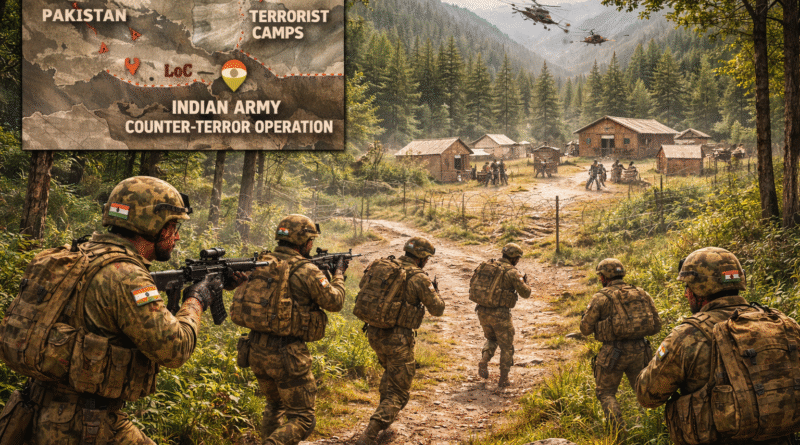
India’s response Operation Sindoor on May 6-10, 2025 was the most significant Indian military action against Pakistan since the 2019 Balakot airstrikes. Nine sites were struck, including LeT’s Markaz-e-Taiba headquarters at Muridke. The strike on Muridke was widely described as the most symbolically and operationally significant of the entire operation. The complex where LeT has trained fighters, stored weapons, and recruited members for 40 years was hit by Indian airstrikes for the first time in the group’s history.
In July 2025, Indian security forces conducted Operation Mahadev near Srinagar, killing Hashim Moosa (alias Suleiman Shah) the field commander of the Pahalgam attack. A former Pakistan Army Special Service Group soldier, Moosa had infiltrated India in 2023 and conducted at least six attacks. His elimination was described by Indian intelligence as the most significant counter-terrorism success since the killing of Burhan Wani in 2016. The UN designated TRF as a terrorist organisation following the Pahalgam attack.
The LeT Hydra Problem: Why Striking the Headquarters Is Not Enough
The most important question about Lashkar-e-Taiba India 2026 is not whether the organisation still exists after Operation Sindoor it does but whether the nature of the threat has changed, and how India must adapt to what comes next.
LeT has demonstrated, across four decades, an extraordinary capacity to absorb losses and reconstitute. The 26/11 Mumbai attacks resulted in the arrest of Hafiz Saeed, a UN global terrorist designation, a $10 million US bounty, and international pressure that forced Pakistan to put him in nominal custody. None of this destroyed the organisation. The creation of TRF after the Article 370 revocation in 2019 shows that LeT adapts its institutional architecture when external pressure increases: it creates proxy organisations with secular names, shifts operational footprint, and continues operations through networks that provide deniability to Pakistan.
The Muridke strike destroyed infrastructure. It did not destroy the human networks, the ISI liaison relationships, the financial channels through charitable fronts, or the ideological conviction that drives recruitment. Experts at Lawfare who studied the Pahalgam attack in detail noted that LeT had been relatively restrained in the years before 2025 operating through TRF with limited resources and that the Pahalgam attack represented a deliberate reactivation, not a capability breakthrough. The reinforcements came from Pakistan. The tactical decision to resume high-profile attacks was made in Pakistan. Until that decision-making environment changes, the threat does not disappear with a single strike campaign.
For India, this means the Lashkar-e-Taiba India 2026 challenge is fundamentally a diplomatic and intelligence challenge as much as a military one. Kinetic operations eliminate commanders and degrade infrastructure. They do not resolve the state-sponsorship problem. The extradition of Tahawwur Rana to India in early 2025 a Pakistani-American businessman with documented ties to the 26/11 attack was the most significant legal-diplomatic victory India has achieved in years on this front. Building more such cases, using international legal mechanisms, and maintaining pressure on Pakistan through the FATF grey list and bilateral channels is the complementary track that military operations alone cannot replace.
ThirdPol’s Take
Lashkar-e-Taiba India 2026 is a reminder that the most dangerous security threats are not those that are difficult to understand they are those where the solution is diplomatically inconvenient. Everyone in the room knows that LeT operates with ISI support, that Pakistan’s civilian government does not control its military’s relationship with militant groups, and that formal bans on JuD and LeT are performative. The Pahalgam attack and Operation Sindoor have changed India’s declared willingness to use force across the LoC. That is significant. What has not changed is Pakistan’s strategic calculus: as long as cross-border terrorism costs Pakistan less than it costs India, and as long as the international community allows Pakistan to manage the consequences through minimal-enforcement bans and nominal criminal proceedings, the incentive structure that produces LeT attacks against India remains intact. Pakistan’s elevation as a mediator in the Islamabad talks — from state-sponsor of the Pahalgam attackers to trusted broker between the US and Iran — illustrates how quickly the geopolitical calculus can shift. India must hold both realities simultaneously: Pakistan as a mediator in the Iran ceasefire and Pakistan as the enabler of the Pahalgam massacre. That is not a comfortable diplomatic position. It is, however, the accurate one.
By Amit Mangal | ThirdPol | April 18, 2026