India Kaveri Engine Revival: Fixing An 18-Year Failure
The India Kaveri engine revival is, in some ways, a story about a bad phone call. DRDO’s Gas Turbine Research Establishment shelved the original Kaveri programme back in 2008 after it failed to hit the thrust, weight, and reliability targets the Tejas fighter needed, delivering around 72 kN of thrust against a requirement of roughly 83 to 85 kN. For nearly two decades, GTRE has carried the reputation of India’s most persistent defence R&D disappointment. What changed this year was not a sudden technical breakthrough. It was US manufacturer GE Aerospace sharply raising its quoted price for F414 engines needed for India’s next-generation AMCA fighter, a decision that appears to have convinced New Delhi it could no longer treat foreign engine dependence as a manageable risk.
Why The India Kaveri Engine Revival Is Happening Now
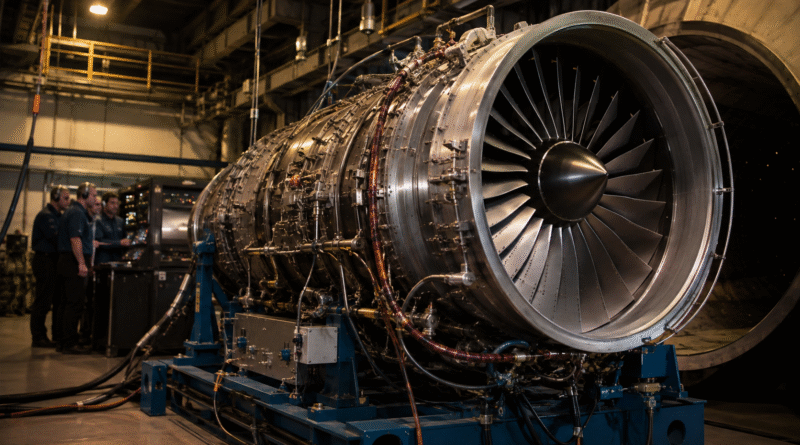
Defence Minister Rajnath Singh visited GTRE in Bengaluru on February 16, 2026, and watched a full afterburner engine test of the Kaveri, a milestone the establishment had been working toward for years. According to reporting from Airforce Technology, Singh told officials India has a five to seven year window to develop a genuinely sovereign fighter engine, a rare and unusually specific deadline for a programme with such a long history of missed timelines. The revived effort, referred to as Kaveri 2.0, aims for the 80 to 85 kN thrust class needed to actually power a fighter jet, a meaningful jump from the dry, non-afterburning Kaveri Derivative Engine already in the 48 to 52 kN range and further along in testing.
The immediate trigger was not subtle. India’s Tejas Mk1A programme has faced severe delays tied directly to GE Aerospace’s F404 engine deliveries, a global supply chain vulnerability entirely outside India’s control. When GE then quoted a sharply higher price for the F414 engines meant to power the more advanced AMCA programme, it exposed exactly the kind of dependency risk that defence planners had tolerated for years while it stayed merely inconvenient rather than actively expensive.
What Kaveri Actually Has To Show For 18 Years
It would be wrong to read the original Kaveri programme as pure failure, even though it never made it into a fighter jet. The effort, which began in 1989 and consumed roughly 3,000 crore rupees by the time it was delinked from Tejas, built up metallurgy expertise, test infrastructure including a high-altitude test bed, simulation capability, and a base of trained engineers that India did not previously have. That knowledge base has already found a use: the dry Kaveri Derivative Engine is positioned to power DRDO’s Ghatak unmanned combat air vehicle, and GTRE has reportedly told manufacturing partner Godrej and Boyce to deliver fully built engines as testing accelerates through 2026, with D2 and D3 endurance trials underway and qualification work for further variants, D4 and D5, expected to follow.
The France-based engine maker Safran has also entered the picture, with a co-development arrangement discussed for powering the Advanced Medium Combat Aircraft, India’s fifth-generation fighter programme, either through a Safran partnership or an engine core evolved from Kaveri’s own technology base. That dual-track approach, leaning on foreign partnership for the near-term AMCA need while pushing Kaveri 2.0 for genuine long-term independence, reflects a more realistic strategy than earlier decades of trying to leapfrog straight to a fully indigenous solution.
The Honest Difficulty Ahead
Building a fighter-class jet engine remains one of the hardest problems in aerospace engineering, mastered by only a handful of countries, and GTRE’s own history is the clearest evidence of how difficult it is even with sustained funding and political attention. The five to seven year window Singh referenced is aggressive by the standards of a program that took nearly two decades to fail its first attempt. Success this time will depend on whether GTRE can translate the incremental technical wins of the dry Kaveri Derivative Engine into the far more demanding afterburning, higher-thrust variant the fighter fleet actually needs, rather than repeating the earlier pattern of promising results that never quite closed the gap to operational requirements.
Roughly 70 percent of India’s capital defence acquisitions are now aimed at indigenous platforms by 2026-27, according to government targets, and a jet engine sits upstream of nearly every one of those ambitions involving fixed-wing aircraft. The India Kaveri engine revival will not be judged by this year’s successful afterburner test alone. It will be judged by whether, five to seven years from now, an Indian fighter jet actually flies on an Indian-built engine for the first time in the programme’s history, something 18 years of effort have not yet managed to deliver.
Key Points
- Kaveri engine (GTX-35VS): DRDO/GTRE indigenous turbofan programme, began 1989, delinked from Tejas in September 2008.
- Original Kaveri delivered ~72 kN thrust vs ~83-85 kN required for Tejas; ~Rs 3,000 crore spent on the original programme.
- Feb 16, 2026: Rajnath Singh visited GTRE Bengaluru, witnessed a full afterburner engine test of Kaveri; cited a 5-7 year window for a sovereign engine.
- Kaveri 2.0: revived afterburning variant targeting 80-85 kN thrust class, needed to actually power a fighter.
- Kaveri Derivative Engine (KDE): dry/non-afterburning variant, 48-52 kN range, positioned for DRDO’s Ghatak UCAV; D2/D3 endurance trials underway in 2026.
- Trigger: GE Aerospace sharply raised quoted price for F414 engines needed for India’s AMCA (5th-gen fighter) programme; Tejas Mk1A also faced delays tied to GE F404 deliveries.
- Parallel track: Safran (France) co-development discussed for AMCA engine, alongside continued Kaveri-based indigenous effort.
- ~70% of India’s capital defence acquisitions targeted toward indigenous platforms by 2026-27.