OPEC India Oil 2026: UAE Exits OPEC What It Means for India
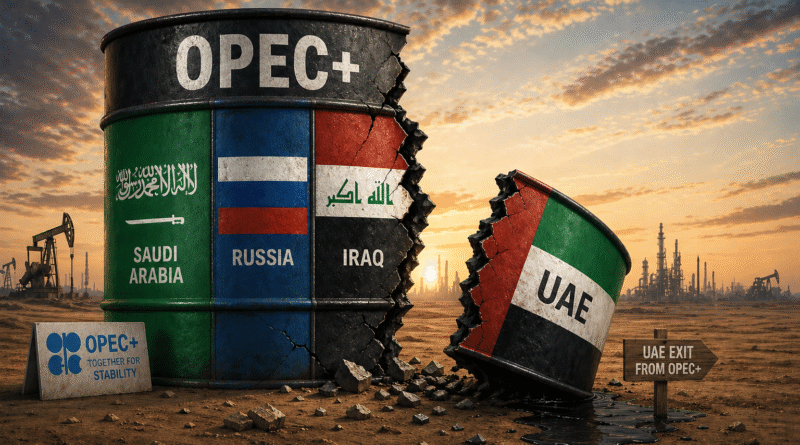
The OPEC India oil 2026 story has reached a turning point that most analysts were not predicting when the year began. OPEC+ the alliance of 23 oil-producing nations that controls roughly half of global oil output is meeting via videoconference today, April 29, to decide May production levels. The UAE, which has been one of the alliance’s most important members, exits the group tomorrow, May 1. And the decision expected today a further production increase of around 188,000 barrels per day is being made against the backdrop of the Iran war, a Hormuz crisis that has locked approximately 20% of global seaborne oil into uncertainty, and an oil price environment that has oscillated between $80 and $100 per barrel since February 28. For India, which imports 85% of its crude oil requirements and is the world’s third-largest oil importer, what OPEC decides and how the UAE’s exit reshapes the organisation’s internal dynamics is not an abstract geopolitical question. It is a direct determinant of India’s inflation rate, its current account deficit, and the LPG prices paid by 330 million households.
What OPEC and OPEC+ Actually Are
OPEC — the Organisation of the Petroleum Exporting Countries was founded in 1960 by Iran, Iraq, Kuwait, Saudi Arabia, and Venezuela, originally to coordinate oil production policy and push back against the pricing power of Western oil companies. It currently has 12 members: Algeria, Congo, Equatorial Guinea, Gabon, Iran, Iraq, Kuwait, Libya, Nigeria, Saudi Arabia, UAE (until tomorrow), and Venezuela.
OPEC+ is the expanded grouping formed in 2016 that added ten non-OPEC producers led by Russia. The “+10” includes Azerbaijan, Bahrain, Brunei, Kazakhstan, Malaysia, Mexico, Oman, Russia, South Sudan, and Sudan. Together, OPEC+ accounts for approximately 40% of global oil production and holds around 80% of the world’s proven oil reserves. Its production decisions directly set the floor and ceiling for global oil prices.
Within OPEC+, the real power lies with a smaller inner group the “Voluntary Eight” or core eight comprising Saudi Arabia, Russia, UAE (not anymore), Iraq, Kuwait, Algeria, Kazakhstan, and Oman. These eight countries have been making the monthly production decisions that have shaped the global oil market through 2025 and 2026. After tomorrow, that inner circle becomes seven.
The UAE Exit: Why Abu Dhabi Is Leaving and What It Does to OPEC+
The UAE’s decision to exit OPEC+ from May 1 has been building for years and was not a surprise to anyone watching the internal dynamics of the alliance. The fundamental tension is simple: the UAE has invested massively in expanding its production capacity it can now produce approximately 4.8 million barrels per day but OPEC+ production quotas have consistently capped its output below its capacity. From Abu Dhabi’s perspective, it spent billions of dollars building infrastructure that OPEC+ quota discipline prevents it from using. Capital Economics described it directly: “Having invested heavily in expanding energy production capacity in recent years, the bigger picture is that the UAE has been itching to pump more oil.”
The exit also reflects the UAE’s broader strategic reorientation. The country that asked Pakistan to repay its $3.45 billion and pivoted its investment strategy toward India rather than the traditional Islamic solidarity bloc is the same country that has decided its commercial and strategic interests are no longer well-served by subordinating its production decisions to a cartel whose most important other members include Iran — the country that fired missiles at UAE territory during the Iran war and Russia, whose geopolitical trajectory has diverged sharply from the Gulf states’ American-aligned security framework.
The immediate effect of the UAE’s exit on OPEC+ is structural and mathematical. The May production hike expected today is approximately 188,000 barrels per day the April hike of 206,000 bpd minus the UAE’s share. From June onwards, OPEC+ will be making decisions without one of its most production-capable members. The alliance will have less flexibility to compensate for unexpected supply disruptions such as the ongoing Hormuz crisis because the UAE’s 4.8 million bpd capacity will no longer be available to deploy as a coordinated response tool.
The Iran Paradox: OPEC+ Is Hiking Output While Iran’s Exports Are Blocked
The most paradoxical dimension of the OPEC India oil 2026 story is that OPEC+ is increasing production targets at the same moment that the Iran war and Hormuz crisis have made those targets largely academic for a significant share of global supply.
Iran produces approximately 3.2 million barrels of crude per day under normal conditions and exports around 1.5 million bpd mostly to China. With the Hormuz Strait contested and the US naval blockade of Iranian ports in effect, Iran’s export capacity is severely disrupted. Iraq, which uses Basra in the southern Gulf as its primary export terminal, is also experiencing shipping disruptions. Together, Iran and Iraq account for roughly 7-8 million barrels per day of production, a significant fraction of which is currently either unable to export normally or facing elevated insurance and transit costs.
OPEC+ is hiking its quota targets precisely to signal that the non-sanctioned members Saudi Arabia, UAE (until tomorrow), Kuwait, and others stand ready to compensate for any prolonged loss of Iranian or Iraqi barrels. Saudi Arabia and the UAE together hold approximately 3.5 million barrels per day of immediately deployable spare capacity. If the Iran conflict extends and Iranian exports drop significantly, that spare capacity becomes the global swing supply that prevents a $120+ oil price scenario. The OPEC+ production increase today is partly a market signal: the alliance is telling oil traders that the Iran war will not produce a supply catastrophe as long as Saudi and Gulf producers can compensate.
What the Saudi Arabia Factor Means for India
In the OPEC India oil 2026 context, Saudi Arabia’s role has become even more central following the UAE’s departure. Saudi Arabia is already India’s second-largest crude oil supplier, and the Kingdom’s production decisions have a direct and immediate effect on the price and availability of oil that India buys.
The India-Saudi relationship in 2026 is operating on two tracks simultaneously. On the economic track, Saudi Arabia stepped in to provide Pakistan with a $3 billion emergency deposit when the UAE demanded its money back a decision that reflects Saudi Arabia’s continued willingness to use financial diplomacy in South Asia in ways that sometimes cut across India’s interests. On the energy track, Saudi Arabia is India’s most reliable supplier at scale, and Saudi Aramco has significant investment stakes in Indian refinery expansions at Ratnagiri and Barmer that give Riyadh a structural interest in keeping India’s oil sector supplied and functional.
The Saudi spare capacity that OPEC+ is holding in reserve for the Iran contingency is directly relevant to India. If Saudi Arabia deploys 1-2 million barrels per day of additional output in response to a prolonged Hormuz closure, India is positioned to be one of the primary buyers of that incremental oil both because of the bilateral relationship and because India’s refineries are physically configured to process Arab heavy crude, the type Saudi Arabia produces in abundance. A supply crisis that seems designed to hurt India turns into a procurement opportunity if Saudi spare capacity comes online.
The UAE Exit and India: A Specific Opportunity
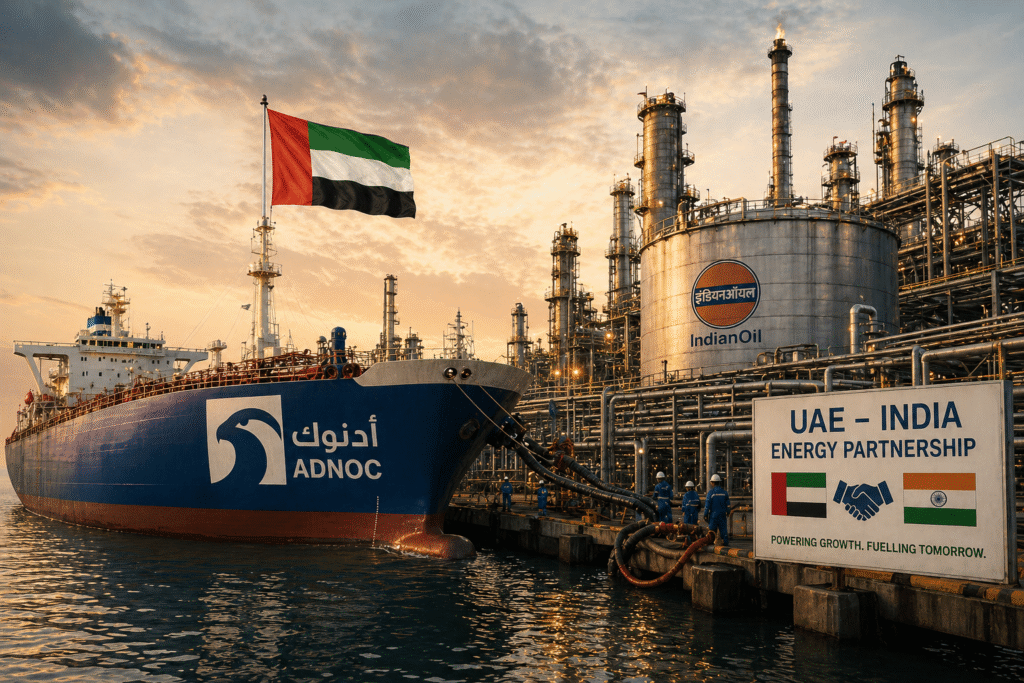
For India specifically, the UAE’s OPEC+ exit creates a discrete opportunity that goes beyond the general OPEC India oil 2026 dynamics. Once the UAE is outside OPEC+ quota discipline, it can produce and sell as much oil as its infrastructure allows currently 4.8 million barrels per day, with targets to reach 5 million bpd by 2027. Abu Dhabi National Oil Company (ADNOC) has been expanding aggressively, and post-exit it has no cartel constraints on how much crude it offers to any buyer at any price.
India and the UAE have the India-UAE CEPA, one of India’s most significant bilateral trade agreements. Energy is already a major component of that relationship. With the UAE free from OPEC+ quota constraints, India can negotiate longer-term oil supply agreements directly with ADNOC at potentially more competitive prices than OPEC+-constrained pricing would allow. Indian Oil Corporation, Bharat Petroleum, and HPCL — India’s three state refiners are already active buyers of UAE crude. A post-OPEC+ UAE that is actively trying to maximise its market share has strong commercial reasons to offer India favourable pricing and supply security.
The timing of the UAE’s exit coming just as the Iran war has disrupted India’s traditional Iranian oil suppliers and at a moment when India has stopped buying Russian oil under the February trade deal with the US creates a genuine opening for the India-UAE energy relationship to deepen rapidly. India needs new reliable crude sources. The UAE needs to sell more oil. The CEPA provides the bilateral framework. The only constraint is the speed at which India’s refinery procurement teams can move to capitalise on the changed market structure.
ThirdPol’s Take
The OPEC India oil 2026 moment is one of those rare conjunctions where geopolitical disruption and structural market change align to create a specific window of opportunity for India if it moves quickly enough to take it. The Iran war has disrupted Iran and Iraq’s export capacity. The February trade deal has shut India out of Russian oil. The UAE is leaving OPEC+ tomorrow and will be free to sell as much as it can produce. Saudi Arabia is holding spare capacity that India can access in a crisis. And OPEC+ is hiking output targets precisely to prevent the Iran war from becoming a supply catastrophe. None of these developments is independently good news for India’s energy bill. Together, they describe a reshaping global oil market in which India as the world’s third largest importer, with active bilateral relationships with both Saudi Arabia and the UAE, and with refinery infrastructure capable of processing Gulf heavy crude is better positioned than almost any other major importer to navigate the new landscape. The question is whether India’s petroleum ministry, its state refiners, and its bilateral trade teams can capitalise on a market structure that favours them before it changes again.
By Amit Mangal | ThirdPol | April, 2026