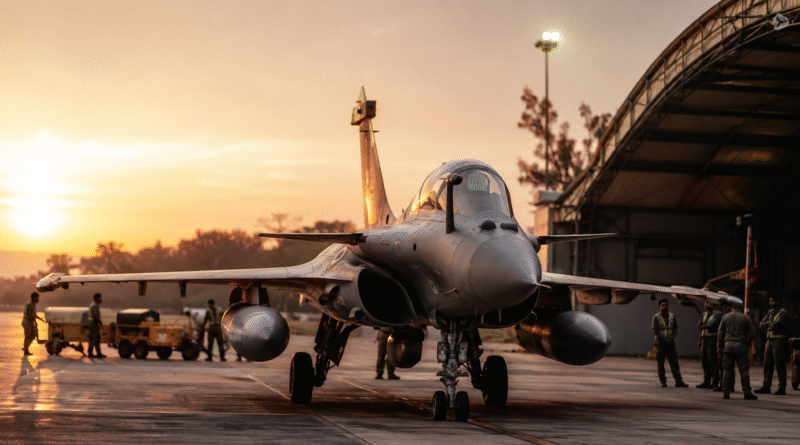
India Rafale MRFA Deal: Why This Time Is Different
The India Rafale MRFA deal has been close to signing before, only to stall. This time, the structure of the deal itself has changed enough that it might actually stick. Dassault Aviation has adopted what defence industry watchers are calling a radically altered strategy for the 114-jet Multi-Role Fighter Aircraft procurement, a mega-deal estimated at roughly 3.25 lakh crore rupees. The French manufacturer is taking direct oversight of the programme, picking its own Indian industrial partners, and running every flight and ground validation on Indian soil. None of that happened the last time India tried something this size, and that failure is exactly why this new approach exists.
What The India Rafale MRFA Deal Actually Involves
The numbers are large by any measure. India’s Defence Acquisition Council granted an Acceptance of Necessity back in February 2026 for 114 Rafale jets, with 18 to arrive off-the-shelf from France and the remaining 96 built domestically. Some reports put the total value near 39 billion US dollars. The jets will come in the newer F4 standard, with an option to upgrade to a future F5 standard, and India’s existing fleet of 36 F3R Rafales would eventually be upgraded to match. Combined with a separate, ongoing negotiation for 31 additional carrier-based Rafale-M jets for the Navy, India’s total Rafale fleet could eventually reach 145 aircraft.
Dassault CEO Eric Trappier has said repeatedly through the year that the company wants the contract signed within 2026. That target has slipped before. A deal that was expected to close around French President Emmanuel Macron’s February visit to India instead ran into a dispute over source code access, with India wanting the ability to independently modify and upgrade the aircraft and France resisting on intellectual property and security grounds. As of the most recent updates, Dassault has finalised a formal Letter of Request and is pushing to close the final contract by the end of this year, pending Cabinet Committee on Security approval.
The Ghost Of MMRCA Still Shapes This Deal
To understand why Dassault changed its approach, it helps to remember what came before. India first launched the Medium Multi-Role Combat Aircraft competition back in 2007, aiming for 126 jets. That process dragged on for years before collapsing entirely in 2015, largely because of a dispute over accountability. Under the old structure, Hindustan Aeronautics Limited was assigned as the default domestic manufacturing partner, and disagreements over who would be responsible for quality and delivery timelines eventually sank the deal. Only a smaller, separate government-to-government order for 36 off-the-shelf Rafales survived from that era.
Dassault appears determined not to repeat that mistake. Instead of a government-assigned partner, the company is curating its own network of Indian suppliers based on technical capability. Tata Advanced Systems has already secured an agreement to manufacture Rafale fuselages in Hyderabad, the first time these components will be assembled outside France. By keeping direct oversight of the programme rather than handing it off, Dassault is betting that clear accountability, not just cheaper costs or faster paperwork, is what actually determines whether a defence mega-deal survives a decade of negotiation.
Why The Indian Air Force Cannot Wait Much Longer
Behind the contract paperwork sits a genuine capability problem. The Indian Air Force currently operates 29 fighter squadrons against a sanctioned strength of 42, a gap that has widened as older Soviet-era aircraft like the MiG-21 and MiG-27 retire faster than replacements arrive. This is not a new story, but it is an increasingly urgent one, particularly given India’s continuing two-front concern involving Pakistan and China along its northern and western borders. Every year the MRFA contract slips is another year the IAF operates below its planned strength.
Dassault, for its part, has its own reasons to want this deal finalised soon. The company delivered 26 Rafales globally in 2025 and expects to deliver around 28 in 2026, gradually working toward a production rate of four aircraft a month. Its order backlog stood at 220 jets by the end of 2025, split between 175 export orders and 45 for France itself. An Indian order of this scale would be one of the largest single additions to that backlog in the aircraft’s history, and would further cement India as, alongside France, one of only two countries operating both land-based and carrier-capable Rafale variants.
What To Watch Before The Ink Dries
The India Rafale MRFA deal is not signed yet, and the source code dispute from earlier this year is a reminder that large defence contracts can stall right up to the final stage. Watch for three things in the coming months: whether the Cabinet Committee on Security clears the deal before the end of 2026 as Dassault hopes, whether the source code and independent-upgrade question gets resolved or simply deferred, and how much of the eventual production genuinely moves through Tata’s Hyderabad line versus remaining concentrated in France. Each of those answers will say more about whether India’s defence self-reliance push is actually working than the headline number of 114 jets ever will.
Key Points
- MRFA = Multi-Role Fighter Aircraft programme; DAC granted Acceptance of Necessity for 114 Rafale jets on February 12, 2026.
- Structure: 18 jets off-the-shelf from France, 96 manufactured domestically in India.
- Estimated deal value: approx. USD 39 billion / Rs 3.25 lakh crore.
- Jets to be delivered in F4 standard, with option to upgrade to future F5 standard; existing 36 F3R Rafales to be upgraded too.
- Separate track: India in talks for 31 additional Rafale-M carrier jets, which could take the total Rafale fleet to 145.
- Key dispute (as of April 2026): India’s demand for source code access to independently modify/upgrade aircraft, resisted by France.
- Tata Advanced Systems Limited (TASL) to manufacture Rafale fuselages in Hyderabad — first such component build outside France.
- Background: MMRCA program (2007) for 126 jets collapsed in 2015 over accountability disputes involving HAL as default partner.
- IAF currently at 29 fighter squadrons against a sanctioned strength of 42.