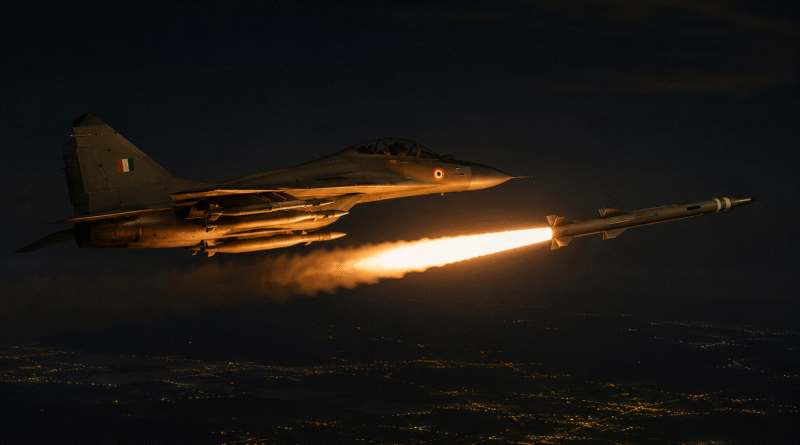
Operation Sindoor One Year: How 96 Hours Transformed India’s Defence Identity
On May 7, 2025, India launched Operation Sindoor 96 hours of precision strikes targeting terror infrastructure in Pakistan after the Pahalgam attack killed 26 civilians. Exactly one year on, the operation continues to reverberate far beyond its tactical objectives. India’s defence exports have surged, its indigenous weapons systems have earned battlefield credibility, and New Delhi’s strategic standing in the global arms market has been permanently altered. Operation Sindoor one year later is not just a military anniversary. It is the story of how a single conflict rewrote India’s industrial and diplomatic identity.
From Battlefield to Export Boom: The Numbers Tell the Story
The most striking consequence of Operation Sindoor has been economic. According to Ministry of Defence data released in April 2026, India’s total defence exports in FY2025-26 reached ₹38,424 crore approximately $4.6 billion marking a 62.6 percent surge over the previous year. This is not a coincidence.
Between July 2025 and March 2026, fresh export orders worth ₹24,000 crore poured in, driven by four systems that proved themselves during the conflict: the BrahMos air-launched missile, the Akash-NG air defence system, indigenous loitering munitions, and the Netra Airborne Early Warning and Control platform. The precision strikes on Pakistani airbases including Nur Khan and Rahimyar Khan demonstrated that Indian systems were no longer aspirational. They were operational, battle-proven, and lethal.
Global perception shifted accordingly. Before Operation Sindoor, India was often positioned in the defence export market as a “budget-friendly alternative” to Western systems. After it, buyers began treating Indian platforms as “strategic necessities.” That distinction carries enormous commercial and diplomatic weight.
India’s Private Defence Sector Comes of Age
Perhaps the most structurally significant shift has been within India’s own industrial base. For the first time, the private sector contributed nearly half of total defence exports — ₹17,352 crore in FY2026, representing 54 percent year-on-year growth. Companies such as Adani Defence, Bharat Forge, Tata Advanced Systems, and Reliance Defence secured landmark contracts that would have seemed improbable five years ago.
Adani Defence partnered with Italy’s Leonardo for helicopter production. Bharat Forge secured contracts for carbines and underwater weapons systems. Mazagon Dock Shipbuilders is finalising a ₹90,000 crore submarine deal with Germany. Tata Advanced Systems won contracts to upgrade the Pinaka multi-barrel rocket system. The industrial momentum has supported approximately 1.5 lakh jobs and is channelling profits into next-generation technologies AI-driven autonomous swarm drones and hypersonic glide vehicles among them.
Defence production as a whole reached ₹1,54,000 crore in FY2025, a 3.2-fold increase over the past decade. Sixty-five percent of equipment is now manufactured domestically a reversal of a dependence on imports that once defined Indian defence planning. The defence budget for FY2027 has been set at ₹7,85,000 crore, accounting for 14.67 percent of the Union Budget.
Strategic Implications: Operation Sindoor One Year Later
The geopolitical consequences of Operation Sindoor extend well beyond bilateral India-Pakistan dynamics. China’s decision to fast-track deliveries of the J-35AE stealth fighter to Pakistan reportedly moving timelines to mid-2026 signals Beijing’s determination to maintain Islamabad’s deterrence capability. Analysts warn this introduces a “two-front” challenge, with Pakistan eventually able to leverage stealth technology for first-strike engagements against high-value Indian assets.
India’s response has been to deepen its own next-generation capabilities while simultaneously diversifying its import base. Russia’s share of India’s arms imports has declined from 70 percent to 40 percent; France and Israel have emerged as key partners. The shift reflects both lessons from Operation Sindoor and the broader recalibration of India-Russia ties in the context of the ongoing Ukraine conflict and US tariff pressure.
Diplomatically, India is now actively packaging its defence capabilities as a form of soft power. New Delhi is offering what analysts describe as “security-in-a-box” deals bundles of missiles, radar systems, and training to partners across South-East Asia, the Gulf, and Africa. This strengthens both the Act East Policy and the Look West outreach, binding strategic relationships to tangible military cooperation.
The Gaps That Remain
The record-breaking export figures should not obscure the structural vulnerabilities that persist in India’s defence ecosystem. Critical high-end technologies advanced jet engines, next-generation sensors, and cutting-edge semiconductors for military applications still require imports. Research and development intensity lags behind global leaders. The gap between what India can manufacture and what it can independently design and engineer remains significant.
Addressing this will require deeper industry-academia collaboration, sustained investment in disruptive technologies, and patience. The Defence Acquisition Procedure 2026 and the iDEX innovation ecosystem are moves in the right direction. But India’s ambition ₹3,00,000 crore in production and ₹50,000 crore in exports by FY2029 — will only be reachable if the next phase of indigenisation moves from assembly to invention.
One Year On: What Operation Sindoor Means for India’s Future
Operation Sindoor one year later is best understood not as a military event frozen in May 2025, but as an inflection point whose consequences are still unfolding. It proved, in the most unambiguous way possible, that India’s indigenous defence ecosystem had reached operational maturity. It catalysed an export boom. It accelerated private sector growth. It repositioned India in the global strategic imagination.
The harder challenge now is to build on these foundations systematically — to close the technology gaps, to sustain the industrial momentum, and to ensure that the next iteration of Indian capability is not just battle-proven, but world-leading. The anniversary is a reminder of how far India has come. The targets ahead are a reminder of how much further it must go.
Key Points
- Operation Sindoor (May 7–10, 2025): 96-hour precision strike operation targeting terror infrastructure in Pakistan following the Pahalgam terror attack (April 2025).
- Defence Exports FY2025-26: ₹38,424 crore ($4.6 billion) — 62.6% year-on-year growth; fresh orders of ₹24,000 crore between July 2025 and March 2026.
- Key systems proven in combat: BrahMos air-launched missile, Akash-NG air defence system, loitering munitions, Netra AEW&C platform.
- Private sector contribution: ₹17,352 crore (nearly 50% of total exports in FY2026); 54% year-on-year growth; ~1.5 lakh jobs created.
- Domestic production: ₹1,54,000 crore in FY2025; 65% of equipment now manufactured in India; defence budget FY2027 = ₹7,85,000 crore (14.67% of Union Budget).
- Import diversification: Russia’s share fell from 70% to 40%; France and Israel are emerging as key partners.
- FY2029 targets: ₹3,00,000 crore in production; ₹50,000 crore in exports.
- iDEX (Innovations for Defence Excellence) and Defence Acquisition Procedure 2026: key policy frameworks driving indigenisation.
- China factor: Fast-tracking J-35AE deliveries to Pakistan post-Sindoor — creates two-front deterrence challenge for India.
- Make in India in Defence: Over 16,000 MSMEs and 1,000 start-ups active in the defence supply chain; ~$2 billion in start-up funding since 2017.
By Amit Mangal | ThirdPol | May 2026