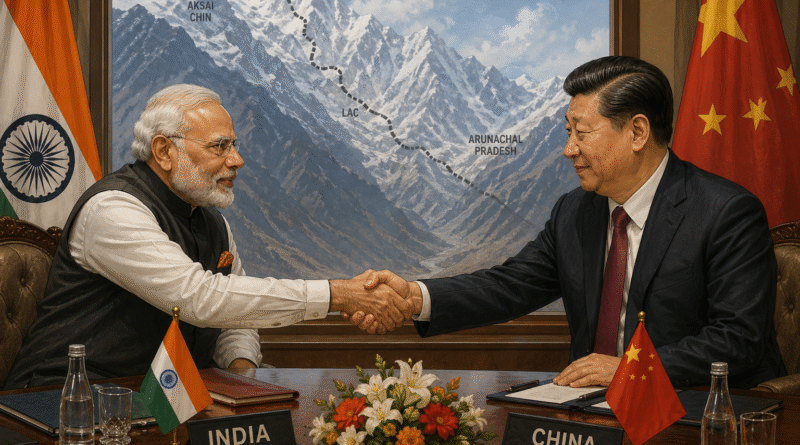
India China Relations 2026: The Thaw That Survived a War and What Xi’s India Visit Would Mean
India China relations 2026 is the most paradoxical bilateral relationship in the world right now. In the span of twelve months, India and China have resumed direct flights for the first time in five years, restored patrolling rights at the disputed Line of Actual Control in Depsang and Demchok, seen their trade surge to the point where China has reclaimed its position as India’s largest merchandise trade partner, and are now discussing whether Xi Jinping will visit India for the BRICS summit in September his first India visit since the 2020 Galwan Valley clash that killed 20 Indian and four Chinese soldiers. In that same twelve months, China provided military, intelligence, and political support to Pakistan during Operation Sindoor India’s most significant military action in decades. China is continuing to build the Yarlung Tsangpo dam on the Brahmaputra river, threatening India’s water security. And Chinese investment in Pakistan under CPEC Phase 2 has accelerated dramatically, with approved Special Economic Zones rising from seven to forty-four. The thaw in India China relations 2026 is genuine. So is the competition. What makes this relationship so analytically challenging is that both are simultaneously true and neither cancels the other out.
How the Thaw Happened: The Road from Galwan to 2026
The India China relations 2026 story cannot be understood without understanding how far the two countries have travelled from the nadir of June 2020. The Galwan Valley clash in which Indian and Chinese soldiers fought with clubs, stones, and bare hands at altitudes above 14,000 feet, resulting in the most significant border deaths between the two countries since 1975 triggered a comprehensive rupture in the bilateral relationship. India banned 267 Chinese apps including TikTok. Investment restrictions on Chinese companies were tightened. High-level visits were suspended. Direct flights were cancelled. The border remained militarised, with tens of thousands of troops facing each other across multiple friction points.
The first sign of a pathway out came in October 2024, when Modi and Xi met at the BRICS summit in Kazan, Russia their first substantive bilateral talks since 2019. In the lead-up to Kazan, India and China reached a patrolling agreement that restored Indian patrol rights in the Depsang Plains and Demchok, the two most contested friction points from the 2020 standoff. From India’s perspective this was a diplomatic victory restoring what China had taken four years earlier without conceding anything on sovereignty. From China’s perspective, the deal was framed as a border patrol arrangement with no implications for territorial claims. Both sides declared success on their own terms, which is the only way deals like this get made.
Through 2025, the thaw deepened incrementally. India’s Defence Minister and External Affairs Minister both visited China. Chinese FM Wang Yi visited India in August. Modi attended the SCO summit in Tianjin in late August 2025 and had another bilateral with Xi. Direct flights resumed on October 27, 2025, with Air India and China Eastern operating the first commercial routes between the two countries in five years. Indian students were allowed to return to Chinese universities. And critically, the thaw survived its most severe test Operation Sindoor in May 2025, when China backed Pakistan diplomatically and militarily. India and China continued talking even as Chinese satellite intelligence was reportedly being shared with Pakistan’s military. The fact that the thaw survived Sindoor is the most significant indicator of its durability.
The Sindoor Test: How the Thaw Survived China Backing Pakistan
The single most important and underreported fact about India China relations 2026 is that China backed Pakistan during Operation Sindoor and the bilateral relationship survived. According to The Diplomat’s comprehensive analysis, China gave Pakistan military, intelligence, and political support during the conflict. Chinese satellite imagery is assessed to have been shared with Pakistan’s military. Chinese diplomatic statements consistently called for restraint rather than condemning Pakistan, and China’s UN ambassador backed Pakistan’s position in the Security Council.
India’s response was carefully calibrated. There were no public accusations against China during the conflict. The special representatives’ talks on the border continued on schedule after the ceasefire. India did not make China’s Pakistan support a condition for continued bilateral engagement. This restraint was deliberate India has consistently pursued a policy of “partial decoupling” under which the border dispute, the trade relationship, the geopolitical competition, and the Pakistan factor are all treated as separate files rather than being bundled together into a single adversarial framework.
This partial decoupling is both strategically rational and politically controversial. It is rational because India genuinely cannot afford to simultaneously manage hostility with China, Pakistan, and the disruption of the US relationship under Trump. Keeping China in a managed competition rather than an active adversarial posture frees India to focus on Pakistan and protects India’s economic interests in a trade relationship worth over $100 billion annually. It is controversial because critics in India’s strategic community and among its allies argue that engaging warmly with China while China arms Pakistan is a form of strategic naivety that rewards bad behaviour.
Trade: China Is India’s Largest Partner Again
One of the most striking developments in India China relations 2026 is the trade picture. India’s exports to China surged in December 2025, while shipments to the United States declined under Trump tariffs. China has reclaimed its position as India’s top merchandise trade partner a status it last held before the 2020 Galwan clash prompted India to diversify its supply chain away from Chinese dependency.
The trade relationship is deeply asymmetric. India runs a trade deficit with China of approximately $85-100 billion annually one of the largest bilateral deficits in the world. India exports raw materials, chemicals, and some manufactured goods to China. China exports electronics, machinery, industrial components, and consumer goods to India. The deficit has been a persistent irritant in India China relations 2026 and earlier, and it has not narrowed despite the diplomatic thaw. India has maintained investment restrictions on Chinese companies Chinese FDI in India remains tightly controlled even as trade flows freely.
The Trump tariff context has changed the trade calculus in ways that benefit both sides. With Indian exports to the US facing higher tariffs, China becomes a more attractive market for Indian goods particularly iron ore, chemicals, and agricultural products. For China, whose own exports to the US have faced tariffs ranging from 50-100% under Trump, India’s large consumer market looks more valuable than it did when American demand was absorbing Chinese production. The shared experience of Trump tariff pressure is one of the structural factors driving India-China trade even as geopolitical competition continues.
Xi’s Potential India Visit: What It Would Mean
The possibility of Xi Jinping visiting India for the BRICS summit in September or October 2026 is the most symbolically significant potential development in India China relations 2026. It would be Xi’s first visit to India since his Gujarat trip in 2014 twelve years ago. It would be the first Chinese presidential visit to India since the Galwan clash. And it would happen with India as BRICS chair, meaning India would be hosting both Xi and the leaders of Russia, Brazil, South Africa, Iran, UAE, and others simultaneously.
From India’s perspective, an Xi visit to New Delhi on India’s terms as a guest at India’s BRICS summit, not as an equal partner choosing the venue is diplomatically valuable precisely because it would demonstrate India’s ability to manage China without either confrontation or capitulation. Hosting Xi in India would signal to the world that India is the BRICS chair that can bring the bloc’s most powerful member to the table, which strengthens India’s Global South leadership credentials and its claim to be a genuinely independent pole in the multipolar world order.
From China’s perspective, attending India’s BRICS summit serves multiple interests. It keeps BRICS coherent as a grouping a BRICS summit without China’s leader would be a significant embarrassment for the bloc’s credibility. It allows Xi to demonstrate that China-India relations have normalised enough for a presidential visit, which is a diplomatic victory for Beijing’s “responsible power” narrative. And it gives China a platform to advance its positions on Global South development finance, trade, and the BRICS New Development Bank at a moment when American global leadership is in question.
The obstacles to an Xi visit are also real. The territorial dispute has not been resolved the sectoral approach and “early harvest” agreements being discussed by Wang Yi and Ajit Doval remain works in progress. China’s Yarlung Tsangpo dam construction continues, threatening downstream water flows into Arunachal Pradesh and Assam. CPEC Phase 2, which routes through Indian-claimed territory in Pakistan-administered Kashmir, remains a fundamental sovereignty dispute. And the Operation Sindoor support for Pakistan has not been formally acknowledged by China, leaving a credibility deficit in the bilateral relationship that a summit visit cannot paper over without some substantive concession.
What US Audiences Need to Understand
American foreign policy analysis of India-China relations tends to fall into one of two traps. The first is wishful thinking the belief that India will eventually align fully with the US against China, making it a de facto ally in the way that Japan and Australia are. The second is cynical dismissal the argument that India’s engagement with China proves it is not a reliable partner and cannot be counted on in a genuine US-China confrontation.
Both readings misunderstand India’s strategic logic. India is not going to become a US ally, formally or informally, as long as it can manage its China relationship through bilateral engagement. The reason is simple: India shares a 3,488-kilometre land border with China. No amount of American security guarantees changes the reality that if India-China relations deteriorate to active hostility, India bears the consequences on its own territory. India therefore has a structural incentive to manage China through engagement that no treaty partner facing China only across the South China Sea or Taiwan Strait shares.
What US audiences should understand is that India’s China engagement is not evidence of unreliability it is evidence of strategic sophistication. An India that keeps China in managed competition rather than open confrontation is an India that is free to deepen its security partnerships with the US, Japan, and Australia on the maritime and technology dimensions of the China challenge. The Quad, AUKUS adjacency, iCET, the defence manufacturing partnership all of these require India to not be in a crisis with China simultaneously. The India China relations 2026 thaw is what makes India’s participation in the US-led Indo-Pacific security architecture sustainable rather than brittle.
ThirdPol’s Take
India China relations 2026 is the clearest demonstration of what genuine strategic autonomy looks like in practice. India is simultaneously deepening trade with China, managing a land border that remains disputed, absorbing the fact that China backed Pakistan during Operation Sindoor, pursuing the BRICS chairmanship that requires Chinese participation, and maintaining a US partnership that views China as its primary competitor. None of these tracks is subordinated to any other. All of them are managed in parallel with full awareness of their contradictions. The question for 2026 is not whether the thaw will hold it will, because both sides benefit from it. The question is whether it can produce enough substantive progress on the border, on trade imbalances, and on the water security dispute to qualify as genuine normalisation rather than managed coexistence. The BRICS summit in September is the test. If Xi comes, the thaw becomes a landmark. If he does not, the relationship settles into what The Diplomat has called its likely long-term form: comprehensive competition in the geostrategic domain, selective cooperation on economic and multilateral issues. That outcome competitive coexistence may be the most stable equilibrium available between two nuclear-armed, billion-plus nations that share the world’s longest disputed border.
By Amit Mangal | ThirdPol | April, 2026