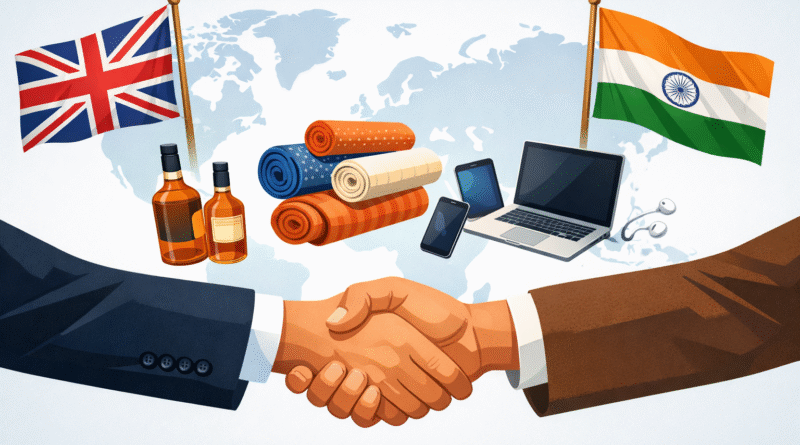
India UK Trade Deal 2026: What the Free Trade Agreement Actually Covers
The India UK trade deal 2026 is about to become real. Signed on July 24, 2025, after three years of negotiations that survived four UK prime ministers, two Indian general elections, and repeated near-collapses over Scotch whisky tariffs and social security payments for Indian workers, the Comprehensive Economic and Trade Agreement (CETA) between India and the United Kingdom has completed UK parliamentary scrutiny. The objection period expired on March 5, 2026. Both sides are expected to confirm an entry-into-force date in April 2026. When it does take effect, tariff reductions begin immediately on thousands of product lines and the UK will have secured what its Business and Trade Committee called the most economically significant bilateral free trade agreement since leaving the European Union.
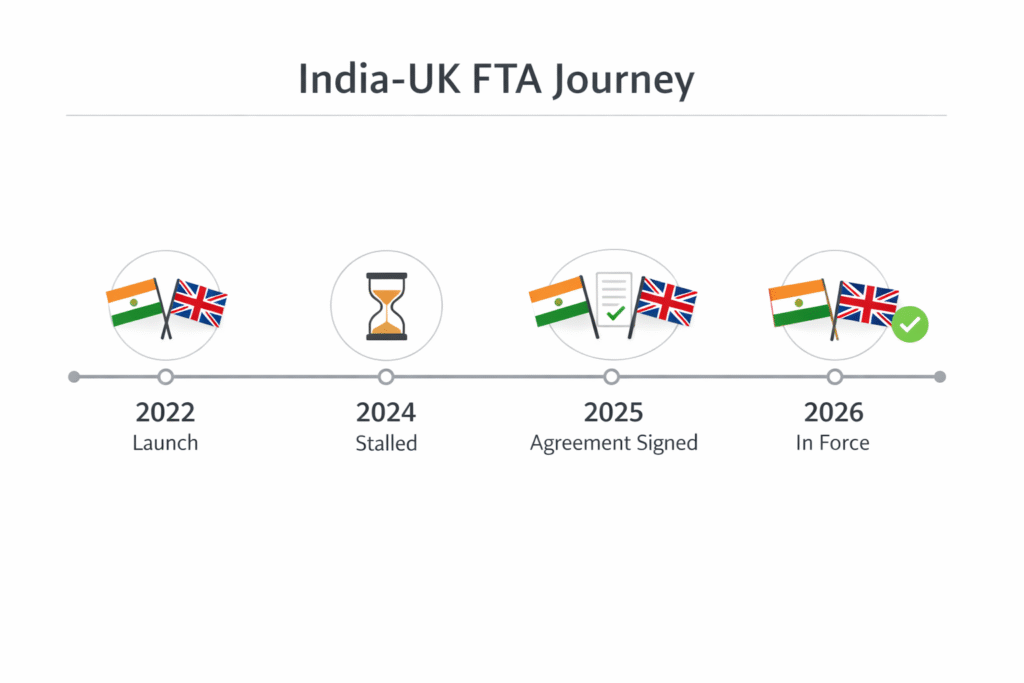
India UK Trade Deal 2026: The Full Timeline
| Date | Event |
| Jan 2022 | India-UK FTA negotiations formally launched. Third post-Brexit FTA for UK (after Australia, New Zealand). |
| 2022-24 | Fourteen rounds of negotiations. Stalled repeatedly over Scotch whisky tariffs, visa mobility for Indian workers, social security (DCC), and EV duties. |
| May 2024 | Negotiations paused — Indian election campaign begins. UK snap election called in late May. |
| Jul 2024 | Labour wins UK election. Keir Starmer becomes PM. India waits for new UK government to form. |
| Feb 2025 | Negotiations resume under Starmer government. Piyush Goyal and Jonathan Reynolds lead talks. |
| Apr 28-29, 2025 | Intensive talks in London. Deal agreed in principle on key remaining issues. |
| May 6, 2025 | Modi and Starmer announce FTA conclusion. Called “most comprehensive trade deal India has ever signed.” |
| Jul 24, 2025 | FTA formally signed by both sides. Bilateral trade target: $120 billion by 2030. |
| Jan 21, 2026 | Deal laid before UK Parliament for CRAG Act scrutiny. Objection period begins. |
| Feb 9, 2026 | House of Commons debate on FTA. Business and Trade Committee calls it “UK’s most economically significant bilateral FTA since Brexit.” |
| Mar 5, 2026 | UK parliamentary objection period expires. Ratification process effectively complete. |
| Apr 2026 | Expected entry into force. Tariff reductions begin. Businesses begin compliance with new customs rules. |
Why It Took Three Years: The Four Sticking Points
The India-UK FTA took longer than almost any analyst predicted in 2022 when negotiations launched. Four specific disputes repeatedly blocked conclusion.
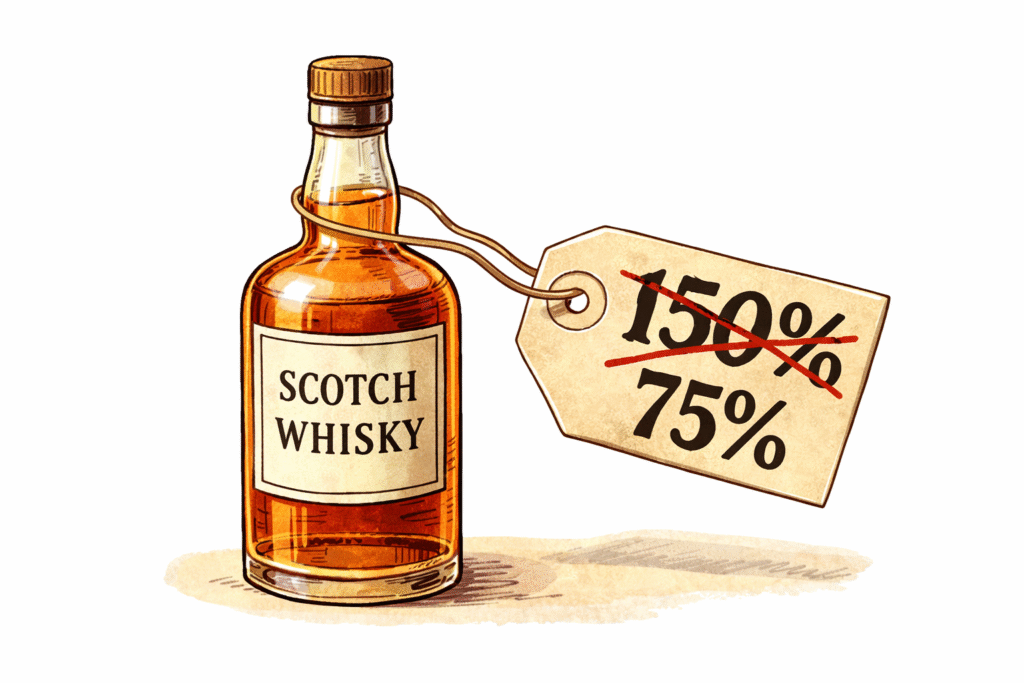
First, Scotch whisky. India taxes imported Scotch at 150% a rate that has priced British whisky out of the Indian mass market for decades, leaving it confined to premium bars and duty-free shops. The UK Scotch Whisky Association made reducing this tariff its single most important lobbying objective. India’s domestic alcohol industry, supported by state governments, lobbied hard against any reduction. The final deal reduces Scotch tariffs from 150% to 75% on entry into force, falling further to 40% over 10 years. Not zero — but a transformation of the market.
Second, social security the Double Contributions Convention (DCC). Indian IT professionals working in the UK on short-term contracts were required to pay into both the UK National Insurance system and India’s social security system simultaneously, even though they would never claim UK benefits. This double contribution made Indian IT service delivery to UK clients significantly more expensive. India pushed hard for a DCC waiver. The agreement includes a DCC commitment workers pay into one system, not both which was separately signed as a side letter in July 2025.
Third, visa mobility. India consistently sought easier entry for Indian professionals, service providers, and business visitors. The UK, managing public pressure on immigration numbers, was reluctant to make visa concessions that could be politically portrayed as opening backdoor immigration. The deal includes mobility provisions for specific categories contractual service suppliers, intra-corporate transferees, independent professionals (yoga instructors, musicians, chefs were specifically cited) without amounting to a general immigration framework.
Fourth, electric vehicles. The UK pushed for reduced Indian EV tariffs to benefit British EV manufacturers and justify continued investment by companies like Jaguar Land Rover (owned by India’s Tata Group). India’s EV industry argued for protection during its development phase. The final deal includes phased EV tariff reductions over 10 years.
India UK Trade Deal 2026: Sector-by-Sector Breakdown
| Sector | India gains | UK gains | Status |
| Textiles & Apparel | UK tariffs (up to 12%) eliminated. Benefits Indian exporters facing US tariff headwinds. Level playing field vs Bangladesh, Vietnam. | Cheaper Indian textiles for UK retailers and consumers. | India wins — immediate tariff elimination on entry into force. |
| Gems & Jewellery | UK tariffs eliminated. Major export sector for India. | UK consumers and jewellery retailers benefit from competitive pricing. | India wins — zero-duty access from day 1. |
| IT & Software Services | Access to UK government IT procurement. Easier mobility for IT contractors, ICT service suppliers. | UK companies can source cost-competitive Indian IT services. | India wins — particularly the DCC (social security) reducing double contributions. |
| Professional Services | Easier temporary entry for Indian professionals, yoga instructors, musicians, chefs, independent professionals. | UK firms get access to Indian professional services market. | India partial win — easier mobility secured but not permanent visa quotas. |
| Scotch Whisky | India reduces tariff from 150% to 75% immediately, then to 40% over 10 years. | Massive market opening — Diageo, Pernod Ricard, and Scotch distilleries gain India access. | UK wins — but India delayed as long as possible. Domestic alcohol industry lobbied hard against. |
| Electric Vehicles | India reduces EV tariffs from 100% to competitive levels over 10 years. | UK EV manufacturers (Jaguar Land Rover under Tata ownership, others) can compete in India. | UK wins — phased, so Indian industry gets adjustment time. |
| Financial Services | Indian banks and financial institutions get access to UK financial sector. | UK financial services (City of London) gets improved India access. | Both sides gain — UK stronger in this area. |
| Agriculture | India gains UK market for tea, spices, rice, processed food, basmati. | UK gains India market for lamb, dairy limited (India protected core items). Scotch whisky is the main win. | India largely protected sensitive agriculture. UK got selective gains. |
The Numbers: What India and the UK Are Trading
The india UK trade deal 2026 is negotiated against a backdrop of already substantial and growing bilateral trade. In the four quarters to Q3 2025, total India-UK trade in goods and services reached approximately $60 billion an 11.7% increase on the year before. India runs a trade surplus with the UK: Indian exports to the UK ($12.92 billion in goods) exceed UK goods exports to India ($8.41 billion). Services trade is larger than goods trade on both sides.
The UK is currently India’s 11th largest trading partner a position both sides want to change. The headline target in the FTA is $120 billion in bilateral trade by 2030, roughly doubling from current levels. The UK government’s own impact assessment estimates the deal will increase UK GDP by 0.13% (approximately £4.8 billion) in the long run modest but significant compared to other post-Brexit FTAs. For India, the gains in textiles, gems, marine products, and IT services are more immediate and larger in proportional terms for the affected sectors.
The 1.8 million-strong Indian diaspora in the UK the UK’s largest ethnic minority group creates a “living bridge” that provides both trade and investment connections. Indian companies are among the largest investors in the UK: Tata Group employs 500,000+ people in Britain through Jaguar Land Rover, Tata Steel, and other subsidiaries. The FTA formalises and deepens a relationship that has already been running at high economic intensity.
What the UK Actually Needed: The Post-Brexit Context
The india UK trade deal 2026 cannot be understood without understanding its post-Brexit context. When the UK left the EU’s single market in January 2021, it simultaneously lost zero-tariff access to 27 countries for its exports and gained the theoretical freedom to negotiate its own trade agreements. Four years into Brexit, the UK’s FTA scorecard is: Australia (concluded 2023), New Zealand (concluded), CPTPP membership (concluded), and now India. The big prizes a US trade deal and an India deal have both proved elusive under multiple governments.
The US deal is still not done. The India deal is. That asymmetry matters politically. The UK’s Business and Trade Committee described the India FTA as more economically significant than the Australia, New Zealand, and CPTPP deals combined. India is the world’s fourth-largest economy and the most populous country. The UK-India trade relationship has more growth runway than any other bilateral FTA the UK has signed since Brexit.
For Keir Starmer’s Labour government, which came to power in July 2024 partly on a platform of economic pragmatism over ideology, concluding the India deal after four years of Conservative government failure is both an economic achievement and a political one. The Trump tariffs on British goods which added pressure to diversify trade relationships away from US dependence made concluding the India deal more urgent in 2025.
What India Got Right and What It Gave Away
From India’s perspective, the india UK trade deal 2026 is a genuine win on the terms that matter most for Indian economic development but not without concessions.
India got tariff elimination on 99% of its goods exports to the UK by value, covering its priority sectors: textiles, gems and jewellery, marine products, leather, footwear, engineering goods, auto parts, and organic chemicals. The IT services provisions and the DCC social security agreement directly address a structural competitiveness problem for Indian IT companies serving UK clients. The mobility provisions for professionals, while limited, are more than India has secured in any previous FTA with a major European country.
What India gave away is more concentrated but still significant. The Scotch whisky concession reducing from 150% to 75% to 40% over 10 years is the most symbolically charged. State governments with domestic alcohol industries will feel this. EV tariff reductions over 10 years expose India’s nascent EV manufacturers to UK competition before they may be ready. And the overall commitment to open financial services and digital trade channels to UK companies creates long-term competitive pressure on domestic Indian players in those sectors.
Critically, India secured exclusions for its most politically sensitive sectors. Core agriculture milk powder, honey, rice, wheat is protected. India did not agree to the UK’s initial demands on government procurement opening or a bilateral investment treaty before the FTA. Those remain future negotiating items. India, as in the EU deal, played the long game: take the gains, protect the vulnerabilities, and leave the hardest questions for the next round.
ThirdPol’s Take
The india UK trade deal 2026 is the right deal, concluded at the right moment, for the right reasons and the timing matters more than the text. India signed deals with the UK and the EU within eight months of each other, both while facing US tariff pressure. That is not a coincidence. It is India executing a deliberate trade diversification strategy under Trump-era pressure — reducing dependence on any single economic partner while building a network of relationships that provides optionality. The UK needed this deal for post-Brexit legitimacy. India needed it for export diversification. Both sides needed it because the US market is less certain than it was two years ago. The DCC social security win for Indian IT workers is quietly the most important provision in the entire agreement — it removes a structural cost disadvantage that has affected every Indian IT company operating in the UK for decades. The Scotch whisky concession will generate the most headlines. The DCC will generate the most money. Watch the IT services numbers over the next three years — that is where India UK trade deal 2026 will prove or disprove its value.
By Amit Mangal | ThirdPol | April, 2026