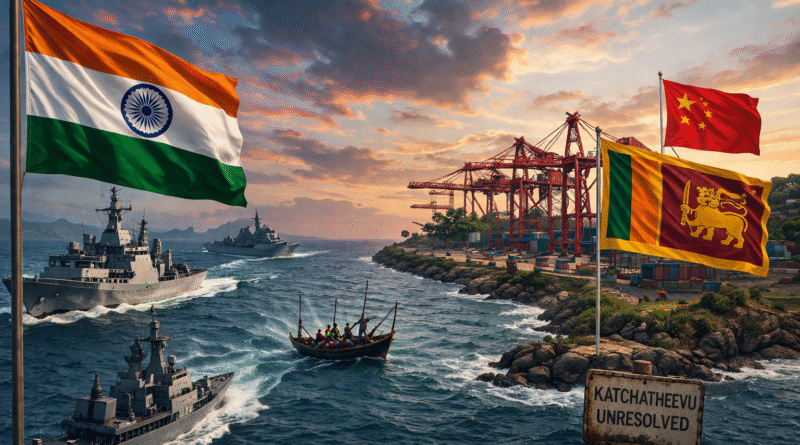
India Sri Lanka 2026: Debt Over, China Shadow Grows
India Sri Lanka 2026 is a relationship that has turned a corner without fully resolving the tensions that define it. Two years ago, Sri Lanka was bankrupt, its foreign exchange reserves exhausted, its citizens queuing for fuel and medicine, its president having fled the country in a helicopter as protesters stormed the presidential palace. India responded faster and more generously than any other country $4.5 billion in financial assistance, emergency fuel shipments, food aid, and medical supplies positioning itself as the “first responder” the Neighbourhood First policy had always promised to be. Today, under President Anura Kumara Dissanayake (AKD) and an IMF stabilisation programme, Sri Lanka is economically stable. The goodwill India earned through the crisis is real and substantial. But the structural issues Chinese infrastructure debt, the Hambantota port lease, hundreds of arrested Indian fishermen in Palk Strait, and the unresolved 13th Amendment have not been solved. They have been managed.
The Economic Crisis and India’s Response: What Changed
Sri Lanka’s 2022 economic collapse was the worst in the country’s post-independence history. Foreign exchange reserves fell to near zero. Inflation hit 70%. The country defaulted on its $83 billion in external debt. Fuel ran out. The Rajapaksa government fell.
India’s response was immediate and decisive in a way that reordered the strategic landscape. While China, Sri Lanka’s largest bilateral creditor initially extended a paltry $75 million in emergency aid (compared to India’s $4.5 billion), India shipped fuel, food, and medicines within days. The Indian High Commission coordinated directly with Sri Lankan authorities on supply logistics. Currency swaps, lines of credit for essential imports, and direct grants were deployed at a speed that multilateral institutions could not match.
The contrast mattered. It damaged China’s “brand value” in Sri Lanka among ordinary citizens who experienced the crisis firsthand and saw which neighbour showed up first. When Cyclone Ditwah hit Sri Lanka in late 2025, India launched Operation Sagar Bandhu within hours dispatching Navy ships, INS Vikrant helicopters (the first overseas deployment of India’s new aircraft carrier), search-and-rescue units, mobile hospitals, and Bailey bridges. In February 2026, India gifted an additional 10 Bailey bridges as part of a $450 million cyclone relief package. President AKD publicly praised India as Sri Lanka’s first responder. The phrase has stuck and it represents a genuine shift in Sri Lankan public opinion toward India.
India Sri Lanka 2026: The Full Bilateral Scorecard
| Issue | Current status | India position | Sri Lanka position | Trajectory |
| Economic crisis recovery | IMF programme ongoing. $83B debt restructured. Economy stabilising, not yet growing. | India gave $4.5B in crisis aid — largest fast emergency support ever given to a neighbour. | Grateful but determined to maintain balance with China. AKD pursuing “independent” foreign policy. | Positive — India credit very high |
| Fishermen (Palk Strait) | 500+ Indian fishermen arrested in 2024. Boats seized. Tamil Nadu domestic pressure on Delhi. | Wants diplomatic resolution protecting Tamil Nadu fishermen’s livelihoods. Opposes bottom trawling ban. | Sri Lanka demands end to Indian bottom trawling — destroying seabed and northern fishing communities. | Structural deadlock — economics vs ecology |
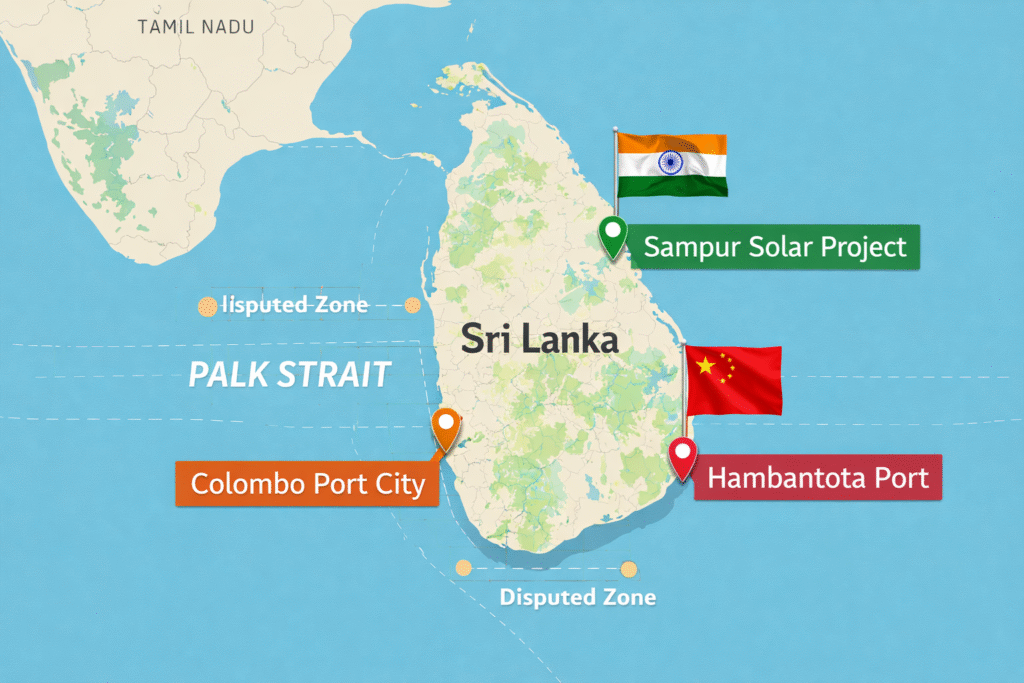
| Hambantota Port (China) | 99-year lease to China Merchants Port Holdings since 2017. Chinese naval vessels permitted. | Deeply concerned. Hambantota gives China a strategic maritime foothold 200km from Tamil Nadu coast. | Defends deal as own decision, not Chinese “imposition.” Needs Chinese investment to continue. | Managed tension — not resolution |
| Defence MoU (India) | First-ever India-Sri Lanka defence cooperation MoU signed April 2025 (Modi visit). IPKF chapter formally closed. | Major milestone — begins formal defence cooperation after 35 years of IPKF bitter legacy. | Positive on defence with India but wants balance — simultaneously deepening China security cooperation. | Positive — cautiously deepening |
| Sampur solar project | Ground-breaking ceremony done during Modi April 2025 visit. India-funded renewable energy project in north. | Key connectivity project. Positions India as development partner in Sri Lanka’s Tamil north. | Welcomes Indian energy investment. Critical for reducing import dependency. | On track |
| Cyclone Ditwah | Cyclone hit Sri Lanka late 2025. India launched Operation Sagar Bandhu immediately. $450M relief package. 10 Bailey bridges gifted Feb 2026. | First-responder positioning. Navy Vikrant deployed — first overseas deployment of new carrier. | President AKD praised India publicly as “first responder.” Boosted goodwill significantly. | Strong positive for India |
| Katchatheevu Island | Island ceded to Sri Lanka in 1974. Tamil Nadu politicians demand return. No India renegotiation likely. | Cannot reopen — treaty in place. Domestic political issue managed not resolved. | Sri Lankan sovereignty — not negotiable. | Frozen |
| 13th Amendment | Unfulfilled — requires devolution of power to Tamil-majority Northern Province. India has consistently pressed for implementation. | India wants Tamil political rights protected. Directly linked to Tamil Nadu domestic politics. | Sri Lanka has resisted full implementation since 1987. AKD government same position. | Stalled |
The China Problem: Hambantota, BRI, and the Debt Shadow
| China project | Investment | Strategic concern for India | Current status |
| Hambantota Port | $1.4B construction + 99-year lease | Naval access 200km from Tamil Nadu coast. Chinese vessels permitted. PLAN presence in Indian Ocean. | Operational. Chinese Merchants Port Holdings controls it. |
| Colombo Port City | $1.4B Chinese-funded city on reclaimed land adjacent to Colombo port. | China Merchant Port Holdings owns 85% of Colombo port extension. Over 30% of India’s container cargo transits Colombo. | Under construction and partly operational. |
| BRI debt restructuring | $4.2B China Exim Bank debt restructured Oct 2023 | China used debt crisis to secure concessions. Restructuring terms not fully disclosed. | Agreed but implementation details limited. India concerned about continued Chinese leverage. |
| Chinese submarine visits | Multiple PLAN submarine dockings in Colombo under Rajapaksa government | Direct naval intelligence concern. Submarines in Indian Ocean near Indian coast. | Formally suspended under AKD government pressure, but pattern established. |
President AKD has tried to thread a difficult needle. Before his January 2025 visit to Beijing which came immediately after his December 2024 state visit to India he told New Delhi explicitly that Sri Lanka would not allow its territory to be used “in a manner that is detrimental to the interest of India.” That was the reassurance India needed before it could accept Colombo’s continued engagement with Beijing.
But AKD’s balancing act has limits. Sri Lanka needs Chinese investment. Its debt to Chinese state banks ($4.2 billion restructured in October 2023) means Beijing retains significant economic leverage. The Colombo Port City a $1.4 billion Chinese-funded artificial island adjacent to Colombo harbour is under construction and will be a permanent feature of Sri Lanka’s economic and strategic landscape. China Merchant Port Holdings already controls 85% of the Colombo port extension. Over 30% of India’s container cargo transits Colombo. These are not theoretical concerns.
The Fishermen Dispute: Why It Will Not Go Away
The most persistently unresolved issue in india Sri Lanka 2026 is the one that affects the most people at the most basic level: the fishermen of the Palk Strait.
Over 500 Indian fishermen were arrested by the Sri Lankan Navy in 2024 alone. Their boats were seized or destroyed. The arrests trigger protests in Tamil Nadu, where the fishing community has significant political weight and where any Indian Prime Minister ignores their concerns at electoral cost. The dispute is rooted in a structural misalignment: Indian fishermen from Tamil Nadu have fished the Palk Bay for centuries, operating in waters that were common before maritime boundaries were formalised in 1974 and 1976. The treaties demarcated the International Maritime Boundary Line but did not factor in the lived realities of thousands of traditional fishermen whose entire fishing grounds now straddle the boundary.
The specific technical dispute is bottom trawling. Indian fishermen use heavy trawling nets that drag along the seabed, harvesting fish efficiently but destroying coral and seabed ecosystems. Sri Lanka’s northern fishing communities who use traditional methods say Indian bottom trawling is devastating the marine environment they depend on. Sri Lanka wants a ban. India’s fishermen say bottom trawling is their traditional livelihood. Both positions are correct, and that is precisely why the dispute has persisted for decades without resolution.
Sri Lankan MP Harsha de Silva, speaking in March 2026, characterised the solution accurately: it is “economics-related, not legal.” What the Palk Bay needs is not another joint working group communique it is a genuine alternative livelihood scheme for Tamil Nadu fishermen who lose access to deep-water grounds, combined with a managed transition to non-destructive fishing methods. That requires sustained political will and financial commitment from India, neither of which has materialised at the scale the problem demands.
The First Defence MoU and AKD’s Balancing Act
The most symbolically significant recent development in india Sri Lanka 2026 was the signing of India’s first-ever defence cooperation MoU with Sri Lanka during PM Modi’s April 2025 visit. The MoU formally closed the “bitter chapter” of the Indian Peace Keeping Force (IPKF), which operated in Sri Lanka from 1987 to 1990 and left a legacy of civilian casualties and mutual mistrust that had complicated defence cooperation for 35 years.
The MoU enables joint naval exercises, intelligence sharing, capacity building, and cooperation on maritime domain awareness in the Indian Ocean. For India, it is a concrete security gain in a country that sits 22 kilometres from its southern coast at the closest point and commands sea lanes connecting the Indian Ocean to the Bay of Bengal.
President AKD has handled the India relationship with genuine diplomatic skill. His first foreign visit after taking office was to India a deliberate signal of priority. His second was to China. He has consistently given India the symbolic precedence while maintaining economic engagement with Beijing. The pledge not to allow Sri Lanka to be used against India’s interests given personally to Modi before visiting Xi is the kind of direct commitment that New Delhi needed from a president who had previously been sceptical of Indian influence.
ThirdPol’s Take
India Sri Lanka 2026 is the best that the relationship has been since the IPKF withdrawal in 1990 and it is still complicated. India earned enormous goodwill through the crisis response and the Cyclone Ditwah relief. The defence MoU closes a chapter. The Sampur solar project and energy connectivity are moving. On the strategic ledger, India is ahead of China in popular sentiment in ways that no amount of BRI infrastructure spending is easily reversing. But the fishermen problem keeps undercutting this goodwill at the grassroots level. Every arrest of Tamil Nadu fishermen in Palk Bay is a domestic political wound in India and a genuine livelihood injury to Sri Lankan northern fishing communities. India needs to invest in a real solution not just another joint working group before this issue poisons the relationship in ways that no amount of crisis aid can repair. The China problem is structural and long-term. Hambantota is not going anywhere. The 99-year lease outlasts any government in either country. India’s best response is not to compete with China on infrastructure investment it cannot win that contest but to deepen what China cannot offer: genuine security partnership, people-to-people connection, and the kind of first-responder reliability that shows up when the crisis is real.
By Amit Mangal | ThirdPol | April, 2026