India Gulf Diaspora Return: What Happens to Workers Coming Home?
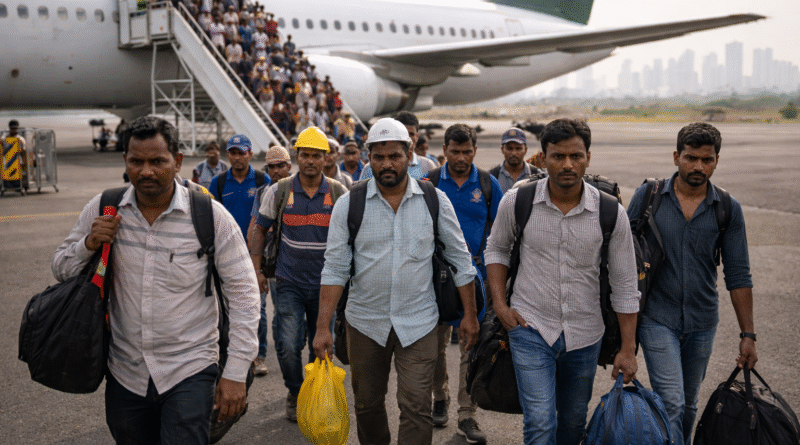
For decades, the Gulf was India’s most reliable economic safety valve. Millions of Indians from Kerala’s nurses and construction workers to UP’s drivers and Bihar’s labourers built lives in the UAE, Saudi Arabia, Qatar, Kuwait, and Bahrain, sending home remittances that funded houses, educated children, and subsidised rural consumption across India’s most populous states. The 2026 Iran war has put that arrangement under its most severe stress since the Gulf wars of 1990. The India Gulf diaspora return over 220,000 Indian nationals repatriated as of late March 2026, with more expected as the ceasefire holds is not just a humanitarian story. It is an economic and social challenge that will play out over years, not months, and will reshape the politics and economies of the states most dependent on Gulf money.
The Scale of India’s Gulf Presence
India has the world’s largest diaspora, and the Gulf is its single largest destination. Before the Iran war, approximately 9 million Indians lived and worked across the six Gulf Cooperation Council states UAE, Saudi Arabia, Kuwait, Qatar, Bahrain, and Oman. This number had been growing steadily for four decades, driven by demand for construction, healthcare, hospitality, domestic work, and increasingly, skilled technical and professional services.
The financial flows generated by this workforce are enormous. India’s total remittance receipts exceeded $125 billion in 2023, making it the world’s largest recipient of remittances for the second consecutive year. The Gulf alone accounts for roughly 55% of that total approximately $68-70 billion annually. In Kerala, remittances from the Gulf represent approximately 36% of state GDP. In Uttar Pradesh and Bihar, Gulf remittances subsidise rural consumption, housing construction, and local retail in districts that have few other income sources. This is not a marginal flow. It is a structural pillar of household finance across India’s most populous regions.
The Iran war disrupted this pillar suddenly and completely. When Iranian drones struck the UAE in March 2026, construction sites shut down, hotels emptied, flight operations at Dubai International were disrupted, and the general atmosphere of fear triggered a mass exodus of foreign workers. India activated its Vande Bharat repatriation programme within weeks. By late March, over 220,000 Indian nationals had been brought home.
India Gulf Diaspora Return: State-by-State Impact
| State | Gulf dependency and current situation |
| Kerala | Largest Gulf-dependent state. ~2.5 million Keralites in the Gulf. Remittances = ~36% of state GDP. LDF government has activated Kerala Pravasi Welfare Board emergency fund. |
| Uttar Pradesh | Largest absolute number of Gulf workers (est. 3+ million). Highly concentrated in districts like Azamgarh, Gorakhpur. Remittance-dependent rural economy in eastern UP. |
| Bihar | Second-largest sending state. Workers concentrated in UAE, Saudi Arabia. Return migrations causing pressure on already-strained job market. |
| Andhra Pradesh / Telangana | Large skilled and semi-skilled workforce in UAE and Saudi Arabia. IT and construction workers. Both state governments tracking returnee flows. |
| Rajasthan | Significant concentration in Gulf construction sector. Workers from Barmer, Jaisalmer, Nagaur districts specifically affected. |
| Tamil Nadu | Significant skilled Gulf workforce. State government running Pravasi Bharatiya Helpline. Returnees showing above-average entrepreneurial activity historically. |
The India Gulf Diaspora Return Is Different From Previous Gulf Evacuations
India has conducted Gulf evacuations before. Operation Kaveri evacuated Indians from Sudan in 1991. Operation Rahat brought back 170,000 Indians from Yemen in 2015. Vande Bharat during COVID repatriated millions. Each time, most evacuees eventually returned to the Gulf as the situation stabilised.
The 2026 India Gulf diaspora return is structurally different in three ways. First, the scale is concentrated. The 220,000 figure is from a six-week period faster and more concentrated than previous evacuations. Second, the profile is more skilled. Economic data from March 2026 indicates that a higher proportion of returnees this time are skilled professionals and business owners who had built substantial lives in the Gulf over years or decades. These are not contract labourers finishing a cycle they are people who had permanent residences, children in schools, and businesses.
Third, and most significantly, the Gulf itself has changed. The Iran war has accelerated a structural shift already underway Gulf states are actively diversifying their economies under Vision 2030 and similar frameworks, mechanising construction, and prioritising nationals and automation over imported labour. The guarantee that a returnee can simply go back to the same job in six months is no longer as solid as it was in 2015.
What Are Returnees Actually Doing?
The initial assumption that returnees would flood India’s already-overcrowded major cities has not materialised. Economic data from March 2026 tells a different story. Returnees are gravitating toward Tier-2 and Tier-3 cities, not Mumbai, Delhi, or Bengaluru. Secondary real estate markets are showing a 14% growth surge, driven by returnee capital being deployed into housing purchases or construction on family land.
This pattern reflects a longer-term shift that was already underway before the Iran war. Gulf returnees over the past decade have increasingly preferred to invest their savings in smaller cities rather than competing in oversaturated metros. The Iran war has simply accelerated a trend, converting what might have been a gradual transition into a rapid one.
In Kerala, the Kerala Pravasi Welfare Board has documented that a significant number of returnees from the 2026 evacuation are not planning to return to the Gulf a higher proportion than previous evacuations. Their intention is to use accumulated savings to start businesses, primarily in food services, logistics, retail, and construction. Whether those intentions translate into successful ventures depends on access to credit, training, and local government support, none of which are currently at the required scale.
The Remittance Cliff: What Falling Flows Mean for India’s Economy
The most immediately measurable economic consequence of the India Gulf diaspora return is the fall in remittances. Remittances are not logged in real time they lag by months but the directional impact is clear. 220,000 workers who are back in India are no longer sending money home. They are spending savings, not generating income.
For Kerala, this is a genuine economic shock. Remittances fund not just household consumption but a significant portion of the state’s construction activity, retail economy, and service sector demand. The Kerala economy has historically absorbed returnee cycles by sending new workers to replace those who came back. The 2026 cycle is happening faster than the replacement pipeline can absorb, and with Gulf states actively reducing their dependence on Indian labour, the long-term pipeline is shrinking.
For UP and Bihar, the impact is felt most sharply in districts that were already among India’s poorest. Azamgarh, Gorakhpur, Mau, the districts with the highest concentration of Gulf workers — have real economies built almost entirely around remittance inflows. A sustained fall in those flows creates local recessions that state governments are not equipped to absorb.
India’s foreign exchange reserves provide a buffer at the macro level. But the micro-level pain in Kerala, UP, and Bihar does not wait for macro buffers to kick in.
The Opportunity Side: Can Returnee Capital Build Something?
Every Gulf returnee wave has, eventually, generated some positive outcomes. The Kerala model of the 1990s where Gulf returnees invested in housing, education, and small businesses produced one of India’s best-performing state economies in terms of human development. The Tamil Nadu returnee wave of the 2000s seeded a significant number of small manufacturers and exporters.
The 2026 India Gulf diaspora return arrives with two advantages over previous waves. First, digital infrastructure is vastly better. Returnees can start online businesses, connect with national and international markets, and access government schemes in ways that were not available in 1991 or 2015. Second, India’s manufacturing push PLI schemes, Make in India, semiconductor investments — is creating new demand for skilled workers, entrepreneurs, and suppliers in exactly the segments where Gulf returnees have experience.
The government has a narrow window to channel returnee capital and skills productively. The tools exist: MUDRA loans for small business, MSME support schemes, state-level investment promotion bodies. The gap is speed and scale. Kerala is ahead of other states in having institutional infrastructure for returnee integration the Norka-Roots agency has 20 years of experience. UP and Bihar do not have comparable institutions, and those are the states with the largest returnee populations.
ThirdPol’s Take
The India Gulf diaspora return of 2026 is both a crisis and a forced transition. The crisis is real — falling remittances, returnees without a clear path, and states unprepared for the scale of reintegration. The transition is equally real Gulf labour markets are structurally tightening, and India’s dependence on Gulf remittances for a significant fraction of household income in its most populous states was always a vulnerability waiting to be exposed. The Iran war has simply exposed it faster than anyone planned for. The productive response is not to wait for returnees to go back to the Gulf. It is to invest now in the infrastructure that turns returnee capital and skills into domestic economic activity. That means MSME credit at scale, state-level returnee integration agencies in UP and Bihar that match Kerala’s Norka-Roots model, and a national skill-to-business pipeline that connects Gulf-experienced workers to India’s manufacturing and services growth story. The ceasefire gives India a short window before the next disruption. It should use it.
By Amit Mangal | ThirdPol | April 2026