India Manufacturing Powerhouse: How Close Is It, Really?
The India manufacturing powerhouse question comes up constantly these days, usually framed as a simple yes or no. It deserves a more honest answer than that. Global companies really are shifting production to India. Apple alone has moved a genuinely large share of iPhone assembly here, and the government has backed that shift with real money. But the same official data that gets cited to celebrate this shift also shows manufacturing’s overall share of India’s economy barely moving, and in some readings actually shrinking, over the past several years. Both things are true at once, and understanding why is the actual story.
The India Manufacturing Powerhouse Ambition, By The Numbers
Start with the target everyone keeps citing. The original National Manufacturing Policy, and later Make in India, set a goal of lifting manufacturing to 25 percent of GDP. The current reality is nowhere close. World Bank data puts India’s manufacturing share at around 13 percent as of 2024, down from 15 percent in 2018. Industry body estimates using slightly different methodology put the figure closer to 17 percent. Either way, this is not a story of dramatic growth. It is a story of a target that keeps getting pushed further out, most recently to 2035 under the newly announced National Mission on Manufacturing.
The regional comparison stings more than the raw number. Vietnam sits at roughly 24 percent, Malaysia at 23 percent, Indonesia at 19 percent, all well ahead of India despite far smaller economies overall. China, even after deliberately reducing its own reliance on manufacturing in favour of services and consumption, still sits around 25 percent. In absolute value-added terms India remains genuinely large, twice the size of Indonesia’s manufacturing sector and nearly four times Vietnam’s, but that scale comes from the sheer size of India’s economy rather than from manufacturing punching above its weight within it.
What’s Actually Working: The Apple Story
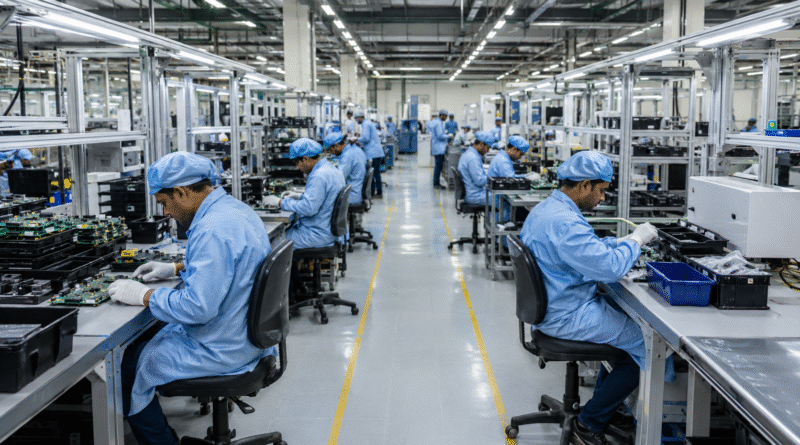
The electronics sector is where the India manufacturing powerhouse case looks strongest, and it is worth taking seriously rather than dismissing as hype. Apple exported more than 50 billion dollars worth of iPhones from India by December 2025, just four years after joining India’s smartphone Production Linked Incentive scheme. India’s share of global iPhone assembly has climbed toward roughly a quarter of Apple’s total output, and industry estimates put it heading toward 28 to 30 percent by 2027. Apple has said it wants most iPhones sold in the United States to come from Indian factories by the end of 2026, driven as much by a desire to reduce dependence on China as by anything India itself offered.
Two Indian manufacturers now anchor this shift. Tata Electronics has expanded rapidly, absorbing a former Wistron factory and building new capacity in Hosur, with its share of India’s iPhone exports climbing from around 13 percent in 2024 toward 40 percent by 2025. Foxconn continues to expand its own facilities in Chennai and near Bengaluru. Electronics has become India’s single largest export category by value, ahead of even traditional strengths like textiles and pharmaceuticals, and domestic value addition in electronics has risen from around 30 percent to roughly 70 percent, with a government target of 90 percent by the 2026-27 financial year.
What’s Not Working: Everything Behind The Final Screw
The honest caveat, and one Apple itself has acknowledged, is that manufacturing costs in India currently run 5 to 8 percent higher than in China, sometimes reaching 10 percent, largely due to logistics costs, a thinner local supplier base, and lower productivity per worker. Apple is absorbing that gap deliberately, as a hedge against geopolitical risk rather than because India is currently the cheaper option. That distinction matters enormously for whether India’s manufacturing gains generalise beyond a handful of strategically motivated companies like Apple to the broader universe of manufacturers making purely cost-based decisions.
The deeper problem is that India has captured the assembly stage of electronics manufacturing far faster than it has captured the component stage. Semiconductors, high-end camera modules, and advanced display assemblies are still overwhelmingly imported from China, South Korea, and Taiwan, even as final assembly happens in Chennai or Hosur. India’s semiconductor mission has approved multiple fabrication and packaging plants over the past few years, but building an actual chip fabrication ecosystem, the machines, the specialised engineers, the ultra-pure water and power supply chains, takes a decade or more even for countries starting with far more industrial infrastructure than India currently has. Assembly-stage manufacturing creates jobs and export revenue, both genuinely valuable, but it does not by itself build the deep industrial base that the word powerhouse usually implies.
The Older, Less Glamorous Problems
Electronics is the sector getting headlines, but it is not representative of manufacturing as a whole. India continues to lose ground to Vietnam and Bangladesh in labour-intensive sectors like garments and footwear, precisely the categories that historically launched East Asian economies into industrialisation. The reasons are familiar and have resisted a decade of policy attention: complex labour laws that make it costly for firms to scale up and down with demand, high logistics costs that eat into export competitiveness, patchy power supply in some industrial clusters, and a land acquisition process that can add years to any large factory project. The Production Linked Incentive scheme has been effective precisely because it works around some of these problems with direct cash subsidies rather than fixing them, which raises a fair question about how self-sustaining the current gains are once the subsidy money tapers off.
There is also a productivity gap that rarely makes headlines but matters enormously. Indian manufacturing workers, on average, produce significantly less output per hour than workers in China, Vietnam, or Mexico, even accounting for lower wages. That gap reflects weaker vocational training, older machinery in large parts of the small and medium manufacturing sector, and inconsistent quality control, all of which take longer to fix than any single incentive scheme can address.
So, Can India Actually Become A Manufacturing Powerhouse?
The realistic answer is a qualified yes, but on a longer timeline and in a narrower set of sectors than the more optimistic headlines suggest. Electronics assembly, and specifically the Apple-anchored smartphone ecosystem, is a genuine and probably durable success, likely to keep growing as India’s suppliers move up the value chain from pure assembly toward components. Sectors tied to strategic diversification away from China, driven by government policy in countries like the United States and the European Union as much as by anything India does domestically, will likely keep favouring India as a hedge destination regardless of India’s own cost competitiveness.
But turning that into a genuine manufacturing powerhouse, in the sense China, South Korea, or Vietnam earned that label, requires fixing the unglamorous structural problems that have resisted a decade of targeted schemes: logistics costs, labour law flexibility, land acquisition speed, and a shallow domestic component and machinery ecosystem beneath the final assembly line. The National Mission on Manufacturing’s 2035 target for a 25 percent GDP share is a tacit admission that this earlier 2022 deadline, and the one before it, were never realistic. Whether 2035 fares any better will depend less on how many new incentive schemes get announced and more on whether the underlying cost of doing business in India actually falls, rather than being permanently offset by subsidy cheques that other countries eventually stop needing to match.
Key Points
- Manufacturing’s share of India’s GDP: ~13% (World Bank, 2024), down from 15% in 2018; industry estimates put it closer to 17%.
- Regional comparison: Vietnam ~24%, Malaysia ~23%, Indonesia ~19%, China ~25% of GDP from manufacturing.
- National Mission on Manufacturing (Budget 2025-26) targets 25% GDP share by 2035, 143 million new jobs, and expanded merchandise exports.
- Apple exported over $50 billion worth of iPhones from India by December 2025, just 4 years after joining India’s smartphone PLI scheme (FY22).
- India’s share of global iPhone assembly: ~25-28%, projected toward 28-30% by 2027.
- Electronics domestic value addition risen from ~30% to ~70%, targeted to reach 90% by FY27.
- Manufacturing costs in India remain 5-10% higher than China, mainly due to logistics costs and a thinner supplier base.
- Key anchors: Tata Electronics (Hosur, absorbed Wistron’s Karnataka plant) and Foxconn (Chennai, Bengaluru) for iPhone assembly.
- Structural bottlenecks: labour law complexity, high logistics costs, land acquisition delays, low manufacturing labour productivity relative to China/Vietnam/Mexico.
By Amit Mangal | ThirdPol | August, 2026