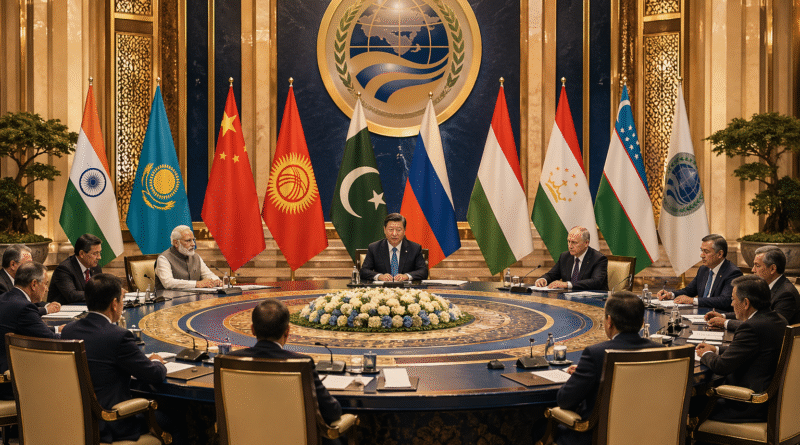
SCO Summit India 2026: India’s Awkward Chair Between Russia, China, and the West
India has been a full member of the Shanghai Cooperation Organisation since 2017. It has never been entirely comfortable with the membership the SCO is a body where India sits alongside Pakistan, where China is the dominant institutional player, and where the organisational culture reflects Central Asian authoritarianism more than Indian democracy.
The sco summit india 2026 is notable because India chairs the body at a moment when these tensions are at peak intensity. How New Delhi navigates the chairmanship tells us something important about how India understands its own role in a fragmenting world order.
What the SCO Is and Isn’t
The Shanghai Cooperation Organisation was founded in 2001 by China, Russia, Kazakhstan, Kyrgyzstan, Tajikistan, and Uzbekistan, with a mandate focused on security cooperation in Central Asia specifically counterterrorism and the interdiction of narcotics and arms trafficking. Pakistan and India joined in 2017; Iran joined in 2023.
The sco summit india 2026 context requires understanding what the SCO is not: it is not NATO, not a formal alliance, not a coherent geopolitical bloc. China and Russia are both members, but their visions for the organisation diverge. Russia has historically used the SCO as a legitimacy platform and wants it to be an explicit counterweight to Western institutions. China wants the SCO as a vehicle for its Belt and Road connectivity ambitions in Central Asia.
India wants neither of those things. India joined the SCO primarily to maintain access to a conversation with Central Asian states that it cannot reach through bilateral diplomacy alone, and to ensure it is not isolated from an organisation that will shape the security environment of its extended neighbourhood.
The Awkward Agenda
The sco summit india 2026 agenda is genuinely awkward. The communique will need language on Ukraine — and there is no language that satisfies both Russia (which wants SCO solidarity against “Western hegemony”) and India (which has maintained studied neutrality). It will need language on Afghanistan, where India’s position diverges sharply from Pakistan’s. And it will need to address the SCO’s own expansion ambitions, which China has been driving in ways that dilute the organisation’s original coherence.
India’s chairmanship approach has been characterised by two moves. First, a push to make connectivity and economic cooperation the headline themes framing the summit around infrastructure, trade facilitation, and development rather than the security-bloc identity that China and Russia prefer. Second, a deliberate effort to include voices from the Global South in the SCO’s framing inviting dialogue partners and observer states from Africa and Latin America, positioning the summit as a pluralistic forum rather than an anti-Western alliance.
The India-Pakistan Factor
Every SCO meeting has an India-Pakistan dimension. Both are full members. Both have bilateral relations that are currently at post-Operation Sindoor lows. The organisational norms of the SCO require India and Pakistan to sit in the same room and agree on joint communiques. This is not comfortable, but it is also not accidental India joined partly to use multilateral settings to manage Pakistan interactions without the full diplomatic burden of bilateral engagement. The SCO summit india 2026 will not resolve India-Pakistan tensions. But it may provide a low-key occasion for the kind of indirect signalling officials speaking in corridors, delegations exchanging positions through interlocutors that keeps communication lines open without requiring political cost on either side