India Space Economy 2026: From ISRO to 399 Startups and Gaganyaan
The india space economy 2026 looks almost nothing like the India space economy of five years ago. In January 2026, Minister of State Jitendra Singh told the Rajya Sabha that India’s space economy has grown to an estimated $8.4 billion, with 399 startups now operating across launch vehicles, satellites, propulsion systems, and space-grade electronics. In 2019, India had fewer than 10 private space companies. The change happened because of a single structural decision: in 2020, the government opened the space sector to private participation and established IN-SPACe the Indian National Space Promotion and Authorisation Centre as a single-window regulator between industry and ISRO. What followed was a transformation that is still accelerating. This year, India’s first uncrewed Gaganyaan capsule is expected to test in orbit, private rockets from Skyroot and Agnikul are making their commercial debuts, and ISRO has announced 18 launches six in partnership with private firms. India currently accounts for 2% of the global space economy. By 2033, the government’s target is 8%.
What Changed: The IN-SPACe Revolution
For most of its 60-year history, India’s space programme was ISRO. The organisation built the rockets, built the satellites, operated the ground stations, and decided what would and would not be launched. Private companies participated as vendors and suppliers, but the entire decision-making and operational architecture was centralised in a government agency. This was not unusual by global standards most countries’ space programmes began this way but by the 2010s it had become a constraint on India’s ability to compete in the rapidly commercialising global space market.
The Space Policy 2023 and the establishment of IN-SPACe changed that. IN-SPACe functions as a regulator and facilitator, granting authorisations for launches, providing access to ISRO facilities, and facilitating technology transfers from ISRO to industry. Over 100 technologies have been transferred to industry so far, including ISRO’s SSLV (Small Satellite Launch Vehicle) design to HAL. Private companies can now access ISRO’s test facilities, launch ranges at Sriharikota, and technical expertise not as vendors doing what ISRO asks, but as independent operators building their own products and finding their own customers.
Pawan Goenka, chairman of IN-SPACe, told The Week in April 2026 that the ISRO-industry relationship has “matured” private firms are now developing technologies, launching satellites, and monetising them independently. Of the 75-member Indian delegation that attended the International Astronautical Congress in Sydney in 2025, 68 were from private companies. That number tells you everything about the velocity of the shift. India sent three times as many private space representatives as government ones to the world’s largest space industry gathering.
India Space Economy 2026: The Private Sector Ecosystem
| Company | What they do | 2026 milestone | Market position |
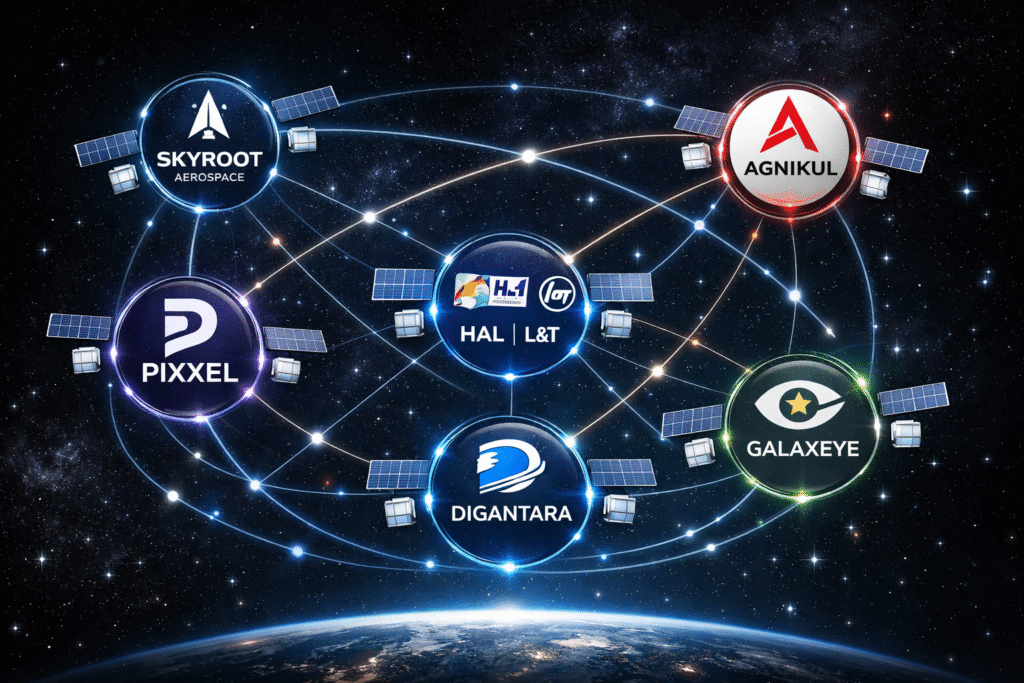
| Skyroot Aerospace | Small satellite launch vehicle: Vikram-1. 3-stage rocket, 300 kg to LEO. | First commercial launch with paying payloads 2026. Unveiled to PM Modi. | First Indian private company to reach orbit (2022 suborbital test). Primary competitor to Agnikul. |
| Agnikul Cosmos | Agnibaan: world’s first single-piece 3D-printed rocket engine. Sub-100 kg to orbit. | First orbital launch 2026. Target: monthly launch cadence post-debut. | Unique manufacturing approach — 3D-printed engines reduce production cost and time by 60%. |
| Pixxel | Hyperspectral Earth observation satellite constellation. 5-metre resolution. | Constellation expansion 2026. Data sold to agriculture, defence, climate sectors. | Only Indian hyperspectral constellation. US govt and Indian defence among early customers. |
| Digantara | Space situational awareness. Launched SCOT — world’s first commercial space surveillance satellite (Mar 2025). | 8 more SCOT satellites in 2026 via SpaceX. 7 more in 2027. | Global first-mover in commercial space traffic monitoring. Strategic defence value. |
| GalaxEye | Multi-sensor Earth observation: SAR + optical combined in one satellite (Mission Drishti). | World’s first multi-sensor EO satellite launch Q1 2026. 1.5-metre resolution. | Technical breakthrough enabling day/night, all-weather imagery. Defence and disaster management use. |
| HAL-L&T consortium | First industry-built PSLV (without ISRO construction). Technology transfer from ISRO. | Launch of PSLV carrying OceanSat-3A — first fully industry-manufactured PSLV 2026. | Marks shift from ISRO building rockets to industry building rockets. Milestone for indigenisation. |
Gaganyaan: India’s Human Spaceflight Programme Enters the Home Stretch
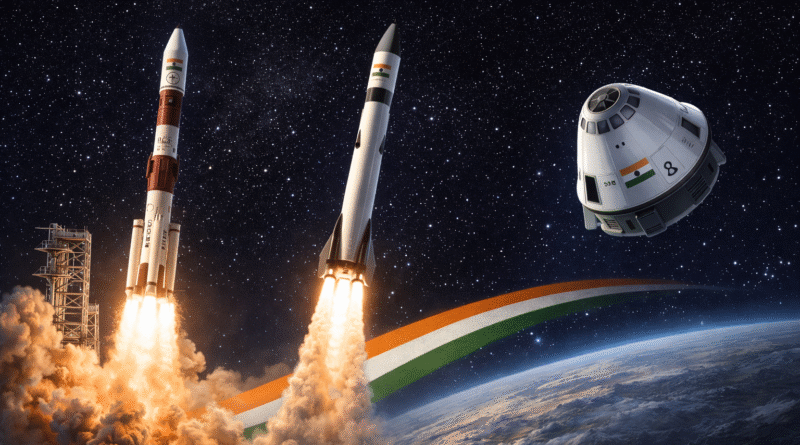
The most symbolically significant event in the india space economy 2026 calendar is the Gaganyaan programme. India is attempting to join the United States, Russia, and China as the only countries with independent human spaceflight capability and 2026 is when the hardware begins its final validation.
The Gaganyaan G-1 mission the first uncrewed test flight will put a humanoid robot called Vyommitra in the crew capsule and send it to low Earth orbit. Vyommitra will simulate astronaut functions, and the spacecraft will validate life support systems, re-entry dynamics, and recovery procedures before any human is put onboard. The second Integrated Air Drop Test (IADT-02) was successfully completed on April 10, 2026, validating the parachute deceleration and splashdown recovery systems. By early 2026, over 8,000 ground tests had been completed.
The broader Gaganyaan programme has been expanded since its original conception. The total budget has grown to Rs 20,193 crore ($2.4 billion), and the programme now includes eight missions through 2028 including precursor modules for the Bharatiya Antariksh Station (BAS). The crewed Gaganyaan-2 flight, with 2-3 Indian vyomanauts in orbit, is targeted for 2027. India’s first astronaut in space on an Indian rocket will be a genuinely historic moment and the india space economy 2026 is the launchpad from which that moment will be achieved.
One important context for Gaganyaan in 2026: India has already had a presence on the International Space Station. Group Captain Shubhanshu Shukla flew to the ISS as part of the AXIOM-4 mission in 2025 — the first Indian in space in over four decades. That mission built operational familiarity with orbital procedures and provided ISRO with live data from an Indian astronaut in microgravity. It is the kind of experience that makes the difference between a technically successful mission and a truly operational human spaceflight programme.
The Defence Dimension: Space and Operation Sindoor
One aspect of the india space economy 2026 that rarely gets discussed in the same breath as startups and launch vehicles is the growing civil-military fusion of India’s space capabilities. ORF’s analysis of 2026 trends makes this explicit: ISRO, in a departure from its earlier posture, acknowledged after Operation Sindoor that the precision strikes on terror infrastructure in Pakistan were “to a great degree, made possible by the country’s space capabilities.”
That acknowledgement is significant. It means India’s Earth observation satellites, reconnaissance platforms, and communication networks are now openly integrated into military planning and execution. The EOS-N1 satellite being launched jointly by ISRO and DRDO in 2026 is explicitly described as an Earth observation satellite for “strategic and surveillance applications.” Digantara’s space situational awareness constellation eight SCOT satellites being launched this year has direct defence implications for tracking adversary space assets.
For the india space economy 2026, this civil-military fusion creates both opportunity and complexity. It means defence procurement becomes a direct driver of commercial space demand — military customers for Earth observation data, secure communications, and space traffic monitoring are growing revenue streams for private companies. It also means India’s space sector is increasingly subject to national security considerations that constrain international partnerships and technology transfers.
The Road to 2033: India’s $44 Billion Space Ambition
| Mission / Programme | What it is | Target timeline | Significance |
| Gaganyaan G-1 (uncrewed) | First uncrewed test flight of crew capsule with humanoid robot Vyommitra onboard. Validates crew systems in LEO. | 2026 (target) | India’s first crewed spacecraft test. Prerequisite to sending humans. |
| Gaganyaan G-2 (crewed) | First Indian crew of 2-3 astronauts (Vyomanauts) to low Earth orbit. | 2027 (target) | India becomes 4th country with independent human spaceflight capability. |
| Bharatiya Antariksh Station (BAS) | India’s own space station. BAS-1 module first unit. 8-mission programme through 2028. | BAS-1 launch by 2028 | Strategic independence from ISS and China’s Tiangong. India’s permanent human presence in space. |
| NGLV (Next Generation Launch Vehicle) | Replacement for PSLV/GSLV. Semi-cryogenic engine. 3x current payload capacity. Reusable first stage planned. | First flight 2030s | Enables India to compete in heavy commercial launch market and launch BAS modules. |
| Chandrayaan-4 (lunar sample return) | Returns lunar soil samples to Earth. Builds on Chandrayaan-3’s south pole landing. | 2027-28 | Demonstrates advanced autonomous docking (tested in SpaDeX 2025). Lunar economy positioning. |
| Shukrayaan (Venus orbiter) | India’s first mission to Venus. Studies atmosphere, surface, internal structure. | 2028 target | Scientific leadership in solar system exploration beyond Moon and Mars. |
Prime Minister Modi’s stated goal is a space economy worth Rs 3.6 lakh crore (approximately $44 billion) by 2033 — roughly 5x the current $8.4 billion. India currently accounts for 2% of the $450 billion global space economy. The 2033 target implies reaching 8%. That is an achievable but non-trivial ambition. It requires the private sector to deliver on its launch vehicle promises, the satellite services market to scale, and India to establish itself as a preferred destination for commercial launches from international clients.
The launch capacity question is central. India currently has limited launch frequency compared to SpaceX (which conducts 90+ launches per year). ISRO’s 18-launch target for 2026 is ambitious by Indian historical standards but modest by global commercial standards. The Next Generation Launch Vehicle (NGLV) — with semi-cryogenic engines and planned reusability is the hardware that would allow India to compete in the heavy commercial launch market. Its first flight is not expected until the 2030s.
The gap between India’s current capacity and its 2033 target is real. What makes the trajectory credible is not the hardware pipeline alone but the institutional infrastructure now in place: IN-SPACe as a regulator, 399 startups creating competitive pressure, VC funding flowing into the sector (LeT-linked startups attracted Rs 430 crore in VC by January 2026), and government demand being systematically generated across defence, agriculture, disaster management, and navigation sectors. The india space economy 2026 is not the endpoint. It is the acceleration phase.
ThirdPol’s Take
The india space economy 2026 is one of the few stories in Indian technology where the ambition and the execution are actually aligned. Chandrayaan-3’s south pole landing in 2023 demonstrated that ISRO can achieve firsts that the US, Russia, and China could not. The creation of IN-SPACe has unleashed a genuine private sector wave 399 startups in four years is not a government programme. It is an ecosystem. The Gaganyaan programme will, in 2026 and 2027, demonstrate whether India can make the transition from spectacular one-off missions to operational human spaceflight. That is the harder test. Orbital mechanics and rocket propulsion India has mastered. The logistics of sustained human presence in space life support, crew rotation, resupply is the next frontier. The Operation Sindoor acknowledgement that space capabilities enabled precision strikes changes the political economy of the sector: defence budgets will increasingly flow toward space capabilities, creating a new demand curve that commercial players can serve. The $44 billion 2033 target is a stretch. But the institutional foundations built between 2019 and 2026 make it the most plausible stretch target in Indian technology policy.
By Amit Mangal | ThirdPol | April 19, 2026