India EU Trade Deal 2026: 16 Years, One Agreement, and What India Actually Gets
The India EU trade deal 2026 was signed on January 27 at Hyderabad House in New Delhi, when Prime Minister Narendra Modi, European Commission President Ursula von der Leyen, and European Council President António Costa announced the conclusion of negotiations for what both sides called the “mother of all deals.” The agreement technically concluded the night before and announced at a formal summit after Republic Day celebrations ends 16 years of on-again, off-again negotiations that began in 2007, stalled in 2013 over disputes about cars, wine, data protection, and agricultural access, and were relaunched in 2022 with renewed urgency driven by US trade pressure and China supply chain concerns. The result is the largest free trade agreement the EU has ever signed and the most ambitious trade deal India has ever concluded. Understanding what it actually means requires looking past the headline numbers at who wins, who loses, and what risks remain unresolved.
Why 16 Years? Why Now?
India and the EU first began FTA talks in 2007. They broke down in 2013 over four irreconcilable disputes: India wanted the EU to open its market to Indian IT professionals and visa mobility for skilled workers. The EU wanted India to reduce its 110% tariffs on European cars, open its dairy sector, and accept stronger intellectual property protections on pharmaceuticals and geographical indications for products like Champagne and Parmigiano Reggiano. Neither side would move sufficiently.
The talks were relaunched in June 2022. Two things changed the political equation. First, the Russia-Ukraine war accelerated European interest in diversifying supply chains and deepening strategic partnerships with democracies outside China’s orbit. India, as the world’s most populous country with a fast-growing economy, became more valuable to Europe as a strategic partner rather than merely a trading counterpart. Second, Trump’s tariffs in 2025 hitting both India and the EU hard created a shared adversity that made completing a deal more urgent for both sides. Von der Leyen put the geopolitical framing explicitly at Davos in January 2026: “a free market of two billion people, accounting for a quarter of global GDP.” That was not primarily a trade pitch. It was a signal about democratic solidarity against protectionism.
The India EU trade deal 2026 was also accelerated by competition. India completed a free trade deal with the UK in 2024. It had FTAs with Australia, UAE, and ASEAN. If India gave the EU’s competitors preferential access without a reciprocal EU deal, European exports would be disadvantaged in a market growing at 6-7% annually. From Brussels’s perspective, the opportunity cost of another failure was too high.
India EU Trade Deal 2026: Sector by Sector — Who Gets What
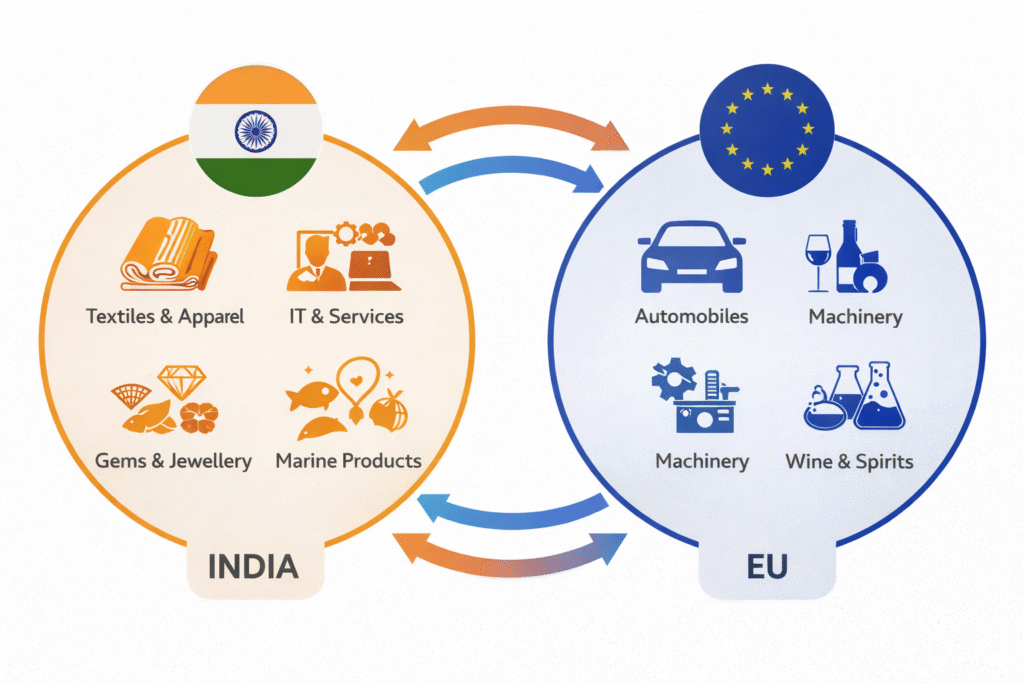
| Sector | Who benefits | What changes |
| Textiles & Apparel | INDIA WINS | EU tariffs of 4-17% → zero at entry into force. $7B in exports → potential $30-40B. Puts India on par with Bangladesh, Vietnam, Pakistan. |
| Leather & Footwear | INDIA WINS | EU tariffs up to 17% → zero. $2.4B sector gains competitive parity with EU-preferred exporters. |
| Gems & Jewellery | INDIA WINS | EU tariffs eliminated. Sector worth billions in annual EU exports. |
| Marine Products | INDIA WINS | Access to €53.6B EU marine import market with tariff elimination. |
| IT & Professional Services | INDIA WINS | Access to 144 services sub-sectors. Easier movement of IT professionals and intra-corporate transferees. |
| Automobiles | EU WINS | India reduces car tariffs from 110% → 10% gradually. Car parts duties abolished over 5-10 years. Renault, VW, BMW, Mercedes benefit. |
| Machinery | EU WINS | India nearly eliminates tariffs up to 44%. Major boost for German, French, Italian manufacturers. |
| Chemicals & Pharma | EU WINS | India reduces tariffs up to 22% on chemicals and 11% on pharma imports from EU. |
| Wine, Spirits & Olive Oil | EU WINS | India opens market to EU alcoholic beverages and food products. Large premium consumer market access. |
| Agriculture (beef, dairy, sugar, rice) | BOTH PROTECT | EU protected these from Indian imports. India protected its farmers from EU competition in key staples. |
| Carbon Border Adjustment (CBAM) | EU WINS | India gets no special exemption from EU’s carbon border tax on steel, aluminium, cement, fertilisers. Indian exporters must pay. |
| Digital Trade | EU WINS | India opens digital market to EU companies. 20-chapter FTA includes digital trade rules and GDPR-aligned data provisions. |
The Big Win for India: Textiles, Leather, and IT Services
The India EU trade deal 2026 delivers most for India in three areas that were previously its most disadvantaged.
Indian textiles and apparel had been paying EU tariffs of between 4% and 17% on exports. Meanwhile, Bangladesh — which has preferential access to the EU under its Least Developed Country status — was shipping garments to Europe duty-free. Vietnam and Cambodia also enjoyed zero or near-zero access through their respective EU trade deals. Indian textile exporters were systematically undercut on price before the goods even crossed the factory gate. The FTA eliminates those tariffs entirely at entry into force. Commerce Minister Piyush Goyal said Indian textile exports to the EU, which stood at around $7 billion annually, could grow to $30-40 billion. Whether that projection is realistic depends on capacity expansion, quality upgrading, and implementation speed but the directional change is genuine.
IT and professional services represent India’s other major gain. The agreement opens 144 services sub-sectors in the EU to Indian providers, and includes a comprehensive mobility framework for Indian IT professionals, intra-company transferees, and contractual service suppliers working for EU clients. For India’s $200+ billion software services industry, easier visa pathways and a more predictable regulatory environment in 27 EU member states each with its own immigration rules and compliance requirements — is a significant structural improvement. Nomura analysts described IT services, professional services, and education as “well-positioned” to benefit from the new mobility provisions.
What India Gave Away: Cars, Chemicals, Wine, and the CBAM Problem
The India EU trade deal 2026 required India to make concessions in sectors it had protected for decades — some of which carry real political and economic risk.
The most symbolically significant Indian concession is automobiles. India reduced its car tariff from 110% to 10% — a massive reduction implemented gradually over the coming years. For Indian manufacturers like Tata Motors and Mahindra, this means competition from Renault, Volkswagen, BMW, Mercedes, and Stellantis in a market that Indian brands have dominated under tariff protection. The transition period provides some buffer, but the direction is unmistakable. European premium and mid-range cars will become significantly more affordable for Indian consumers. For Indian manufacturers, it is a competitive shock that requires accelerating their own product quality and technology investment.
On chemicals (tariffs down from up to 44%) and pharmaceuticals (down from 11%), India reduces costs for its own manufacturers who use these as inputs a supply chain benefit while also opening the door to more European pharmaceutical finished goods. The pharma dynamic is complex: Indian generic manufacturers are not threatened (their competitive advantage is manufacturing cost, not tariff), but European branded medicines become cheaper, which could shift market share at the premium end.
The Carbon Border Adjustment Mechanism (CBAM) is the most underappreciated risk in the India EU trade deal 2026. The EU’s CBAM imposes a carbon price on imports of steel, aluminium, cement, fertilisers, and hydrogen from countries that do not have equivalent carbon pricing. Indian exporters in these sectors — particularly steel, which is a significant India-EU trade item will be required to pay the EU’s carbon price on their exports. The provisional FTA text confirms India gets no special exemption from CBAM. As carbon prices rise in the EU Emissions Trading System over the coming years, this adds a structural cost burden to India’s heavy industry exports that will grow over time.
The Strategic Context: Why This Deal Matters Beyond Trade
The India EU trade deal 2026 is not primarily about tariffs. It is about strategic positioning in a world fragmenting between blocs.
The EU has been India’s largest trading partner for years bilateral goods trade was €120 billion ($136 billion) in 2024, with India exporting $75 billion and importing $60 billion. The FTA creates a framework for that relationship to deepen systematically rather than depend on goodwill. For India, this is important because it reduces the leverage any single partner the US, China, Russia can exercise over New Delhi’s economic choices. A diversified trade portfolio is a form of strategic autonomy in practice.
For the EU, the deal secures a foothold in the world’s fastest-growing large economy at a moment when European export markets are under pressure. With the US turning protectionist under Trump, with China increasingly seen as an adversarial competitor, and with Russia isolated, India represents the EU’s most important untapped relationship. The FTA locks in preferential access before other major players can consolidate their own positions.
The deal also has a China dimension. India has been trying to reduce its trade deficit with China — which runs at $85 billion annually by building alternative supply chains with democratic partners. The EU FTA accelerates this by making European machinery, chemicals, and components more accessible as substitutes for Chinese imports. It also brings India more firmly into the rules-based trading order that the EU champions a signal that matters in the context of India’s BRICS chairmanship and its navigation between great-power blocs.
What Comes Next: Ratification and the CBAM Fight
The India EU trade deal 2026 was concluded in negotiations on January 27 but has not yet formally entered into force. The provisional treaty text was released on February 28, 2026. Before it takes effect, the agreement must be approved by the Council of the European Union, receive consent from the European Parliament, and pass through India’s Union Council of Ministers. Formal signing is expected in early 2027. Full entry into force follows after that.
The ratification timeline matters because both sides have domestic political constituencies that will push back. In India, the automobile industry and farmers will lobby against implementation of the most painful concessions. In the EU, member states with strong agricultural lobbies (France, in particular) will scrutinise what India gets in services against what Europe gets in goods. The CBAM provision will be a specific flashpoint — India has already signalled discomfort with carbon border levies that it views as trade protectionism dressed as environmental policy.
ThirdPol’s TakeThe India EU trade deal 2026 is the right deal at the right time and it has been 16 years coming for a reason. The barriers that blocked this deal for so long are real: Indian farmers cannot compete with European agriculture, Indian manufacturers are not ready for unrestricted European car competition, and India’s data protection frameworks are not aligned with GDPR. The FTA’s genius is in deferring or partially addressing these conflicts rather than resolving them. Cars get a long transition period. Agriculture stays largely protected on both sides. Data rules will be negotiated under the digital trade chapter over years. What is delivered immediately textiles, IT services, gems, leather creates enough economic momentum to sustain political will through the harder conversations ahead. The CBAM problem is the one genuinely unresolved tension. As India grows its steel and industrial exports to Europe, it will increasingly bump into carbon costs that European competitors do not face. How that tension is managed will define whether the India EU trade deal 2026 deepens or stagnates a decade from now.
By Amit Mangal | ThirdPol | April 2026