Pax Silica India: What the US-Led Tech Alliance Means for New Delhi
Pax Silica India became a reality in February 2026, when New Delhi signed onto a US-led alliance most Indians had never heard of.
Pax Silica is a US-led alliance focused on securing the global supply chain for semiconductors, critical minerals, and artificial intelligence. India is now a member alongside Japan, South Korea, the United Kingdom, and Israel. Understanding why India joined, and what it gets in return, matters for anyone watching India’s place in the new global order.
First, What Exactly is Pax Silica?
The name is a play on Pax Americana the post-World War II era of American-led global stability. Silica refers to silicon, the foundational material in semiconductors and computer chips.
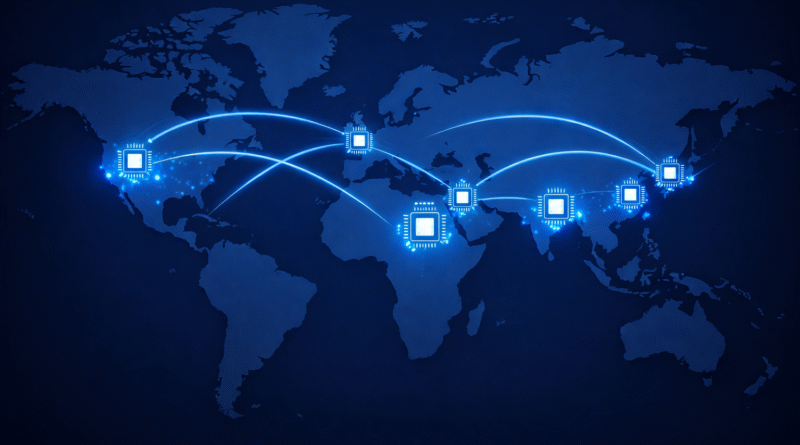
Think of Pax Silica as an economic NATO for the technology age. Member countries commit to building supply chains for critical technologies chips, minerals, AI infrastructure among trusted, democratic partners. The unstated but unmistakable goal: reduce dependence on China.
The initiative covers what its architects call the full silicon stack:
- Critical minerals rare earths and metals needed to make chips and batteries
- Semiconductor fabrication the fabs that actually manufacture chips
- AI systems and infrastructure data centres, software, and deployment networks
The United States launched Pax Silica in late 2025. By early 2026, it had pulled in some of the world’s most important technology nations.
Who Are the Other Members?
| Country | What They Bring | Why They Matter |
| India | Critical minerals, engineering talent, semiconductor ambitions, large domestic market | Largest democracy; Indo-Pacific anchor; growing chip manufacturing base |
| Japan | Advanced semiconductor tech (TSMC partner), precision manufacturing, R&D depth | Trusted US ally; critical to Asia supply chain resilience |
| South Korea | Home to Samsung, SK Hynix — global DRAM and NAND leaders | Indispensable to global memory chip supply |
| United Kingdom | AI research, financial services tech, Five Eyes intelligence alignment | Post-Brexit push for tech partnerships; strong regulatory credibility |
| Israel | Cybersecurity, chip design (Intel’s R&D hub), AI startups | Small but outsized tech footprint; deep US military-tech ties |
India becomes the tenth signatory. Its entry is also arguably the most geopolitically significant, given its size, its position in the Indo-Pacific, and its complicated history of balancing between the US and Russia.
Why Did India Join Now?
The timing is not accidental. India’s decision to join Pax Silica came weeks after a reset in India-US relations that had grown strained through 2025.
The friction had a specific cause: India kept buying discounted Russian crude oil even as the US pressured it to stop. Washington responded with a 25 percent tariff on Indian goods, on top of existing reciprocal tariffs of 25 percent. That added up to a 50 percent effective tariff wall a serious blow for Indian exporters in sectors like textiles, leather, and seafood.
The reset came in early 2026. India agreed to curb Russian oil imports, and the US agreed to drop the additional 25 percent levy and reduce reciprocal tariffs from 25 percent to 18 percent. An interim trade deal followed. Both sides were looking for a symbolic win to cement the reset, and Pax Silica provided exactly that.
But the motivations go deeper than optics.
What Does India Actually Get from Pax Silica?
India’s semiconductor ambitions have been building for years. The government has pushed hard to attract chip manufacturers, offering production-linked incentives and talking up India as an alternative to China-dominated supply chains.
The problem is that semiconductor manufacturing is extraordinarily capital-intensive and technically demanding. No company makes that bet without confidence in a country’s reliability as a partner. Joining Pax Silica sends exactly that signal.
More concretely, membership means:
- Access to US-led supply chain partnerships shared standards, co-investment frameworks, and technology-sharing among trusted partners
- A seat at the table as the rules for AI and semiconductor governance are written rather than being a rule-taker
- Strengthened position in attracting foreign direct investment from companies wanting to build in a Pax Silica-compliant country
- Critical mineral cooperation India has significant deposits of materials essential for chips and batteries, and Pax Silica provides a framework to develop them with allied partners
The China Angle
Pax Silica is explicitly designed to reduce what its founders call weaponised dependency the risk that any country can be coerced by cutting off access to critical technology inputs.
Today, China dominates multiple points in the semiconductor supply chain: raw material refining, assembly and testing, and a growing share of chip design. A country dependent on Chinese supply chains for critical technology inputs is, in the view of Pax Silica members, strategically exposed.
For India, this is a familiar argument in a new domain. India already participates in the Quad, which has a significant technology and supply chain component. Pax Silica takes that further, adding a formal commitment to building alternative supply chains.
India walks a careful line here. It has not explicitly framed Pax Silica as anti-China. New Delhi’s diplomatic tradition is to avoid joining alliances that look explicitly adversarial. But the strategic logic is clear to everyone involved.
What About India’s Strategic Autonomy?
This is the obvious tension. India has long prided itself on not being permanently aligned with any single power. It buys Russian weapons and oil. It participates in Chinese-led forums like BRICS and the Shanghai Cooperation Organisation. It balances.
Critics will argue that joining Pax Silica tilts India toward the US in ways that could constrain its future choices. If the alliance deepens, will India face pressure to align on semiconductor export controls, AI governance standards, or technology standards that it had no hand in designing?
The counterargument and the one Indian officials will make is that strategic autonomy cannot mean strategic irrelevance. A world in which the US, Japan, South Korea, and Europe set the rules for AI and chips while India sits out is not a world that serves Indian interests. Better to be inside shaping the rules than outside accepting them.
Whether that logic holds up over time depends on how much genuine influence India wields within Pax Silica and how much its own domestic semiconductor and AI ecosystem develops.
What This Means for India’s Tech Sector
For India’s electronics and semiconductor industry, the near-term implications are positive. Pax Silica membership signals to global companies that India is a serious player in allied supply chains. That matters for companies making location decisions about chip packaging, assembly, and eventually fabrication facilities.
India’s critical mineral sector also gets a boost. The country has significant reserves and some refining capacity in minerals that Pax Silica specifically targets. Those assets now have a clearer pathway to becoming part of allied supply chains rather than competing purely on price in a market dominated by Chinese processing capacity.
For AI, the impact is longer-term. Pax Silica’s AI infrastructure pillar is about ensuring that AI data centres, software stacks, and governance frameworks are developed among trusted partners. India’s large pool of engineering talent becomes a significant asset in this context.
The Bottom Line
Pax Silica is not just a trade arrangement. It is a signal about which side of the great technology divide India is choosing to stand on. That does not mean India is abandoning its balancing tradition it will continue buying Russian oil to some extent, continue engaging with China on trade, and continue insisting on its independent voice in global forums.
But the direction is clear. When the US ambassador to India describes Pax Silica as defining the 21st century economic and technological order, and when India signs on, something has shifted. The question is whether India can extract real value from that membership in investment, in technology access, in supply chain resilience rather than simply providing the numbers for someone else’s coalition.
That is the story worth watching.
Amit Mangal writes on India’s foreign policy and geopolitics at ThirdPol. Follow ThirdPol on X and LinkedIn.
Pingback: H-1B Visa India 2026: What Trump's Programme Review Means for Indians