What Is the Line of Actual Control? The India-China Border Explained
The Line of Actual Control is the most consequential border dispute in the world that most people cannot locate on a map. It is a 3,488-kilometre line that neither India nor China has fully agreed upon, patrolled by tens of thousands of soldiers on both sides at altitudes between 4,000 and 5,400 metres, and periodically the site of the kind of violence rocks, clubs, fists, then guns that two nuclear-armed states should not be experiencing. Understanding why this border exists, why it cannot be resolved easily, and what the 2024 patrolling agreement actually accomplished is essential for anyone trying to understand India-China relations in 2026.
Why the LAC Exists: The Unfinished Business of 1962
The LAC exists because the 1962 Sino-Indian War ended in a ceasefire but not a peace treaty. When Chinese forces advanced deep into Indian-claimed territory in October 1962 and then withdrew unilaterally in November, they left behind a changed physical reality on the ground and a disputed political reality in the maps. Neither side agreed on what the boundary was before the war. Neither side agreed on what it was after the war. The term “Line of Actual Control” was first used by Chinese Premier Zhou Enlai in a 1959 letter to Nehru referring to the line the two sides actually controlled, as opposed to the line either side claimed. It was adopted as the operative description in the 1993 border agreement, and it has functioned as India-China’s de facto boundary ever since.
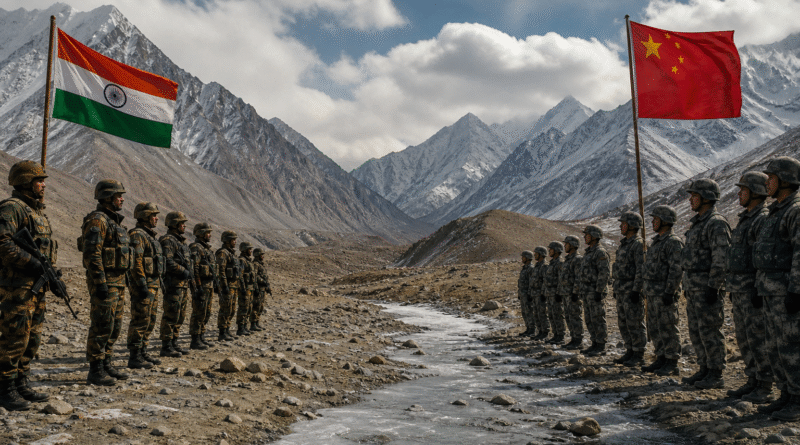
The problem is that “actual control” is itself disputed. Each side patrols different alignments in contested areas. Where India’s patrol goes and where China’s patrol goes do not match and in some areas, the patrols overlap, creating the face-off situations that have become routine on the LAC. The Galwan Valley clash of June 2020 was the most lethal of these face-offs, but not the only one. Doklam (2017), Depsang (2013), Demchok (multiple years) the LAC produces face-offs in cycles.
The Three Sectors and Their Disputes
The Western Sector is the most volatile. It covers Ladakh India’s northernmost union territory and is where all major recent disputes have occurred. Depsang Plains: China has blocked Indian patrols from accessing five traditional patrol points (PP10, PP11, PP11A, PP12, PP13) at the “Bottleneck” since 2020. Demchok: village near the LAC where China disputes the river alignment that determines the boundary. Galwan Valley: site of the 2020 clash. Pangong Tso lake: finger areas 4-8 where China advanced in 2020 before partial disengagement.
The Middle Sector covers Himachal Pradesh and Uttarakhand. It is the shortest and least disputed sector approximately 545 km. Disputes exist but have not produced major clashes. The Eastern Sector is the most strategically significant from China’s perspective. It covers Arunachal Pradesh which China claims entirely as “South Tibet” and Sikkim. The Tawang area in Arunachal is particularly sensitive: China launched its 1962 war in part to capture Tawang.
What the 2024 Patrolling Agreement Actually Resolved
The October 2024 agreement ahead of the Kazan BRICS summit was significant but limited. India restored patrol rights at Depsang Plains its soldiers can now access the five patrol points blocked since 2020. Demchok’s tensions were also reduced through local commander-level arrangements. Buffer zones established after 2020 in certain areas were adjusted.
What the agreement did NOT resolve: the underlying sovereignty dispute at any of these locations, the fundamental question of where the LAC actually runs, China’s claim to Arunachal Pradesh, the infrastructure competition where India is building roads and China is building “model villages” on its side of the perceived LAC, or the larger India-China strategic competition that makes LAC management so difficult. The 2024 agreement is a de-escalation, not a resolution.
ThirdPol’s Take
The LAC will not be resolved in any of our lifetimes through a final border treaty. The conditions for a permanent agreement mutual recognition of territorial realities, a peace treaty framework, and a change in the political incentives that make territorial concession domestically toxic for both governments do not exist and will not be created easily. What India and China can do and what the 2024 agreement represents is manage the LAC so that face-offs are resolved at the local commander level before they become political crises. That management requires sustained diplomatic investment, military-to-military communication protocols, and a shared interest in not letting border incidents derail the trade and economic relationship. All three of those conditions currently exist. They are fragile. The LAC will test them regularly.
By Amit Mangal | ThirdPol | May 1, 2026