Kashmir Rail Link Economy: One Year Of USBRL
A year is enough time to know whether an infrastructure project actually changes an economy or just makes for a good inauguration photo. The Kashmir rail link economy is now old enough to answer that question with real numbers rather than promises. Prime Minister Narendra Modi dedicated the Udhampur-Srinagar-Baramulla Rail Link to the nation on June 6, 2025, closing out a project first sanctioned in 1994-95 and delayed for nearly three decades. As of this month, the Railways Ministry says the fully commissioned line is providing genuine all-weather connectivity to the Kashmir Valley, opening what officials describe as new market access for farmers and small businesses that simply did not exist before.
What USBRL Actually Is, In Plain Terms
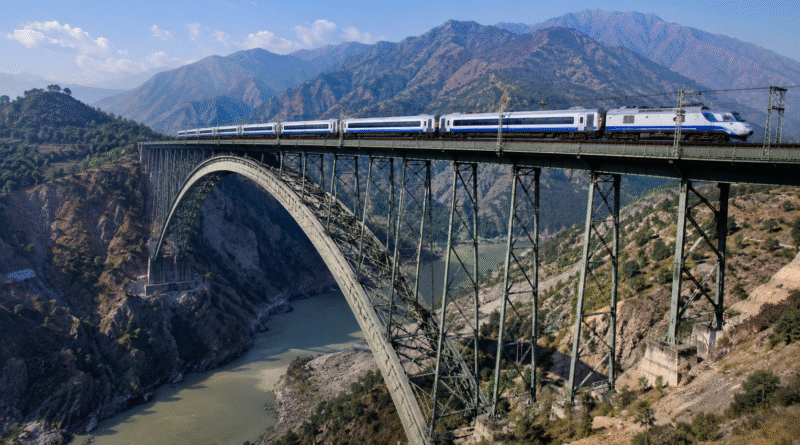
The numbers behind the project explain why it took so long. USBRL runs 272 kilometres from Udhampur to Baramulla, built at a cost of roughly 43,780 crore rupees, and required 36 tunnels totalling 119 kilometres along with 943 bridges cut through some of the most difficult Himalayan terrain in the country. The centrepiece is the Chenab Rail Bridge, the world’s highest railway arch bridge at 359 metres above the riverbed, taller than the Eiffel Tower, engineered to withstand wind speeds up to 260 kilometres an hour in an active seismic zone. The Anji Khad Bridge nearby is India’s first cable-stayed railway bridge. Construction reportedly generated over 5 crore man-days of employment and built 215 kilometres of approach roads along the way, work that mattered locally well before the first train ever reached Srinagar.
The Kashmir Rail Link Economy, One Year In
What makes this project worth revisiting a year later is the word all-weather. Before USBRL, the only road connecting the Kashmir Valley to the rest of the country ran through the Jawahar Tunnel on the Srinagar-Jammu highway, a route regularly shut for days at a time by landslides and heavy snowfall, cutting off the Valley’s farmers and traders from national markets during exactly the seasons when perishable produce needed to move fastest. A functioning rail line that operates through winter conditions changes that calculation entirely, and it is precisely this shift that Railways Minister Ashwini Vaishnaw pointed to this month when describing the line’s effect on farmers and small and medium enterprises seeking better market access.
Kashmir’s economy leans heavily on horticulture, apples above all, along with saffron, walnuts, and handicrafts, goods where spoilage risk and delivery time directly determine what a farmer or artisan actually earns. A rail corridor that keeps running when the highway does not gives producers a second route to national markets during the exact weeks a single closed road previously meant unsold, rotting stock. The Vande Bharat Express services Modi flagged off between Katra and Srinagar on the same day as the dedication were framed around tourism and pilgrimage traffic, but the freight implications for horticulture exporters matter just as much to the underlying Kashmir rail link economy, even if they get less attention in the coverage.
The Part That Still Needs Watching
A single successful engineering project does not automatically translate into full economic transformation, and it is worth being honest about what has not yet been demonstrated. Freight volume data specific to USBRL, actual tonnage of apples, saffron, or handicrafts moved by rail rather than road, has not been published in detail as of this writing, which makes it hard to independently verify how much of the market access officials describe has actually materialised versus how much remains potential rather than realised gain. The current passenger service level, historically around 19 special train services across the Baramulla-Banihal-Budgam stretch, also constrains how much freight capacity is genuinely available until service frequency scales up to match demand.
There is also the broader context of how USBRL fits into India’s wider infrastructure push. The project sits within the same PM GatiShakti framework that has evaluated 396 infrastructure projects worth roughly 207 billion dollars nationally, with public capital expenditure rising to 12.22 lakh crore rupees in the 2026-27 budget, an 11.5 percent increase over the prior year. USBRL is a genuine engineering achievement inside that broader push, but it is one data point, not proof that India’s infrastructure execution problems, the same kind that have left the National Highways Authority of India well behind its FY27 road award targets elsewhere in the country, have been solved.
Why This Matters Beyond Kashmir
The Kashmir rail link economy is worth watching not just for what it does locally, but as a test case for a broader argument India’s infrastructure planners have been making for years: that connectivity itself is an economic policy, not merely a convenience. If USBRL genuinely lifts farmer incomes and small enterprise access to markets over the next few years, it becomes a template for how India justifies expensive, decade-spanning infrastructure investment in difficult terrain elsewhere, from the Northeast to the Himalayan border regions where similar connectivity gaps persist. If the promised gains stay mostly rhetorical, it becomes a cautionary tale about the gap between an impressive ribbon-cutting and the years of freight data needed to prove an infrastructure project actually changed how an economy functions. One year in, the honest answer is that USBRL has cleared the engineering test decisively. Whether it clears the economic one is still being written, one harvest season at a time.
Key Points
- USBRL: Udhampur-Srinagar-Baramulla Rail Link, 272 km, sanctioned 1994-95, declared a National Project in 2002.
- Fully dedicated to the nation by PM Modi on June 6, 2025, after the final Sangaldan-Katra section was completed.
- Cost: ~Rs 43,780 crore; includes 36 tunnels (119 km total) and 943 bridges.
- Chenab Rail Bridge: world’s highest railway arch bridge, 359m above riverbed, built to withstand winds up to 260 km/h in Seismic Zone 5.
- Anji Khad Bridge: India’s first cable-stayed railway bridge, 331m high, supported by 48 cables.
- T-49 tunnel: India’s longest transportation tunnel, 12.75-12.77 km.
- USBRL construction generated 5+ crore man-days of employment; 215 km of approach roads built.
- August 2026 update (Railways Ministry): USBRL cited as providing all-weather connectivity, improving market access for Kashmir’s farmers and SMEs.
- Fits within PM GatiShakti framework: 396 infrastructure projects evaluated nationally, worth ~$207 billion; FY27 capex up 11.5% to Rs 12.22 lakh crore.
By Amit Mangal | ThirdPol | August, 2026