India US Trade Deal: The Last 1% and the July Drop-Dead Date
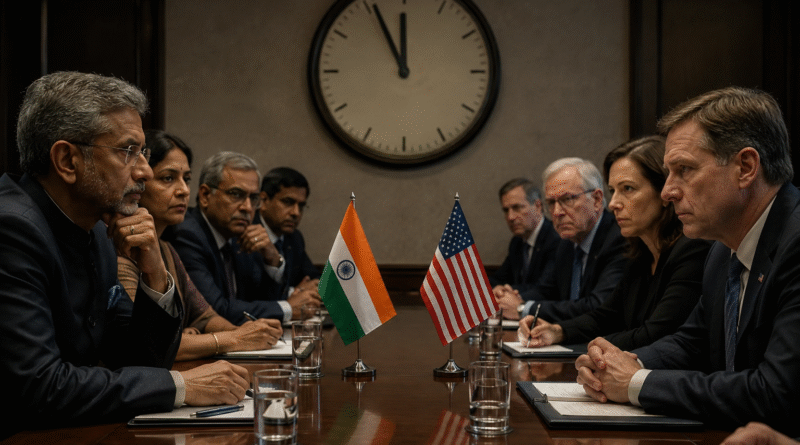
The India US trade deal has been described as imminent, near-final, or just around the corner for most of 2026. Now, for the first time, there is a concrete countdown attached to those phrases. US Ambassador to India Sergio Gor said on Friday, May 29, that a team from the US Trade Representative’s office is arriving in New Delhi on June 1 to work through “the last one per cent” of the agreement. An Indian negotiating team had already visited Washington the previous week for the same purpose. Both sides are operating under a shared and privately acknowledged deadline: if the deal is not done by end-July 2026, India risks losing the tariff advantage it has been negotiating for over a year.
From Tariff War to Framework: The Rocky Road Here
The journey to this point has been anything but smooth. The story begins in the first weeks of the Trump administration, when India became the first country to launch formal bilateral trade agreement talks with Washington. By April 2025, however, the relationship had cratered. Trump imposed an additional 26 percent reciprocal tariff on Indian goods, then suspended it for 90 days. When India continued buying Russian crude oil, a further 25 percent levy was added, taking the total tariff burden on some categories of Indian exports to 50 percent. India publicly called the move “unfair, unjustified, and unreasonable.” The February 2026 framework agreement, announced jointly by Modi and Trump during a Modi White House visit, brought the headline rate down to 18 percent but it was a framework, not a signed deal. The last 1 percent, it turns out, is where the hardest bargaining lives.
What Is Actually in the Last 1%
What is actually inside that last 1 percent? Based on statements from negotiators on both sides and analysis from trade specialists, several issues remain live. The most contentious is the agricultural access question: Washington wants India to reduce import barriers on American farm products including dairy, poultry, and genetically modified crops. India has protected its agricultural sector with near-religious consistency across every administration and is unwilling to allow US farm products to flood a market where over 40 percent of the workforce is employed. The second sticking point is the Section 301 investigation the USTR has opened into Indian trade practices covering manufacturing overcapacity, labour standards, and market access barriers. India wants this investigation closed or at least frozen as part of any deal; Washington has been reluctant to formally link the two.
The Court Curveball
A third complication has emerged from an unexpected direction: American courts. In May 2026, the US Court of International Trade invalidated the broad reciprocal tariff framework under the International Emergency Economic Powers Act (IEEPA), ruling that the law did not grant the administration authority to impose wide-ranging import tariffs. The Supreme Court ruling from February 2026 had already created legal uncertainty around the tariff architecture. India’s negotiators are now reassessing what tariff commitments they actually need to make in exchange for what relief, since the legal basis for the tariffs they were negotiating against may itself be unstable. The 10 percent baseline tariff under Section 122 of the Trade Act of 1974 — the fallback mechanism Washington has been using expires in July, which is partly why end-July has become the natural deadline.
The Drop-Dead Date and What It Means for Indian Exporters
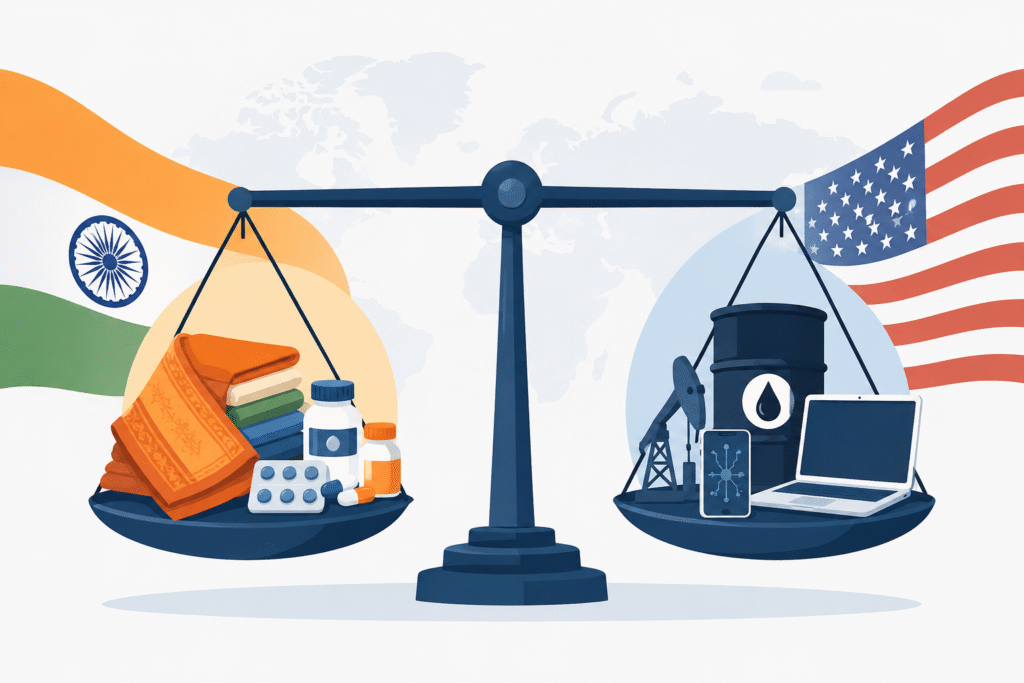
Mark Linscott, a senior fellow at the US-India Strategic Partnership Forum and former senior USTR official, has been unusually blunt about the stakes. The “drop-dead date is clearly end of July,” he said in a recent interview, warning that India risks being left with a higher tariff rate than competitors like Vietnam, Bangladesh, and Pakistan if talks drag beyond that point. India’s tariff in the current interim arrangement sits at 18 percent slightly better than Pakistan’s 19 percent and Vietnam’s 20 percent. But those numbers could shift if competitor nations conclude their own deals first. The commercial calculus is stark: the US is India’s largest export destination, accounting for roughly 22 percent of India’s total merchandise exports. Textile mills in Surat, gem cutters in Jaipur, leather goods manufacturers in Agra, and pharmaceutical companies across India all have skin in this negotiation.
The Geopolitics Behind the Trade Numbers
The geopolitical dimension of the India US trade deal is as important as the commercial one. The deal is not being negotiated in isolation. It is happening alongside the Quad foreign ministers’ meeting just concluded in New Delhi, Modi’s impending White House visit (invited formally by Rubio during his India trip), and a broader recalibration of the US-India strategic relationship that went badly off track in 2025. The Trump administration views India’s commitment to reduce Russian oil purchases as both an economic and strategic concession it deprives Moscow of revenue and pushes India closer to American energy suppliers. From India’s side, the deal is partly about protecting its manufacturing sector at a critical moment, when the government is trying to attract global supply chains relocating out of China under its Production Linked Incentive scheme.
Pharmaceuticals: An American Problem Too
The pharmaceutical sector deserves special attention. India supplies roughly 40 percent of generic medicines consumed in the United States. The February 2026 White House joint statement included a commitment to remove the reciprocal tariff on generic pharmaceuticals subject to the successful conclusion of the Interim Agreement meaning Indian pharma exporters are directly waiting on this deal to close. Any delay or collapse of negotiations would hit American consumers as much as Indian manufacturers, since US drug prices for generics would rise if Indian suppliers faced punitive tariffs.
Commerce Minister Piyush Goyal has told industry associations that the interim agreement is close. The negotiating team on India’s side is led by Special Secretary Rajesh Agrawal, who has been shuttling between New Delhi and Washington since early 2025. The USTR’s chief negotiator Brendan Lynch leads the American delegation arriving on June 1. Neither side has formally confirmed what the June 1-4 sessions will produce, but Ambassador Gor’s public statement that the deal will be signed “over the next few weeks and months” is about as close to a pre-announcement as diplomatic language permits. The India US trade deal, if concluded, would be the most significant bilateral economic agreement India has signed since the India-EU FTA of January 2026 and a far more consequential one for India’s manufacturing exporters.
Key Points
- India-US Bilateral Trade Agreement (BTA): negotiations launched February 13, 2025. Target boost bilateral trade to $500 billion by 2030 from current ~$220 billion.
- February 2026 Framework: Trump reduced tariffs on Indian goods from 50% to 18% after India committed to cease Russian oil imports and pledged $500B in US purchases. Headline tariff: 18% (vs Pakistan 19%, Vietnam 20%, Bangladesh 20%).
- USTR team arriving New Delhi June 1-4 to finalise the ‘last 1%’ of the interim trade agreement; Indian team already visited Washington the previous week.
- Drop-dead date: end of July 2026, per USISPF advisor Mark Linscott, the Section 122 baseline tariff expires in July, and competitor nations are also negotiating deals.
- Key unresolved issues: US agricultural market access (dairy, poultry, GMO crops); Section 301 USTR investigation into Indian trade practices; digital trade and IPR provisions.
- Court rulings complicate the deal: US Court of International Trade invalidated broad IEEPA tariff framework in May 2026; US Supreme Court also created legal uncertainty in February 2026. India is reassessing its negotiating position.
- India-US pharmaceutical dependence: India supplies ~40% of generic medicines to the US. White House joint statement (Feb 2026) linked pharma tariff removal to successful conclusion of interim deal.
- Sectors seeking relief: textiles (Surat), gems and diamonds (Jaipur), leather (Agra), pharmaceuticals, organic chemicals, home décor, and aircraft parts.
- PL Scheme (Production Linked Incentive): India’s PLI scheme aims to attract global supply chains relocating out of China. A concluded trade deal with the US would significantly accelerate PLI inflows.
By Amit Mangal | ThirdPol | May 2026