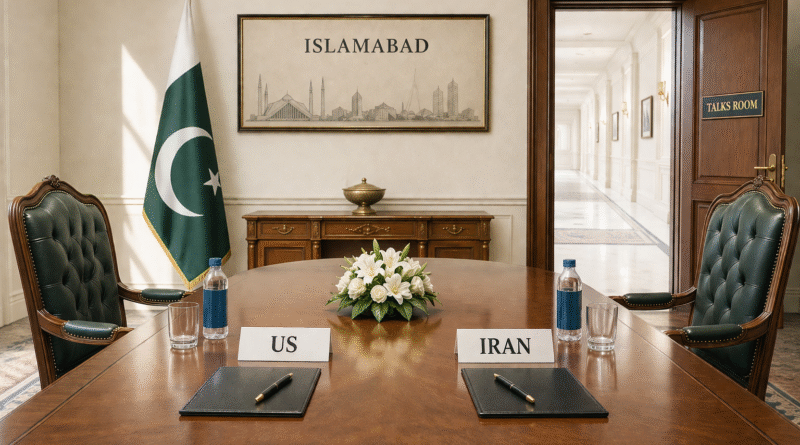
Iran Talks Failed 2026: Araghchi Left Islamabad, Trump Cancelled the Mission What Now?
The Iran talks failed 2026 story has reached its most dangerous point yet. On Saturday morning, Iranian Foreign Minister Abbas Araghchi left Islamabad without meeting a single American official. The White House had announced on Friday that Jared Kushner and Steve Witkoff would fly to Pakistan on Saturday to resume direct engagement with the Iranians after the Islamabad talks collapse of April 12-13. Iran’s Foreign Ministry denied any meeting was planned. Araghchi arrived, met Pakistani mediators, and left. Trump’s response came hours later on Truth Social: he had told the US team not to travel. The ceasefire extended just days ago on the basis that Iran’s “seriously fractured” government needed time to produce a unified proposal now has no diplomatic process attached to it. The only mechanism that was working, Pakistan’s mediation, has produced two successive failures in two weeks. War resumption is no longer a distant threat. It is the default outcome if nothing changes in the next 72 hours.
What Happened This Morning: The Sequence
The collapse of the second Islamabad round was faster and more complete than the first. On April 12-13, at least the two sides were in the same building for 21 hours before Vance left. This time, they never got within the same city at the same time.
On Friday, White House Press Secretary Karoline Leavitt confirmed to Fox News that Witkoff and Kushner “will be off to Pakistan again tomorrow morning to engage in talks.” She added that Vance would be on standby to fly to Pakistan if talks progressed, and that the White House had “seen some progress from the Iranian side in the last few days.” That last claim some progress was the signal that intelligence or back-channel communication had produced enough movement to justify a second attempt.
Iran’s position was the opposite. Foreign Ministry spokesperson Esmaeil Baghaei posted on X that “no meeting is planned to take place between Iran and the US.” Semi-official news agencies Tasnim and Nournews the latter affiliated with Iran’s Supreme National Security Council both confirmed there were no negotiations with Americans on the agenda. Araghchi flew to Islamabad anyway, met Pakistani PM Shehbaz Sharif and FM Ishaq Dar for several hours, conveyed Iran’s position to be passed to the Americans, and departed for Muscat.
Trump’s Truth Social post followed Araghchi’s departure: he had told Kushner and Witkoff not to travel. The quote being circulated was characteristically blunt: “Too much time wasted on traveling.” Vance, who had been on standby, did not board a plane. The second Islamabad round was over before it began.
Why Iran Would Not Meet: The Four Reasons
The Iran talks failed 2026 situation is not simply Iranian stubbornness. Four specific and structural reasons explain why Araghchi could not sit across from Kushner and Witkoff on Saturday even if he wanted to.
The first is the trust deficit created by the blockade. Iranian officials have said explicitly they cannot trust a negotiating partner whose navy is simultaneously seizing Iranian ships in the Indian Ocean and turning back 34 vessels from Iranian ports. From Tehran’s perspective, you cannot negotiate a ceasefire with someone who is actively enforcing a war instrument the naval blockade during the talks. The US position is that the blockade is a pressure tool to bring Iran to the table. Iran’s position is that you cannot talk with someone while they are strangling your economy. Both positions are internally consistent. Neither creates space for a meeting.
The second is Mojtaba Khamenei’s continued invisibility. The Supreme Leader has not appeared publicly since his election on March 9. He has not authorised a negotiating framework that Araghchi could bring to Islamabad. Without the Supreme Leader’s explicit backing for a position, Araghchi cannot make commitments — and without commitments, a meeting is just a photo opportunity that exposes Iran to domestic accusations of capitulation without producing anything in return.
The third is Qalibaf’s position. Mohammad Bagher Qalibaf Speaker of Iran’s Parliament, who led the Iranian delegation in the first Islamabad round reportedly grew so frustrated with the infighting in Iranian leadership after the April 12-13 collapse that he threatened to step aside. A US official confirmed to Axios that Vance did not travel this time specifically because Qalibaf, his counterpart, would not travel with Araghchi. The Iranian delegation has no unified leadership. Araghchi and Qalibaf represent different factions with different red lines. Without agreement between them, Iran cannot produce the “unified proposal” that Trump demanded as the condition for the ceasefire extension.
The fourth is the Moscow factor. Araghchi is now travelling from Muscat to Moscow. Russia has been a consistent voice telling Iran not to capitulate to American demands and the Moscow stop suggests Iran is consulting with its most important strategic backer before committing to any framework. Russia’s interests are served by a prolonged Iran-US conflict that ties down American military attention and drives up oil prices that fund Russia’s war economy. Russian advice to Iran is unlikely to be “accept Trump’s terms quickly.”
What Trump’s “Too Much Time Wasted” Actually Signals
Trump’s cancellation of the Kushner-Witkoff trip and his “too much time wasted on traveling” language is being read in two very different ways by analysts watching the Iran war.
The optimistic reading is that Trump is applying maximum pressure signalling that his patience is genuinely finite, that Iran cannot indefinitely use ceasefire extensions to buy time without producing a proposal, and that the next step is military resumption. In this reading, the cancellation is a negotiating move designed to force Iran to make a substantive offer within hours. Qatar is reportedly pushing for an agreement and spoke to Trump on Friday. Oman, where Araghchi is stopping, has historically served as the back-channel between the US and Iran. The Muscat stop may be precisely where the back-channel delivers a position that makes a third Islamabad round possible within days.
The pessimistic reading is that the diplomatic process has genuinely broken down and Trump is preparing domestic opinion for a return to strikes. His stated willingness to “be bombing again in the near term” has been consistent since the ceasefire was extended. General Caine’s statement on April 25 that US Central Command remains “prepared to resume major combat operations if ordered by the President” was not rhetorical. The US military maintained its combat posture throughout the ceasefire. A return to strikes does not require significant preparation it requires a presidential decision.
The honest assessment sits between these two readings. Trump does not want a resumed war the Iran operation has been costly in terms of munitions, carrier group deployment time, and political attention. But he also cannot be seen to be endlessly extending a ceasefire while Iran stalls. The 72-hour window that now exists before the Islamabad failure becomes an irreversible diplomatic collapse is the moment where either Oman produces something from Araghchi’s Muscat stop, or Pakistan’s Dar and Sharif call Trump personally again to buy more time, or the US resumes strikes and the ceasefire is formally over.
What This Means for India Right Now
For India, the Iran talks failed 2026 development is the worst possible combination of events in a single morning. The diplomatic track that was keeping the ceasefire alive however tenuously has collapsed for the second time. Oil prices have moved sharply on the news. LPG supply chains are back in uncertainty. The Indian Ocean dark fleet operations that ThirdPol reported yesterday continue. And Araghchi’s Moscow visit means Russia is now being consulted on the Iranian position adding a Russia variable to an already complex US-India relationship management challenge.
India’s MEA has not responded publicly to the second Islamabad collapse as of this writing. The silence is becoming harder to justify. Every time the Iran diplomatic process collapses, India’s energy security deteriorates, its Chabahar investment becomes more remote, and its position as a reliable “voice of restraint” loses credibility because its restraint is producing no influence on the outcome. India is a BRICS chair, a G20 alumnus, a country with relationships with all parties including Russia and Oman. If there was ever a moment for India to activate those relationships and offer a specific constructive proposal not just calls for dialogue this is it. The window is 72 hours.
ThirdPol’s Take
The Iran talks failed 2026 moment is the most dangerous since the original February 28 strikes. At every previous crisis point the first Islamabad collapse, the ceasefire extension, the dark fleet Indian Ocean expansion there was a visible diplomatic thread to pull. This morning, there is none. Araghchi is in a plane to Muscat. Trump is on Truth Social. The ceasefire has no attached diplomatic process. Pakistan’s credibility as a mediator is taking its second consecutive hit. What makes this moment specifically different from the previous collapses is Araghchi’s Moscow stop. If Russia advises Iran to hold firm which is Russia’s rational interest given that high oil prices fund its war economy Iran will not produce a proposal that the IRGC hardliners will accept. The Muscat-Moscow-Islamabad sequence suggests Iran is building a diplomatic coalition to resist rather than accommodate. That is not the pattern of a government preparing to submit a “unified proposal” to Trump. The 72-hour window is real. Watch Oman.
By Amit Mangal | ThirdPol | April, 2026