India ASEAN Relations 2026: Why the Maritime Year Matters More Than It Looks
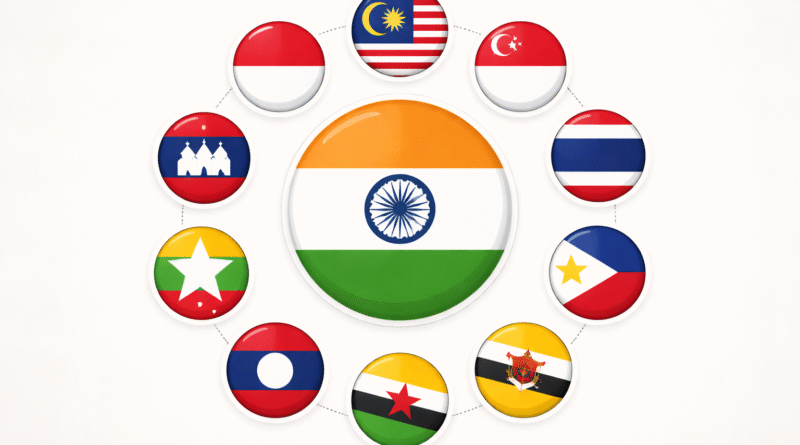
India ASEAN relations 2026 have entered their most consequential phase since the partnership was upgraded to a Comprehensive Strategic Partnership in 2022. In October 2025, PM Modi declared 2026 as the “ASEAN-India Year of Maritime Cooperation” a designation that, on the surface, sounds like a routine diplomatic milestone. But the timing, the context, and the strategic pressures shaping both India and ASEAN tell a different story. With China aggressively expanding its footprint in the South China Sea and the Indian Ocean, with the US under Trump pulling back from its traditional role as Indo-Pacific guarantor, and with India simultaneously managing an Iran war energy crisis and a neighbourhood reset, ASEAN has quietly become one of India’s most important strategic relationships. Understanding what India actually wants from ASEAN and what ASEAN wants from India is the real story behind the 2026 maritime year.
How India ASEAN Relations 2026 Arrived Here: A Timeline
| Year | Milestone |
| 1992 | India becomes ASEAN Sectoral Dialogue Partner. Beginning of Act East (then Look East) Policy under PM Narasimha Rao. |
| 1996 | India becomes ASEAN Full Dialogue Partner. |
| 2012 | India-ASEAN relationship elevated to Strategic Partnership at Phnom Penh Summit. |
| 2014 | Modi upgrades India’s Look East Policy to Act East Policy. ASEAN declared central pillar of the new framework. |
| 2018 | India-ASEAN Commemorative Summit in New Delhi. Leaders of all 10 ASEAN states were Republic Day chief guests. |
| 2022 | India-ASEAN relationship elevated to Comprehensive Strategic Partnership. |
| Oct 2025 | Modi at 22nd ASEAN Summit (Kuala Lumpur). Declares 2026 as ASEAN-India Year of Maritime Cooperation. |
| 2026 | ASEAN-India Year of Maritime Cooperation. India-ASEAN Plan of Action 2026-2030 launched. AITIGA review ongoing. |
India ASEAN Relations 2026: What the Maritime Year Actually Means
When Modi declared 2026 as the Year of Maritime Cooperation, he was making a statement about geography and strategy, not just diplomacy. India and ASEAN together sit astride some of the most critical waterways in the world the Malacca Strait, through which 30% of global maritime trade passes; the Andaman Sea; the South China Sea; and the eastern Indian Ocean. Together, India and ASEAN’s combined GDP exceeds $3.6 trillion. Together they represent nearly one-quarter of the world’s population.
The maritime focus in India ASEAN relations 2026 is a direct response to China’s growing naval presence in both the South China Sea and the Indian Ocean. China has built artificial islands with military facilities in the Spratly Islands. It has established a naval base in Djibouti and negotiated basing access in several Indian Ocean states. The People’s Liberation Army Navy (PLAN) now regularly operates in waters that India and ASEAN countries consider their strategic neighbourhood.
The Year of Maritime Cooperation is India’s way of telling ASEAN: we are here, we are committed, and we share your concerns about who else is in these waters. The specific initiatives under the 2026 framework include joint naval exercises, maritime domain awareness sharing, blue economy cooperation, joint disaster relief operations, and maritime connectivity projects. None of these are new ideas but the formal designation of a cooperative year is meant to accelerate delivery and signal political will.
The China Variable in India ASEAN Relations 2026
China is the elephant in the room that structures every dimension of India ASEAN relations 2026, even when it is not mentioned by name. ASEAN’s approach to China is fundamentally different from India’s. ASEAN, as a group, practices what is sometimes called “hedging” maintaining good relations with both China and the United States while avoiding a forced choice between them. Individual ASEAN states have different positions: the Philippines under Marcos has been more assertive against China’s South China Sea claims, while Cambodia and Laos lean significantly toward Beijing.
India’s position is more adversarial. Since the Galwan clash of 2020, India has treated China as a strategic competitor rather than a partner. It has built border infrastructure, engaged with the Quad, and deepened defence ties with countries that share its China concerns. But India cannot export its China policy to ASEAN. Most ASEAN states trade more with China than with any other partner. They will not formally align against Beijing, and they will push back against any framing that forces them to choose sides.
What India can offer ASEAN is a credible alternative for defence cooperation, technology, and connectivity that does not come with the political dependencies that Chinese investment tends to create. The BrahMos missile — which India is selling to the Philippines — is a concrete example of this. Vietnam has expressed interest in BrahMos. Indonesia is deepening defence cooperation with India. India ASEAN relations 2026 are most effective when India leads with capability, not ideology.
India’s ASEAN Partners: Who Matters Most and Why
| Country | India relevance |
| Indonesia | India’s largest ASEAN trading partner. Key in Indian Ocean / Pacific connectivity. Hosts Malacca Strait traffic. |
| Vietnam | Shared China concerns. Strong defence interest in India’s BrahMos. Major manufacturing hub. |
| Singapore | Financial hub. Indian diaspora gateway. Critical for India’s tech and fintech expansion in ASEAN. |
| Philippines | South China Sea frontline state. Supported India’s UNCLOS position. Country coordinator for India-ASEAN. |
| Malaysia | 2025 ASEAN chair. Hosted 22nd Summit. Large Indian diaspora. Palm oil trade tensions. |
| Myanmar | India-Myanmar-Thailand highway route. Fragile since 2021 military coup. Instability affects India’s connectivity. |
| Thailand | Gateway to Mekong region. BIMSTEC overlap. India-Thailand-Malaysia highway. |
| Cambodia, Laos, Brunei | Smaller partners. China-leaning. Limited direct India bilateral weight. |
| Timor-Leste | Newest ASEAN member (2025). India-friendly. Strategic Indian Ocean position. |
The Trade Gap: India ASEAN Relations 2026’s Biggest Unresolved Problem
The most underdiscussed challenge in India ASEAN relations 2026 is the trade relationship and specifically how badly imbalanced it has become. India-ASEAN two-way trade reached approximately $122 billion in 2023-24, making ASEAN India’s fourth-largest trading partner. But India runs a trade deficit with ASEAN of roughly $43 billion annually. India imports far more from ASEAN primarily electronics, machinery, palm oil, and chemicals than it exports.
The India-ASEAN Trade in Goods Agreement (AITIGA), signed in 2009, is widely seen in India as having hurt domestic manufacturing by opening Indian markets to ASEAN goods without generating equivalent export opportunities. Indian industry has complained for years that non-tariff barriers in ASEAN markets effectively neutralise the tariff reductions India offered. Modi has called for a review of AITIGA and pushed for a new trade architecture that better serves Indian exporters.
The AITIGA review is ongoing in 2026 and is a direct test of whether India ASEAN relations 2026 can move beyond strategic symbolism into economic substance. If the review produces a revised agreement that genuinely opens ASEAN markets to Indian services, pharmaceuticals, textiles, and defence exports, the economic foundation of the partnership strengthens significantly. If it stalls as trade negotiations in this region often do the maritime year will look good on paper but feel hollow in practice.
India’s Act East Policy: Is It Working?
The Act East Policy, announced by Modi in 2014 as a rebranding and upgrade of the earlier Look East Policy, has produced measurable results over 12 years. India has signed free trade agreements with ASEAN (2009), Singapore (2005), Malaysia (2011), Japan (2011), and South Korea (2009). It has deepened defence cooperation with Vietnam, the Philippines, and Indonesia. It has connected Moreh in Manipur to Mae Sot in Thailand through the India-Myanmar-Thailand Trilateral Highway, though the project remains incomplete. It is investing in port infrastructure in Myanmar and connectivity projects across the Northeast.
But the honest assessment of India ASEAN relations 2026 in the context of Act East is that India has consistently under-delivered on connectivity compared to what China has achieved through Belt and Road Initiative projects in the same geography. China has roads, railways, and ports throughout mainland ASEAN Cambodia, Laos, Myanmar, and Thailand. India has proposals, partial completions, and policy frameworks. The intent has been right. The execution has been slower than the strategic moment requires.
The maritime year in India ASEAN relations 2026 is an opportunity to change that narrative to show ASEAN that India can deliver not just defence cooperation but also infrastructure, trade, and technology. India’s own economic growth, its semiconductor ambitions, its digital public infrastructure, and its pharmaceutical sector all represent genuine offerings. The question is whether the Act East framework can channel these into concrete ASEAN partnerships at the speed the moment demands.
ThirdPol’s Take
India ASEAN relations 2026 represent India’s best current opportunity to build strategic depth in a geography it actually has leverage in. Unlike the China relationship where India is managing a powerful adversary — or the Pakistan relationship where hostility defines the dynamic ASEAN is a partner that genuinely wants closer ties with India and is actively looking for alternatives to over-dependence on China. The maritime year, the AITIGA review, and BrahMos sales to the Philippines are all pieces of this. What India needs to add is the economic relationship that China has used so effectively not through debt traps, but through genuine trade and investment that creates interdependence. The 21st century may belong to India and ASEAN, as Modi said. But that claim will be made good by infrastructure contracts and export agreements, not by summit declarations.
Pingback: South China Sea 2026: Why India Cannot Afford to Be a Bystander