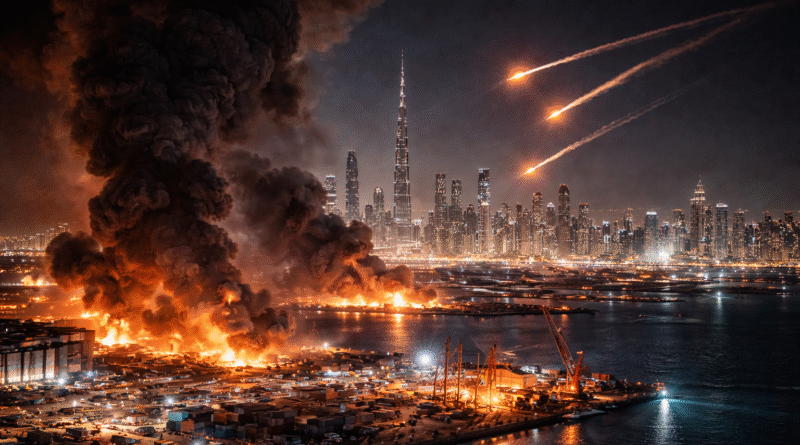
Why Iran Is Attacking Dubai: What Is Behind Tehran’s Strikes
The biggest question right now is simple: Why Iran is attacking Dubai and why does the UAE seem to be facing more pressure than other Gulf countries?
The answer is not limited to one reason. Iran’s focus on the UAE appears to come from a mix of military strategy, political anger, and symbolism. Dubai is not just another city in the Gulf. It is one of the most visible and internationally connected places in the region. So when Iran turns its attention toward the UAE, the message spreads far beyond the battlefield.
That is what makes this crisis so serious.
The UAE has become one of the clearest pressure points in the region. It is close to major conflict zones, strongly linked with the United States, open in its ties with the West, and deeply connected to trade, tourism, and global finance. For Iran, that makes it an effective target if the goal is to create fear, disruption, and political pressure all at once.
The UAE is one of America’s closest partners in the Gulf
A major reason behind the attacks is the UAE’s close security relationship with the United States. The country hosts key American military facilities, including Al Dhafra Air Base. That alone puts it in Iran’s line of sight.
Iran cannot easily strike the US mainland. So it appears to be targeting places in the region where American power has a visible presence. The UAE fits that role very clearly.
This is also why the question Why Iran is attack Dubai cannot be separated from Washington’s role in the conflict. From Tehran’s point of view, hurting the UAE means hurting an important US partner. It raises the cost for America’s allies and sends a warning to countries that stand too close to Washington during wartime.
Dubai’s global image makes every attack more powerful
Dubai has something many cities in the region do not. It has global visibility.
It is known as a city of luxury, tourism, business, shopping, aviation, and investment. Millions of people around the world know Dubai’s skyline, its airports, its hotels, and its reputation for safety. That reputation has real value.
This is where things become more serious. If Iran targets an isolated military site, the impact stays limited. But when the fear reaches Dubai, the whole world notices. News spreads faster. Tourists panic. Investors become cautious. Airlines react. Insurance risks rise. Markets start watching more closely.
So when people ask, Why Iran is attacking Dubai, one possible answer is that Dubai gives Iran a bigger psychological effect. Even limited disruption there can create a much louder global reaction.
The UAE’s economy is highly exposed
The UAE is not just a military partner of the US. It is also one of the most important economic hubs in the Gulf. Its ports, airports, logistics corridors, financial districts, and tourism centres make it extremely valuable.
That value also makes it vulnerable.
If ports come under threat, trade feels the shock. If airports face disruption, aviation suffers. If tourists begin to feel unsafe, the hospitality sector takes a hit. If global businesses lose confidence, the ripple effect can spread quickly.
Iran likely understands this very well. Attacking the UAE does not only create military tension. It also creates economic stress. Dubai represents business confidence, and once that confidence weakens, the pressure goes far beyond one city.
Iran may want to damage the UAE’s image of stability
For years, the UAE has built its identity around order, safety, and modern development. In a turbulent region, it has often presented itself as the place where life and business can continue without chaos.
That image is one of its biggest strengths.
But it is also a weak point in times of war. When drones, missile alerts, or visible damage begin to enter the public conversation, the emotional impact is strong. Even if much of the threat is intercepted, people remember the fear. They remember the footage. They remember the uncertainty.
Iran may not only be trying to hit physical targets. It may also be trying to crack the UAE’s carefully built image as a stable and secure destination.
Ties with Israel have made the UAE even more sensitive
The UAE’s relationship with Israel is another major factor. Since the Abraham Accords in 2020, the UAE has remained one of the most visible Arab countries to normalize ties with Israel.
Iran has never accepted that comfortably.
For Tehran, this was more than diplomacy. It was seen as a strategic alignment with a long-standing enemy. In a wider war involving Israel, that background becomes even more important.
So if someone asks, Why Iran is attacking Dubai, the answer may also lie in the UAE’s political choices over the past few years. Iran likely sees the country not just as a US-friendly Gulf state, but also as an Arab power that moved closer to Israel.
The UAE is smaller, concentrated, and easier to shake
There is also a practical reason. The UAE is geographically smaller and more concentrated than larger regional powers. Its key economic centres are tightly packed and highly visible. That means even a limited strike can create outsized fear and attention.
In a country like this, disruption is felt quickly.
Airspace closures, pressure on ports, or security concerns near famous areas can instantly become major headlines. That makes the UAE a high-impact target. Iran may believe that it can generate more pressure here with fewer attacks than it could elsewhere.
This is not only about revenge. It is also about messaging
The attacks also come in the shadow of deep anger after the killing of Ayatollah Ali Khamenei in US-Israeli strikes. Iran’s response clearly carries the weight of revenge.
But revenge alone does not explain everything.
Target selection usually reveals strategy. The UAE offers Iran a rare mix of military relevance, political symbolism, economic importance, and global visibility. It is close enough to strike, important enough to matter, and vulnerable enough to feel the pressure.
That is why this crisis looks so sharp in the UAE.
Why Iran Is Attacking Dubai More Than Other Gulf Cities
Dubai and the wider UAE give Iran the chance to create the greatest impact from each strike.
By targeting the UAE, Iran can pressure a close US partner, unsettle a country linked to Israel, disrupt trade and tourism, and shake one of the Gulf’s strongest images of safety and success.
That is what makes the UAE different in this conflict.
It is not just nearby. It is politically loaded, economically important, and globally watched. And in a war where perception matters almost as much as force, that makes Dubai and the UAE especially valuable targets for Tehran.
The Analysis Desk at ThirdPol analyses political and economic developments in Iran and their wider impact on West Asian geopolitics.