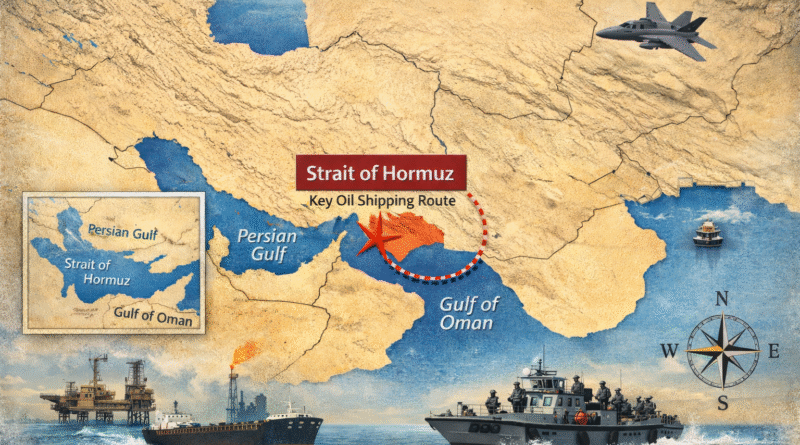
Strait of Hormuz: Why This Tiny Waterway Matters to the World
Tensions in West Asia are rising again. The ongoing conflict involving Israel and Iran has started to affect one of the most sensitive routes in global trade, the Strait of Hormuz.
Recent reports suggest that shipping traffic through the strait has dropped sharply. This has triggered fresh worries about global oil supplies and possible increases in fuel prices around the world.
To understand why the situation is serious, it helps to look at where the strait is located and why it matters so much.
Strait of Hormuz: Location and Strategic Importance
The Strait of Hormuz is a narrow water passage that connects the Persian Gulf with the Gulf of Oman and the Arabian Sea.
It lies between Iran in the north and Oman and the United Arab Emirates in the south.
At its narrowest point, the strait is only about 33 kilometres wide. For such a small stretch of water, it carries an enormous amount of global trade.
A huge portion of the world’s oil and gas moves through this route every day. Experts estimate that over 20 percent of global oil and gas supplies pass through the Strait of Hormuz.
This makes it one of the most important energy routes on the planet.
Several major oil-producing countries depend on this waterway to export their energy resources. These include:
- Saudi Arabia
- Iran
- Iraq
- Kuwait
- Qatar
Because so many countries rely on this passage, any disruption here quickly becomes a global concern. Even small tensions can affect shipping, insurance costs, and fuel prices worldwide.
Major Global Maritime Chokepoints
The Strait of Hormuz is not the only critical passage in global shipping. Around the world, a few narrow routes control a large part of international trade. These are often called maritime chokepoints.
Some of the most important ones include:
Strait of Malacca
A crucial route connecting East Asia with Europe and the Middle East.
Bab-el-Mandab Strait
Located at the entrance of the Red Sea and vital for trade between Europe and Asia.
Suez Canal
An artificial canal that links the Mediterranean Sea with the Red Sea. It significantly shortens the route between Europe and Asia.
Panama Canal
Connects the Atlantic Ocean with the Pacific Ocean and plays a major role in global shipping.
Bosphorus and Dardanelles Straits
These waterways connect the Black Sea with the Mediterranean.
Together, these chokepoints shape global trade routes. If even one of them faces disruption, the effects can be felt across the world.
Current Situation in the Strait of Hormuz
Recent developments in West Asia have made the situation in the Strait of Hormuz extremely tense.
Following military actions involving the United States, Israel, and Iran, shipping activity through the strait has dropped dramatically. Some maritime tracking estimates suggest that traffic has fallen by nearly 95 percent.
Reports also indicate that around 600 ships are currently stuck in nearby waters, waiting for safer conditions before moving forward.
There have also been incidents of attacks on vessels near the strait. Because of this, many shipping companies are becoming cautious about using the route.
The fear is simple. One serious attack could damage ships, destroy cargo, and risk the lives of crew members.
Legal Status of Maritime Routes
Under international maritime law, major seas and straits are considered part of the global commons. This means ships from all countries have the right to pass through them.
Countries located near these waters do have control over their territorial waters and exclusive economic zones. However, they cannot permanently block international shipping lanes like the Strait of Hormuz.
That said, laws alone cannot guarantee safety. When military tensions rise, the situation changes quickly.
Shipping companies often avoid dangerous routes even if they are legally open. The risk becomes too high.
Because of the current crisis, marine insurance premiums have surged. In some cases, insurance costs for ships passing through the region have increased 10 to 15 times higher than usual.
Why the Strait is a Strategic Tool for Iran
For decades, Iran has viewed the Strait of Hormuz as an important strategic pressure point.
Iranian officials have sometimes suggested that they could block or disrupt the strait if tensions escalate. Even the possibility of such action creates global concern.
Threatening to interfere with shipping allows Iran to send a message to its rivals, especially the United States and Israel.
This strategy is not new. During the Iran-Iraq War in the 1980s, commercial vessels in the region were attacked in what became known as the “Tanker War.”
Because the strait carries such a large share of global energy supplies, any threat to it attracts worldwide attention.
Impact on India’s Energy Security
India is one of the countries most affected by any disruption in the Strait of Hormuz.
The reason is simple. India depends heavily on energy imports from the Gulf region.
Oil Imports
Around 40 percent of India’s crude oil imports travel through the Strait of Hormuz. If shipping slows down or stops, fuel supplies could tighten and prices could rise.
Liquefied Natural Gas (LNG)
India also relies heavily on LNG from Qatar. In fact, about half of India’s LNG imports come from Qatar, and natural gas supports several key sectors such as:
- Fertiliser production
- Electricity generation
- City gas distribution
- Industrial energy use
Any disruption in LNG supply can quickly affect multiple industries.
Cooking Gas Supply
India imports nearly 60 percent of its LPG, which many households use for cooking. A large share of this supply originates in the Gulf region before passing through the strait.
A prolonged disruption could therefore affect everyday household energy use as well.
Steps India is Taking to Reduce Risk
The Indian government has started preparing for possible disruptions.
Several measures are being considered or implemented:
Diversifying energy imports
India is looking at alternative suppliers such as the United States, Russia, and Australia.
Adjusting refinery production
Refineries are being encouraged to increase the production of propane and butane, which are essential components of LPG.
Diplomatic coordination
India is also discussing maritime insurance support with the United States to help ships safely transit the region.
These steps are meant to protect the country’s energy supply if the situation in the Gulf worsens.
Possible Impact on Global Oil Prices
Whenever tensions rise in the Strait of Hormuz, global oil markets react quickly.
Since a large portion of the world’s oil moves through this route, even a small disruption can push prices upward.
History shows how sensitive oil markets are to geopolitical conflicts. For example, during the Russia-Ukraine war, global oil prices surged past 125 dollars per barrel.
At the moment, prices remain below 90 dollars per barrel. However, if shipping disruptions continue or military tensions escalate, prices could rise again.
Higher oil prices often lead to inflation, which affects economies across the world.
The Analysis Desk at ThirdPol analyses political and economic developments in Iran and their wider impact on West Asian geopolitics.
Pingback: Oil Prices Above $100: Why Supply Security Matters for India
Pingback: India LPG Shortage and the Iran War: Why 330 Million Households Are Running Dry - ThirdPol