What Is the Quad and Can It Survive Trump’s Unpredictability?
The Quad alliance India 2026 is in the strangest position it has been in since it was revived in 2017. On paper, it is more institutionalised than ever, working groups on critical minerals, counter-terrorism, cyber, subsea cables, space. The Malabar naval exercise continues every year without interruption. Secretary of State Marco Rubio made meeting the Quad foreign ministers his first act after being sworn in, in January 2026.
And yet the Quad summit that was supposed to happen in India in 2026 has been shelved. Trump reportedly had a testy exchange with Modi and decided not to attend. No new date has been set. The grouping has not held a leaders meeting since September 2024 over 18 months ago. Analysts are now openly asking whether the Quad can survive a US president who courts Xi Jinping one week and ignores his Indo-Pacific allies the next.
This article covers everything, what the Quad actually is, what it has and has not achieved, why it is in trouble right now, and what India should do about it.
What the Quad actually is
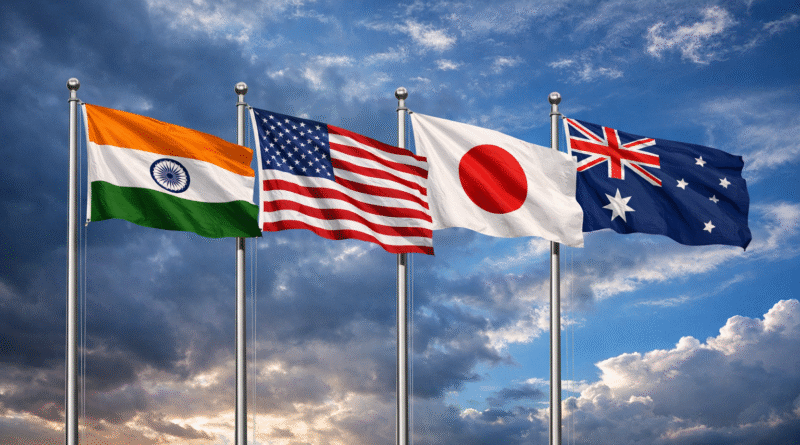
The Quad formally the Quadrilateral Security Dialogue is an informal strategic grouping of four democracies: India, the United States, Japan and Australia. It is not a military alliance. There is no mutual defence treaty. No member is obligated to come to another’s defence if attacked. It is better understood as a coordination forum. Four countries with shared concerns about China’s rise that have decided to talk regularly, exercise together, and cooperate on specific issues.
The issues it works on have expanded well beyond security. The Quad has working groups on vaccines, cancer treatment, climate, critical minerals, cyber security, subsea cables, infrastructure financing, space, and counter-terrorism. The vaccine initiative delivered nearly a billion doses across the Indo-Pacific during COVID. The Critical Minerals Initiative, launched in February 2026, is designed to reduce dependence on Chinese rare earth processing. These are real, concrete outcomes that often get lost in debates about whether the Quad is an ‘Asian NATO.’
It is not an Asian NATO and never was. India has been the clearest voice on this for years, Delhi refused to even use the word ‘Quad’ in official documents because it did not want to signal an anti-China military commitment. India remains the brake on any push to turn the Quad into a formal security alliance. And given everything India is currently managing Russia oil, China border, Chabahar, Iran war that caution is not weakness. It is a considered strategic position.
How the Quad got here: A brief history
| Year | What Happened |
| 2004 | Tsunami response brings India, US, Japan, Australia together for first time |
| 2007 | Quad formally launched at ASEAN sidelines by Shinzo Abe |
| 2008 | Australia withdraws under PM Kevin Rudd to avoid offending China |
| 2017 | Quad revived at Manila ASEAN summit — all four back at table |
| 2020 | Galwan Valley clash — India-China tensions push India closer to Quad |
| 2021 | First Quad Leaders Summit held virtually under Biden — Quad formally elevated |
| 2021 | Quad Vaccine Initiative launched — 1 billion doses pledged for Indo-Pacific |
| 2022 | Quad Leaders Summit in Tokyo — joint statement on Ukraine, Taiwan, China |
| 2024 | Last Quad Leaders Summit held — in Wilmington, Delaware under Biden |
| Jan 2026 | Rubio meets Quad FMs on Day 1 as Secretary of State — strong signal |
| Feb 2026 | Quad Critical Minerals Initiative launched |
| Mar 2026 | Trump skips Quad summit in India after testy Modi exchange — Quad dormant |
The pattern in that table is striking. The Quad keeps dying and keeps coming back. Australia withdrew in 2008 to please China. It came back in 2017. The Quad went dormant under Obama. It came back under Modi and Trump’s first term. It was elevated to leaders level under Biden. Now, under Trump’s second term, it is going dormant again.
The question worth asking is whether this cycle will repeat whether the Quad will come back again after Trump or whether the structural conditions that sustained it are changing in ways that make the next revival harder.
What the Quad has actually delivered
| Area | What Quad Has Done | Current Status |
| Naval exercises | Annual Malabar exercise — US, India, Japan, Australia | Active — continues regardless of summit status |
| Critical minerals | Quad Critical Minerals Initiative launched Feb 2026 | Active — top priority under Trump |
| Counter-terrorism | 3rd CTWG meeting held Dec 2025 | Active — next meeting planned 2026 |
| Technology | Quad Critical and Emerging Tech Working Group | Partially active — some groups dropped under Trump |
| Climate | Q-CHAMP clean energy initiative | Deprioritised under Trump — energy security replacing climate |
| Vaccines | 1 billion doses pledged 2021 — mostly delivered | Completed — not being renewed |
| Infrastructure | Quad Partnership for Cable Connectivity and Resilience | Active — subsea cable protection key concern |
| Space | Earth observation data sharing for disaster response | Active |
| Cyber | Quad Cybersecurity Partnership | Active — expanding |
Reading that table honestly, the Quad’s record is mixed. The vaccine initiative was a genuine achievement — nearly a billion doses delivered across the Indo-Pacific, countering China’s vaccine diplomacy during COVID. The Malabar naval exercise has real military value, improving interoperability between four navies that may need to operate together in a crisis. The Critical Minerals Initiative addresses a genuine strategic vulnerability.
But the broader ambitions a regional infrastructure alternative to BRI, a coherent technology governance framework, a unified stance on Taiwan and the South China Sea have not materialised. The Quad has been better at talking than delivering on its most ambitious goals. And the working groups that were active under Biden are being quietly dropped or deprioritised under Trump, who is less interested in multilateral processes and more interested in bilateral deals.
The Trump problem and why it is worse this time
Trump’s relationship with the Quad has always been complicated. In his first term, he was broadly supportive, the Quad foreign ministers met, exercises continued, and the grouping gained momentum. But Trump’s transactional approach to alliances created constant uncertainty. Partners could never be sure whether a presidential tweet would undermine months of diplomatic work.
In the second term, the problem is more acute. Trump has been prioritising his relationship with Xi Jinping in ways that directly undercut the Quad’s China-hedging rationale. A visit to Beijing is expected this month. His tariff threats against India, 50% at their peak have created real tension with the partner that is supposed to be the Quad’s anchor in South Asia. And now he has shelved the Quad summit in India after what was described as a testy exchange with Modi.
The Lowy Institute captured the structural problem precisely: the Indo-Pacific is too important to be left to the vagaries of US politics. Trump’s whimsical approach to policy, from shelving summits to threats of punitive tariffs, carries a cost. The Quad has always been a peculiar grouping, dependent on the commitment of its most powerful member, the United States. In moments of convergence, it has generated momentum. In moments of distraction or divergence, the Quad has faltered.
This is a moment of distraction. Trump is focused on Iran, on the trade deal, on his relationship with China. The Indo-Pacific and the Quad specifically is not his immediate priority.
The proposal nobody expected: An India-Japan-Australia trilateral
The most interesting strategic idea to emerge from the Quad’s current difficulties is a proposal that would have seemed radical a year ago — replacing the Quad with a trilateral grouping of India, Japan and Australia, without the United States.
The Lowy Institute argued this explicitly in February 2026. Unlike the Quad, where the United States’ overwhelming presence skews agendas, the India-Japan-Australia grouping would rest on a more equal distribution of interests. Each member has faced the realities of China’s rise firsthand and each has developed its own strategies for coping with Beijing’s assertiveness. What unites them is a shared need for strategic autonomy vis-a-vis both Washington and Beijing.
For India, the logic is particularly strong. Trump’s 50% tariffs on Indian goods highlight the structural fragility of relying on Washington. The Quad might still be useful as a platform, but as a long-term pillar of strategy, it leaves India exposed to American unpredictability. Japan is India’s largest ODA donor. Australia is a key partner on critical minerals and defence. The three countries have real complementary interests that do not require American leadership to activate.
The Supply Chain Resilience Initiative a trilateral effort launched in 2021 by India, Japan and Australia — is the template. It has largely languished, but the framework exists. Reviving and expanding it into a broader strategic partnership would give the three countries a hedge against both Chinese coercion and American unpredictability.
What the Quad means for India specifically
India’s relationship with the Quad is the most complicated of the four members and the most interesting.
India is the only Quad member that directly borders China and shares a disputed Himalayan frontier with it. It is the only member that is not a US ally in the formal treaty sense. It is the only member that buys significant weapons from Russia. And it is the only member that has consistently resisted turning the Quad into an anti-China military alliance.
That resistance has sometimes frustrated Washington and Tokyo, who would like a more confrontational Quad posture. But India’s position reflects a genuine strategic calculation not weakness. India needs the Quad for technology partnerships, naval interoperability, and diplomatic signalling. But it cannot afford a Quad that commits it to a confrontational stance toward China while it is simultaneously trying to manage a border dispute, deepening BRICS ties, and navigating the fallout from the Iran war.
CNAS noted that pushing India toward a larger security role in the Quad would be a hard sell with New Delhi, which seeks to avoid being part of any multilateral grouping that resembles a security alliance. That assessment remains accurate in 2026.
What India wants from the Quad is specific and practical: technology partnerships, critical minerals cooperation, naval exercises, and the diplomatic signal that Washington, Tokyo and Canberra are engaged in the Indo-Pacific. It does not want an Asian NATO. It does not want to be in a grouping that forces it to choose between China and the US. And it will not pretend otherwise regardless of what Trump says or does not say about summit attendance.
ThirdPol’s Take
The Quad is not dead. It is dormant again and it will come back again. The institutional infrastructure is real. The working groups are real. The Malabar exercise is real. None of that disappears because Trump decided not to fly to New Delhi for a summit.
But the Lowy Institute’s proposal for an India-Japan-Australia trilateral deserves serious consideration not as a replacement for the Quad, but as a supplement to it. The three countries’ shared interests in supply chain resilience, critical minerals, maritime security and rules-based regional order do not require American participation to be worth pursuing. And having a resilient trilateral framework means that when Washington goes through its periodic bouts of unpredictability, India and its partners have something to fall back on.
The deeper problem the Quad exposes is one about Indian grand strategy. India wants to benefit from US security commitments in the Indo-Pacific without making the formal alliance commitments that would give those benefits real teeth. That is a reasonable position — strategic autonomy has served India well. But it means that when the US becomes unreliable, India’s Quad-based security architecture loses its anchor.
The answer is not to abandon strategic autonomy. It is to build the bilateral and trilateral relationships with Japan and Australia that make India’s regional position resilient regardless of what happens in Washington. That is a project that needs to start now not after Trump’s term ends and not after the next crisis makes the gap visible again.
Amit Mangal writes on India’s foreign policy and geopolitics at ThirdPol. Follow ThirdPol on X and LinkedIn.