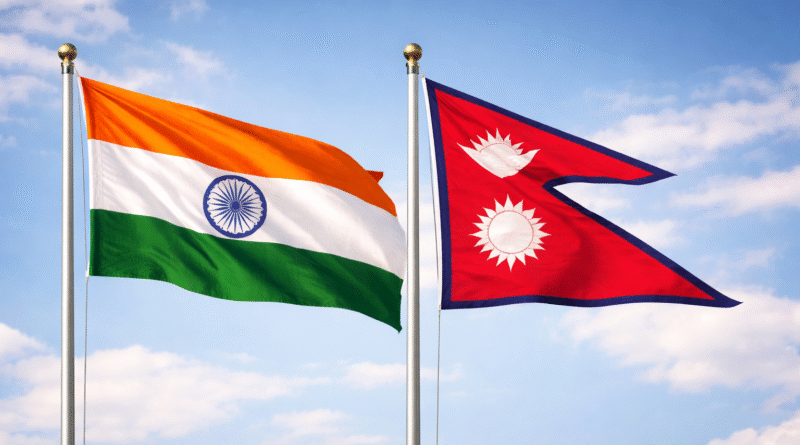
India–Nepal Relations: Civilisational Roots and Challenges
India–Nepal relations stand out in South Asia for their depth and intimacy. Few neighbouring countries share ties as open and personal as those between India and Nepal. An open border, shared faiths, and everyday human connections shape this relationship far beyond formal diplomacy.
People move freely across the border. Families live on both sides. Festivals, marriages, and livelihoods often overlap. Hinduism and Buddhism bind the two societies through sacred spaces such as Pashupatinath, Janakpur, Lumbini, and Bodhgaya. These links are not symbolic. They are lived, daily realities.
The modern framework of this relationship was formalised through the Treaty of Peace and Friendship in 1950. The treaty allows free movement, employment, and trade across borders. Over time, India has emerged as Nepal’s largest trade partner, investor, and development supporter. Cooperation now spans connectivity, hydropower, disaster relief, and security management.
Despite ups and downs, the relationship continues to matter deeply to both sides. Geography, history, and people ensure that neither country can ignore the other for long.
Historical Background of India–Nepal Relations
India–Nepal relations did not begin in 1950. They evolved slowly, shaped by culture, power shifts, and regional politics. Some moments strengthened trust, while others left lasting scars.
Ancient civilisational links
Hindu and Buddhist traditions connect India and Nepal at a civilisational level. Pilgrimage routes between Janakpur, Pashupatinath, Bodhgaya, and Lumbini have remained active for centuries. These links created a sense of shared spiritual geography long before modern borders existed.
Treaty of Sugauli, 1816
Signed between Nepal and British India, this treaty defined Nepal’s territorial boundaries along the Kali River. While it settled borders at the time, it also laid the foundation for later disputes such as Kalapani and Susta.
Post-independence reset, 1950
The 1950 Treaty of Peace and Friendship marked a turning point. It formalised open borders, reciprocal rights, and security cooperation. For India, it ensured Himalayan security. For Nepal, it offered economic access and political support during transition.
Cold War balancing
Over time, Nepal sought to reduce over-dependence on India. Engagement with China increased, especially after the 1962 Sino-Indian War altered regional power dynamics. Nepal adopted a careful balancing strategy between its two large neighbours.
Economic blockade, 1989–90
The lapse of trade and transit treaties caused severe shortages in Nepal. GDP growth fell sharply. The episode left deep emotional and political resentment and damaged mutual trust.
Democratic transition, 1990
The restoration of democracy in Nepal helped normalise relations. New trade and transit agreements were signed. Connectivity improved, and cooperation slowly recovered.
Maoist phase and the China factor
After 2006, Nepal’s political landscape changed. China expanded its economic and infrastructure presence. India was no longer the only major external partner shaping Nepal’s options.
Post-2014 engagement
High-level political visits revived momentum. India extended credit lines, accelerated hydropower projects, and expanded cultural diplomacy. The tone became more proactive.
Earthquake diplomacy, 2015
After the devastating earthquake, India launched Operation Maitri to provide immediate rescue and relief. The response highlighted humanitarian solidarity, even though later political frictions resurfaced.
Indo-Nepal Treaty of Peace and Friendship, 1950
The Indo-Nepal Treaty of Peace and Friendship remains the legal backbone of bilateral relations. It governs mobility, economic rights, and security coordination.
Citizens of both countries can live, work, and conduct business across borders without visas or passports. A 1,770-km open border supports livelihoods, remittances, and social exchange. At the same time, it creates challenges related to smuggling and security management.
The treaty also requires both sides to keep each other informed about external security threats. This clause reflects the strategic sensitivity of the Himalayan region.
Indian and Nepali businesses receive national treatment after entry, reducing trade barriers. However, many in Nepal now see the treaty as unequal and outdated. The Eminent Persons Group recommended revisions, but these proposals remain unimplemented.
Areas of Cooperation in India–Nepal Relations
1. Trade and Economy
Economic ties are the backbone of the relationship. India is Nepal’s largest trade partner, transit provider, and investor.
Bilateral trade reached ₹57,858 crore in 2018–19. Indian exports dominated this figure, highlighting Nepal’s dependence on Indian markets. Nearly all of Nepal’s third-country trade passes through Indian ports, making transit access vital for Nepal’s economic stability.
Indian companies operate across banking, insurance, power, tourism, and manufacturing. Hydropower exports are rising. By mid-2022, Nepal had exported electricity worth ₹10.38 billion to India.
2. Connectivity
Connectivity projects deepen integration and reduce Nepal’s landlocked constraints.
The Jayanagar–Kurtha railway is operational and is being extended to Bardibas. Plans for an electric rail corridor between Kathmandu and Raxaul aim to transform cross-border mobility.
The Motihari–Amlekhgunj petroleum pipeline ensures steady fuel supply. Inland waterway initiatives now link Nepal to Indian river systems and onward to the Indian Ocean.
3. Energy and Hydropower
Hydropower cooperation serves both economic and climate goals.
The 900-MW Arun-3 project, implemented by SJVN, reflects long-term Indian investment. Agreements on Arun-4 and the Pancheshwar Multipurpose Project further strengthen energy ties.
India’s commitment to import 10,000 MW of electricity from Nepal over a decade offers Nepal a stable revenue stream and long-term market access.
4. Defence Cooperation
Military ties remain unique and symbolic.
Around 32,000 Nepali citizens serve in Indian Army Gorkha regiments. The annual Surya Kiran exercise improves joint preparedness in disaster response and counter-terrorism.
Both countries also exchange honorary General ranks between army chiefs, reflecting institutional trust built over decades.
5. Cultural Ties
Culture keeps the relationship grounded at the people’s level.
Sister-city agreements link Kathmandu with Varanasi, Lumbini with Bodhgaya, and Janakpur with Ayodhya. India offers more than 1,500 scholarships annually to Nepali students. Religious tourism continues to grow through shared pilgrimage circuits.
6. Humanitarian and Development Assistance
India is Nepal’s largest development and disaster-response partner.
Since 2008, India has provided over USD 1.5 billion for health, education, infrastructure, and rural development. Operation Maitri after the 2015 earthquake remains a landmark effort.
India also supplied nearly 9.5 million COVID-19 vaccine doses under Vaccine Maitri. During global crises such as the Russia–Ukraine war and the Israel–Hamas conflict, India assisted in evacuating Nepali citizens alongside its own.
Challenges in India–Nepal Relations
Despite strong foundations, the relationship faces real challenges.
Territorial disputes over Kalapani and Susta intensified after Nepal released a new political map in 2019. These issues complicate border management and public trust.
The 1950 treaty is increasingly viewed in Nepal as unequal. Trade imbalance remains sharp, with Nepal importing far more from India than it exports.
China’s growing presence through Belt and Road projects has altered regional equations. The open border also faces misuse through smuggling, trafficking, and fake currency circulation.
Delays in project delivery and perceptions of political interference have fuelled resentment among some sections of Nepali society. Recent moves, such as Nepal issuing currency notes with disputed territories, have further strained diplomatic confidence.
Final Note
India–Nepal relations are shaped as much by emotion as by strategy. History binds them. Geography locks them together. The challenge ahead lies in managing disagreements without losing the human warmth that defines this unique partnership.
Pingback: UGC Guidelines 2026: New Equity Rules for Indian Universities