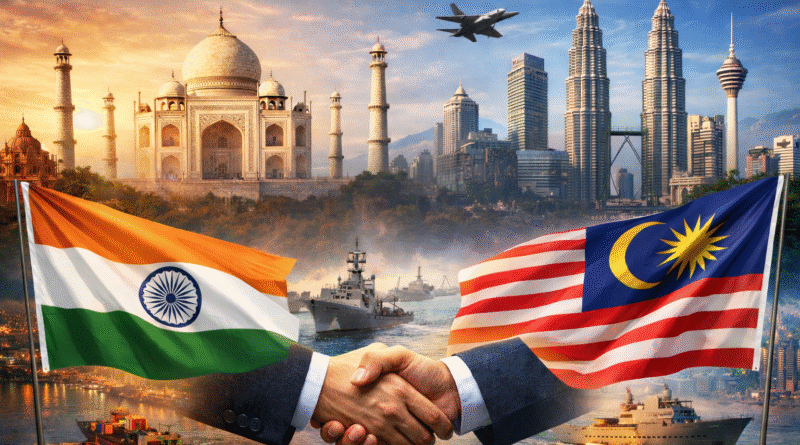
India–Malaysia Relations: Latest Developments and Strategic Outlook
India–Malaysia relations took a major step forward during Prime Minister Narendra Modi’s visit to Kuala Lumpur in February 2026. The visit was not symbolic. It delivered concrete outcomes and signalled a shared intent to work more closely in a rapidly changing global environment.
A Relationship Rooted in History
India and Malaysia share civilisational ties that go back more than two thousand years. Ancient trade routes across the Indian Ocean carried ideas, beliefs, and languages along with goods. Sanskrit influences and Hindu-Buddhist traditions remain visible in Malaysia’s early history, forming the cultural foundation of India–Malaysia relations.
Formal diplomatic relations began soon after India’s independence. Since then, political engagement between the two countries has remained steady and constructive.
Political and Diplomatic Engagement
In 2024, India and Malaysia upgraded their ties to a Comprehensive Strategic Partnership, reflecting growing political trust within India–Malaysia relations. High-level visits, regular foreign office consultations, and coordination at global platforms have strengthened this partnership.
Malaysia has openly supported India’s demand for permanent membership in a reformed United Nations Security Council. This support highlights political alignment on global governance reforms.
Trade and Economic Cooperation
Malaysia is India’s third-largest trading partner within ASEAN, making trade a central pillar of India–Malaysia relations. Bilateral trade reached US$ 19.86 billion in 2024–25, with Indian exports valued at US$ 7.32 billion and imports at US$ 12.54 billion.
Between April 2000 and March 2025, Malaysian investments in India stood at around US$ 1.27 billion. India exports petroleum products, engineering goods, meat and dairy products, and organic chemicals. In return, it imports vegetable oils, machinery, electrical equipment, and minerals from Malaysia.
Malaysia’s location along the Strait of Malacca and the South China Sea makes it a crucial partner for India’s Act East Policy and maritime connectivity plans, further strengthening India–Malaysia relations.
Defence and Security Cooperation
Defence cooperation has grown steadily over the years under the broader framework of India–Malaysia relations. Joint exercises, maritime coordination, and capacity-building initiatives are now regular features of the relationship.
Both countries share concerns over freedom of navigation, maritime security, piracy, and terrorism in the Indo-Pacific region. Intelligence sharing and counter-terrorism cooperation have gained importance as security challenges evolve.
People-to-People and Diaspora Ties
The Indian diaspora in Malaysia, numbering over two million, forms the emotional backbone of India–Malaysia relations. Persons of Indian origin are active across politics, business, education, and cultural life.
Tourism, educational exchanges, and cultural programmes continue to deepen mutual understanding and trust between the two societies.
Regional and Global Cooperation
India and Malaysia work closely through platforms such as ASEAN, the East Asia Summit, and the Indian Ocean Rim Association. India recognises ASEAN centrality in the Indo-Pacific, while Malaysia strongly supports India’s Act East Policy. This shared regional vision reinforces long-term India–Malaysia relations.
What Happened During the 2026 Visit
Prime Minister Modi’s visit to Kuala Lumpur marked a clear shift from intent to action in India–Malaysia relations.
India and Malaysia signed 11 agreements and MoUs covering defence, semiconductors, digital technology, health, and energy. One of the most important outcomes was a framework agreement on semiconductor cooperation. It reflects both countries’ ambition to become part of global advanced manufacturing supply chains.
India invited Malaysian investment in electronics, artificial intelligence, renewable energy, and healthcare. It also highlighted domestic reforms aimed at improving the ease of doing business.
Both leaders strongly reaffirmed a zero-tolerance approach to terrorism. They condemned cross-border terrorism and called for global cooperation to counter terror financing, radicalisation, and misuse of emerging technologies. Prime Minister Modi made it clear that there would be no double standards on this issue.
Defence cooperation is expected to expand further, especially in maritime security, intelligence sharing, and joint training initiatives. The two sides also agreed to deepen coordination at multilateral forums, including the United Nations and the Financial Action Task Force.
Another notable decision was to promote trade settlement in local currencies, the Indian Rupee and the Malaysian Ringgit. This move aims to reduce transaction costs and dependence on third-country currencies.
Malaysia once again reiterated its support for India’s permanent membership in a reformed UNSC. India also announced plans to open a new Indian Consulate General in Malaysia to improve consular services and strengthen diaspora engagement.
Why This Visit Matters
The 2026 visit underlined a growing strategic convergence within India–Malaysia relations. Both countries see stability in the Indo-Pacific as essential. Both support ASEAN centrality. And both want reforms in global governance institutions to reflect present-day realities.
The message was clear. India–Malaysia relations are no longer limited to history and goodwill. They are increasingly shaped by shared interests, practical cooperation, and a common vision for the future.
The Analysis Desk at ThirdPol covers India’s foreign policy, neighbourhood security, and regional geopolitics.