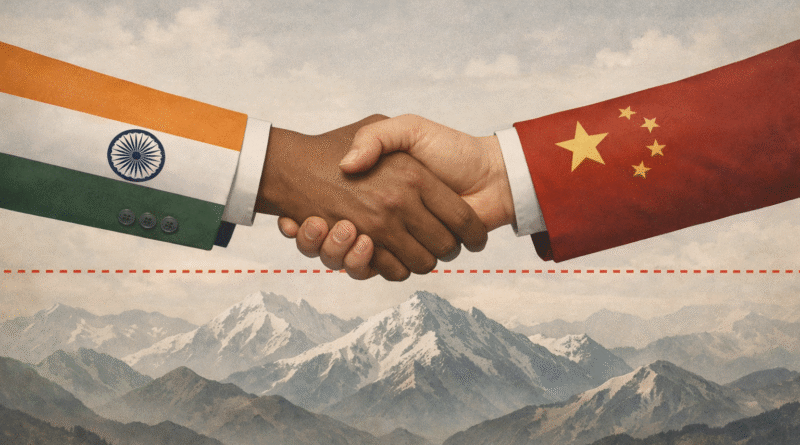
India China Reset 2026: Is the Thaw Between Modi and Xi Real This Time?
On April 1, 2026, China’s ambassador to India marked 76 years of diplomatic ties between the two countries. He called them “neighbours that cannot be moved apart.” A week earlier, Chinese Foreign Minister Wang Yi urged the two countries to coordinate their back-to-back BRICS presidencies. The India China reset 2026 is being talked about in diplomatic language warm enough to suggest a genuine thaw. But behind the warm words, the Line of Actual Control is still the most militarised it has been since 1962, bilateral trade sits at over $118 billion with India running a massive deficit, and China is building roads in the Shaksgam Valley while India responds with its own 1,748 km Frontier Highway. The question is not whether the India China reset 2026 is happening. It clearly is. The question is what it actually means and whether it will survive contact with the underlying tensions that caused the freeze in the first place.
How Did India and China Get Here? A Timeline
| Date | Event |
| June 2020 | Galwan Valley clash. 20 Indian soldiers killed. India bans 200+ Chinese apps, restricts FDI. |
| Oct 2024 | Modi-Xi meet in Kazan on BRICS sidelines. First delegate-level talks in 5 years. LAC disengagement deal announced. |
| Jan 2026 | Xi wishes India on Republic Day: calls both nations “good neighbours, friends and partners.” Direct flights resume. |
| Aug 2025 | Modi visits Xi in Tianjin (SCO Summit). Modi invites Xi to BRICS 2026 in New Delhi. LAC patrolling resumed in Depsang and Demchok. |
| Mar 2026 | Chinese FM Wang Yi urges India-China BRICS coordination: “Together we can bring new hope to the Global South.” |
| Apr 1, 2026 | China marks 76th anniversary of India-China ties. Ambassador: “Neighbours that cannot be moved apart.” |
What Triggered the Reset
The ice between India and China cracked in October 2024, not because of any dramatic diplomatic breakthrough but because both sides ran out of reasons to keep it frozen. The immediate trigger was the Kazan BRICS summit, which gave Modi and Xi a neutral platform for their first delegate-level meeting in five years. The announcement that followed India and China had agreed to resume patrolling in Depsang and Demchok, the two remaining friction points in eastern Ladakh was the concrete outcome that justified the meeting.
Underneath the diplomatic mechanics were two structural pressures pushing both sides toward engagement. First, the US-India relationship had deteriorated significantly through 2025 Trump’s tariffs, his outreach to Pakistan after Operation Sindoor, and the general unpredictability of Washington’s South Asia policy had given New Delhi reason to reduce its dependence on the American relationship. Second, China’s own economic headwinds sluggish domestic growth, Western sanctions, and trade decoupling pressures made the prospect of a hostile neighbour who was also a $118 billion trading partner harder to justify.
The India China reset 2026 is in many ways a pragmatic response to a world neither country fully controls. When the external environment becomes unpredictable, the cost of unnecessary bilateral hostility rises.
Is the India China Reset 2026 Real or Just Optics?
The honest answer is: both, depending on which dimension you measure.
On the diplomatic and economic track, the reset is real and measurable. Direct flights between India and China suspended since 2020 resumed in January 2026. Chinese investment restrictions are being quietly reviewed. Trade, which never actually fell despite four years of political hostility, is growing. Modi invited Xi to the BRICS Summit in New Delhi. Xi accepted. Wang Yi called for the two countries to “step up and support each other’s BRICS presidencies.” These are not empty gestures.
On the military and territorial track, the reset is cosmetic at best. Both sides have withdrawn from Depsang and Demchok but “withdrawal” in LAC terminology means pulling back to pre-April 2020 positions, not pre-2017 positions or pre-2013 positions. Buffer zones with no patrolling rights still exist. India has lost access to patrol points it previously held. The Arunachal Frontier Highway is being built because India does not trust that the diplomatic warmth will last. China’s infrastructure push in Tibet and the Shaksgam Valley continues regardless of whatever Wang Yi says in press conferences.
The India China reset 2026 exists at the diplomatic level. It has not filtered down to the military and strategic level, and there is little evidence it will any time soon.
The Trade Problem Nobody Wants to Talk About
India’s trade deficit with China is one of the most politically awkward facts in New Delhi’s relationship with Beijing. In 2023-24, two-way trade was $118.4 billion making China India’s largest trading partner, ahead of even the United States. India imports electronics, machinery, chemicals, and solar panels from China in enormous quantities. It exports much less back.
The deficit runs at roughly $85 billion annually. That means India is financing Chinese industry to the tune of $85 billion a year while simultaneously building military infrastructure to deter Chinese aggression. This contradiction is not lost on Indian policymakers. India’s 2024 Economic Survey explicitly called for greater integration into Chinese supply chains to boost exports. The India China reset 2026 creates the political space to have that conversation but not to resolve it quickly.
The deeper problem is structural. India cannot easily replace Chinese imports in the short term. Electronics components, active pharmaceutical ingredients, and solar panels all have significant Chinese dependency. Decoupling is a multi-year project even if the political will exists. And right now, the political will is pointing in the opposite direction — toward re-engagement, not decoupling.
What the BRICS Summit Means for the India China Reset 2026
The BRICS Summit in New Delhi expected later in 2026 is the centrepiece of this year’s diplomatic calendar for both countries. If Xi attends in person, it will be his first visit to India since 2019. The optics alone would represent a significant marker of the India China reset 2026.
But the summit creates its own pressures for India. BRICS now includes Russia, China, Iran, Saudi Arabia, Egypt, UAE, Ethiopia, and Indonesia alongside the original five. The de-dollarisation agenda which India has been trying to quietly sideline to avoid angering the Trump administration will resurface. China and Russia have both pushed for more aggressive BRICS positions on the dollar. India will try to steer the summit toward infrastructure, AI, and climate finance rather than currency politics. Whether it succeeds will depend on how much leverage Modi can exercise as the host.
Wang Yi’s call for India and China to coordinate their consecutive BRICS presidencies is significant. If that coordination holds India in 2026, China in 2027, it would represent the deepest diplomatic alignment between the two countries since before the Galwan clash. Whether it holds is the open question of the India China reset 2026.
What Could Break the Reset
Three scenarios could unravel the India China reset 2026 quickly.
First, another LAC incident. The border is still militarised with over 50,000-60,000 troops deployed on each side in eastern Ladakh. A local confrontation even an accidental one could set the relationship back years, as 2020 demonstrated. The mechanisms for managing incidents have improved since Galwan, but the underlying territorial disputes have not been resolved. They are being managed, not solved.
Second, a major move by Pakistan. China’s all-weather relationship with Pakistan means that any significant India-Pakistan escalation another Pahalgam, another Operation Sindoor forces Beijing to choose between its diplomatic reset with India and its strategic partnership with Islamabad. China will choose Pakistan. The India China reset 2026 has no provision for that scenario.
Third, a trade or technology confrontation. If India moves aggressively on Chinese investment restrictions, bans additional Chinese apps or technology, or aligns too closely with a US semiconductor supply chain that explicitly excludes China, Beijing will respond. The reset is partly built on the assumption that India will not do these things. That assumption may not survive the full pressure of the US-China technology war.
ThirdPol’s Take
The India China reset 2026 is real in the same way that a ceasefire is real it stops the fighting without resolving the dispute. Both sides want stability right now because instability is expensive and the external environment is already turbulent enough. That is a legitimate reason for a reset, and it should not be dismissed. But it is a reason rooted in convenience, not conviction. The underlying issues the LAC, the trade deficit, Chinese infrastructure in Shaksgam Valley, the Pakistan factor have not changed. What has changed is the cost-benefit calculation on both sides, temporarily. India should use the breathing room the reset provides to accelerate its border infrastructure, reduce its supply chain dependence on China, and deepen ties with partners who share its concerns about Beijing’s long-term intentions. The reset is an opportunity. Whether India uses it strategically or merely diplomatically will define what the India China reset 2026 actually amounts to.
By Amit Mangal | ThirdPol | April 2026