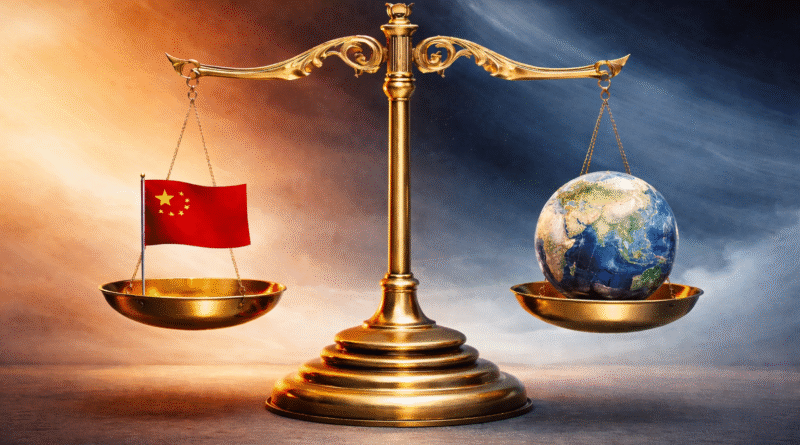
India China Relations 2026: What Beijing’s Growing Confidence Means for New Delhi
India China relations in 2026 are at a turning point — and most Indians do not fully realise how much has changed in the last six months. China is more strategically confident than it has been in years. Its economy has stabilised, its military is modernising at pace, and its global influence is growing across Africa, the Middle East, and Latin America. Meanwhile, India just eased investment rules for China for the first time since the 2020 Galwan Valley clash, reopened direct flights, and is navigating an awkward BRICS chairship that includes Iran — a country China has now stepped in to support while India stayed silent.
For India, sitting on a 3,488 km shared border with this increasingly assertive neighbour, understanding what drives Beijing’s strategic thinking is not an academic exercise. It is a national security priority. This article breaks it down — China’s economy, its military, its diplomacy, and what all of it means specifically for New Delhi.
Closer Ties with Russia and the Global South
This growing confidence was strengthened by deeper ties with the Global South and closer coordination with Russia. Relations with most major countries appeared more stable, though Japan remained an exception.
However, this confidence is not total. Chinese leaders are aware of domestic weaknesses and a tough external environment. Concerns about these issues emerged at the Fourth Plenary Session and the Central Economic Work Conference in late 2025, where President Xi Jinping reiterated the importance of national security, technological independence, and the real economy.
Economic Stress and a Turn Inward
Despite official growth figures around 5 percent in 2025, China’s economy faces severe challenges. Domestic consumption is weak. The property sector still undermines confidence. Deflationary pressures persist, with producer prices negative for over three years.
Productivity growth and corporate profits are low. Local governments are under financial pressure, which limits their ability to implement major stimulus measures.
Rather than shifting decisively to consumption-led growth, Beijing is focusing on state-led technological self-reliance. Key sectors include advanced manufacturing, semiconductors, artificial intelligence, green energy, and dual-use technologies. The 15th Five-Year Plan for 2026 to 2030 emphasizes supply-chain protection and full-value-chain control to minimize vulnerability to external shocks.
Ironically, this inward focus has coincided with increased reliance on exports. China’s trade surplus exceeded one trillion dollars in the first eleven months of 2025. Its dominance in electric vehicles, batteries, solar panels, and industrial machinery has strengthened across global value chains.
This renewed surge in exports, often described as a second China shock, has disrupted both developed and developing economies, increasing global trade tensions and shaping China strategic posture.
Political Consolidation and Military Posture
In 2025, power under Xi Jinping further consolidated. Information control tightened, ideological discipline was reinforced, and the definition of national security expanded into civilian and economic areas.
At the same time, the removal of several senior military officers revealed ongoing weaknesses within the party-state system.
Militarily, the People’s Liberation Army continued rapid modernization of both conventional and nuclear forces. Emerging shifts towards an early-warning counter-strike posture indicate a leadership willing to accept more risk in defending what it views as essential interests.
Changing Great-Power Dynamics
Externally, a crucial development was the adjustment of relations with the United States during President Donald Trump’s second term. The 2025 U.S. National Security Strategy defined China mainly as an economic rival, decreased focus on the Indo-Pacific, and reflected a more inward-looking America First approach.
However, competition remained. U.S. actions in Venezuela harmed Chinese interests and provoked strong reactions from Beijing.
The Trump–Xi meeting in Busan in October 2025 led to a limited easing of tensions through minor tariff adjustments and selective relaxation of export controls. These steps indicated transactional accommodation rather than deep cooperation and contributed to China strategic posture.
What India China Relations Look Like on the Ground in 2026
India China relations in 2026 are best described as a cautious thaw — real enough to notice, fragile enough to break.
The most significant development came on March 10, 2026, when the Union Cabinet approved changes to India’s Foreign Direct Investment policy — amending Press Note 3 of 2020, the regulation that had blocked Chinese investment in India since the Galwan Valley clash. Under the new rules, overseas companies with up to 10 percent Chinese shareholding can now invest in India under the automatic route without seeking prior government approval. For strategic manufacturing sectors — capital goods, electronics, and solar supply chains — approvals will be fast-tracked within 60 days.
This is a significant signal. As the South China Morning Post noted, India had deliberately tied its FDI policy to border stability after 2020 — loosening it now reflects a calculated judgement that the border situation has stabilised enough to allow economic re-engagement. But experts are careful not to overstate it. “I would read this as a pragmatic recalibration rather than a structural reset in India-China relations,” said Reema Bhattacharya of Verisk Maplecroft. Chinese companies will still factor in the risk that investment rules can tighten again if bilateral tensions flare.
The numbers tell a sobering story about how much ground was lost. Despite being India’s second-largest trading partner, China accounts for only 0.32 percent — just $2.51 billion — of total FDI equity inflows into India since April 2000. Meanwhile, India’s trade deficit with China has widened dramatically: imports from China rose 11.52 percent to $113.45 billion in 2024-25, while Indian exports to China fell 14.5 percent to $14.25 billion. India buys far more from China than it sells — and that gap is growing.
On the border, the situation is what analysts describe as “stable but abnormal.” As of early 2026, both sides have completed disengagement at the Depsang Plains and Demchok areas — restoring patrolling rights that had been lost since 2020. This was a meaningful step. But buffer zones remain in place, and the underlying territorial disputes that caused the 2020 standoff have not been resolved. Disengagement is not the same as de-escalation.
Then there is the BRICS dimension. India holds the BRICS chairship in 2026 — and both India and China are founding members of the bloc. But their visions for what BRICS should be are fundamentally different. China wants BRICS to explicitly challenge Western dominance — on de-dollarisation, on sanctions, on Ukraine. India consistently resists this framing, preferring to position BRICS as a development and Global South forum. The Iran war has sharpened this tension: China has stepped in as Tehran’s most reliable great power ally while India stayed silent, creating an asymmetry within BRICS that will be difficult to manage under India’s chairship.
The deepest structural problem in India China relations remains unchanged: India runs a massive trade deficit with China, is dependent on Chinese imports for electronics and industrial inputs, has unresolved border disputes, and is competing with China for influence across South Asia and the Indian Ocean. The FDI relaxation and the border disengagement are positive signals — but they are tactical adjustments, not strategic breakthroughs.
What India Must Do
India China relations in 2026 demand a clear-eyed strategy — neither the naïve optimism of “Hindi-Chini Bhai-Bhai” nor the reflexive suspicion that treats every development as a trap.
The FDI relaxation is sensible economic pragmatism. India needs Chinese capital and technology in specific sectors — solar panels, electronics manufacturing, electric vehicles — where Chinese expertise can accelerate India’s own industrial ambitions. Accepting that reality is not weakness. It is strategy.
But economic engagement must be matched with strategic firmness. The border disengagement at Depsang and Demchok is welcome — but buffer zones still limit India’s traditional patrolling rights. India cannot allow economic normalisation to reduce pressure on China to resolve the underlying territorial disputes.
On BRICS, India should use its 2026 chairship to demonstrate that the bloc can function as a genuine development forum — not an anti-Western club. That requires India to be more vocal, not less, about the rules-based order. Silence on Iran did not serve India’s Global South credibility.
The bottom line: China is more confident, more assertive, and more strategically active in 2026 than at any point in the last decade. India’s response must be equally clear — engage where interests align, compete where they diverge, and never mistake tactical accommodation for strategic trust.
The Analysis Desk at ThirdPol writes on India’s foreign policy choices, strategic constraints, and the shifting global order shaping the region.
Pingback: Why Does Trump Want Greenland and Why Europe Is Shocked
Pingback: India Foreign Aid 2026: Who Gets Funded and Who Gets Cut