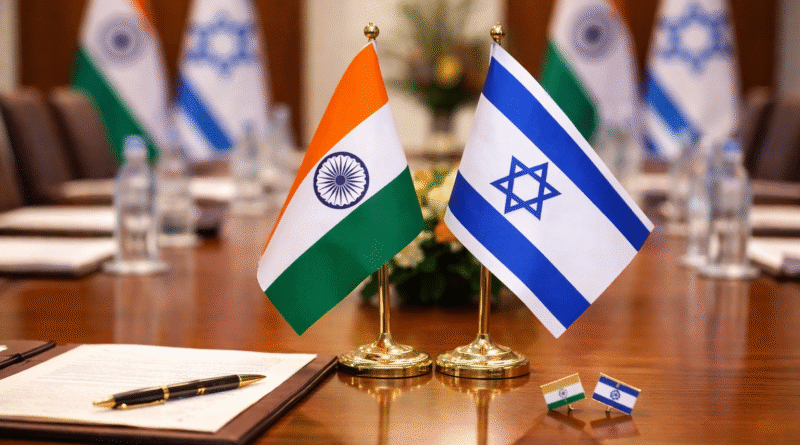
India and Israel Relations: From Cautious Distance to Strategic Partnership
Prime Minister Narendra Modi is on an official visit to Israel. It is his first trip since the historic 2017 visit. That earlier visit changed the tone of India and Israel relations. For the first time, an Indian Prime Minister travelled to Israel after full diplomatic ties were established. It was a clear signal that the relationship had matured.
This visit comes at a tense moment. West Asia is facing uncertainty. The Gaza ceasefire is fragile. Tensions involving the United States and Iran are rising. In such times, even a routine diplomatic visit carries deeper meaning. India and Israel today share more than formal ties. They share strategic interests.
The Early Years of India and Israel Relations
India recognised Israel in 1950, not long after the state was formed in 1948. But full diplomatic relations took decades. Domestic politics, energy needs, and support for Palestine shaped India’s early approach.
A major shift came in January 1992. During Yasser Arafat’s visit to India, Prime Minister P V Narasimha Rao made it clear that engaging Israel would not weaken India’s support for Palestine. Instead, it could strengthen India’s global position. On January 29, 1992, India and Israel formally established diplomatic relations. It was a turning point that changed the direction of foreign policy.
Defence Ties: The Strongest Pillar
Even before 1992, security cooperation existed in limited form. India received military supplies from Israel during the 1962 war with China. However, the relationship remained discreet.
The Kargil conflict in 1999 marked a breakthrough. Israel supplied precision-guided munitions to India at short notice. It was critical support at a crucial time. Trust deepened. Since then, defence cooperation has become one of the strongest pillars of India and Israel relations.
Today, Israel is among India’s key defence suppliers. Cooperation includes advanced weapons systems, surveillance equipment, and joint research.
Political Engagement Gains Momentum
Between 2000 and 2003, high-level visits increased. External Affairs Minister Jaswant Singh and Home Minister L K Advani travelled to Israel. Leaders from different political backgrounds also visited, showing bipartisan support.
In September 2003, Israeli Prime Minister Ariel Sharon visited India. It was a landmark event. Defence and security cooperation expanded further. In 2012, External Affairs Minister S M Krishna visited Israel, focusing publicly on agriculture, science, and trade while strategic ties quietly continued.
India and Israel After 2014
After coming to power in 2014, Prime Minister Narendra Modi brought India and Israel relations into the open. In September 2014, he met Prime Minister Benjamin Netanyahu in New York. It was the first meeting of its kind in nearly a decade.
High-level visits followed quickly. Home Minister Rajnath Singh visited Israel in 2014. President Pranab Mukherjee made the first-ever visit by an Indian President in 2015. External Affairs Minister Sushma Swaraj visited in 2016. Over time, several ministers and officials strengthened the engagement.
The Historic 2017 Visit
The 2017 visit by PM Modi was historic. He did not combine it with a visit to Palestine, which earlier leaders often did. This move showed confidence. It reflected India’s ability to manage independent relationships in West Asia.
In January 2018, Prime Minister Netanyahu visited India. Since then, both leaders have remained in close contact. Frequent conversations reflect sustained engagement at the highest level.
Expanding Economic and Strategic Cooperation
India and Israel relations are no longer limited to defence. The partnership now includes technology, innovation, agriculture, water management, cybersecurity, and artificial intelligence.
In November 2025, both sides signed fresh defence agreements and began negotiations for a free trade agreement. Israel’s strengths in high-tech sectors match India’s push for digital growth and innovation.
Israel is also an important partner in connectivity initiatives such as the India-Middle East-Europe Economic Corridor. Economic cooperation is steadily expanding.
A Changing Regional Context
Since 2017, West Asia has undergone major changes. The Abraham Accords led to normalisation between Israel and several Arab nations. At the same time, new conflicts have emerged.
The Hamas attack on October 7, 2023 triggered a prolonged war in Gaza. A US-backed ceasefire currently holds, but the situation remains delicate.
Tensions with Iran have also increased. A short but intense Israel-Iran conflict in June 2025 raised fears of broader escalation. The United States increased its military presence in the region. Stability remains uncertain.
India’s Diplomatic Balance
For India, the challenge is clear. Israel is a vital defence and technology partner. At the same time, India maintains strong ties with Gulf countries and continues engagement with Iran.
India’s approach has been practical. It supports peace and dialogue. It avoids extreme positions. It seeks to protect national interests while maintaining strategic autonomy.
Conclusion
India and Israel relations have evolved steadily over decades. What began as cautious engagement has become an open and strategic partnership. Prime Minister Modi’s visit takes place in a sensitive environment, but it reflects confidence.
India and Israel today stand connected by defence, technology, trade, and shared strategic interests. In a complex geopolitical landscape, this partnership continues to grow stronger, guided by realism and long-term vision.
The Analysis Desk at ThirdPol writes on India’s foreign policy, regional security, and shifts shaping the World.