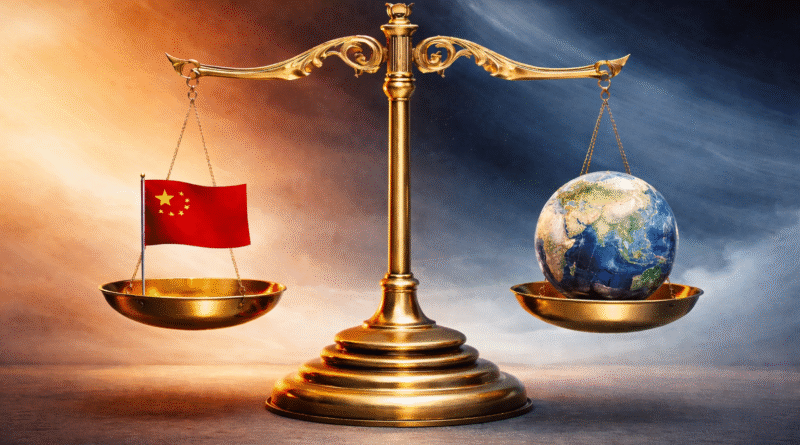
China’s Strategic Posture Explained: Economy, Military, and Diplomacy
As 2026 begins, China’s strategic posture seems caught between confidence and concern. Domestically, it faces economic and structural issues. Internationally, it projects increased strategic confidence. This contrast influences Beijing’s domestic governance, foreign policy, and military positioning.
For India, the situation is complicated by shifting U.S. priorities. As Washington focuses more narrowly, India’s ability to navigate its relationship with China diminishes, making it even more challenging.
A Shift in Strategic Mood: From Anxiety to Assertiveness
Unease Over U.S. Pressure
Until late 2024, Chinese strategic thinking leaned towards caution. Slowing economic growth, ongoing U.S. pressure, and fears of geopolitical isolation weighed heavily on Beijing.
By mid-2025, this outlook shifted. Chinese leaders and analysts began to feel that the country had stabilized its position in the competition among great powers. They believed Beijing was managing tensions with Washington more effectively and had gained some ground in trade negotiations, reinforcing China strategic posture.
Closer Ties with Russia and the Global South
This growing confidence was strengthened by deeper ties with the Global South and closer coordination with Russia. Relations with most major countries appeared more stable, though Japan remained an exception.
However, this confidence is not total. Chinese leaders are aware of domestic weaknesses and a tough external environment. Concerns about these issues emerged at the Fourth Plenary Session and the Central Economic Work Conference in late 2025, where President Xi Jinping reiterated the importance of national security, technological independence, and the real economy.
Economic Stress and a Turn Inward
Despite official growth figures around 5 percent in 2025, China’s economy faces severe challenges. Domestic consumption is weak. The property sector still undermines confidence. Deflationary pressures persist, with producer prices negative for over three years.
Productivity growth and corporate profits are low. Local governments are under financial pressure, which limits their ability to implement major stimulus measures.
Rather than shifting decisively to consumption-led growth, Beijing is focusing on state-led technological self-reliance. Key sectors include advanced manufacturing, semiconductors, artificial intelligence, green energy, and dual-use technologies. The 15th Five-Year Plan for 2026 to 2030 emphasizes supply-chain protection and full-value-chain control to minimize vulnerability to external shocks.
Ironically, this inward focus has coincided with increased reliance on exports. China’s trade surplus exceeded one trillion dollars in the first eleven months of 2025. Its dominance in electric vehicles, batteries, solar panels, and industrial machinery has strengthened across global value chains.
This renewed surge in exports, often described as a second China shock, has disrupted both developed and developing economies, increasing global trade tensions and shaping China strategic posture.
Political Consolidation and Military Posture
In 2025, power under Xi Jinping further consolidated. Information control tightened, ideological discipline was reinforced, and the definition of national security expanded into civilian and economic areas.
At the same time, the removal of several senior military officers revealed ongoing weaknesses within the party-state system.
Militarily, the People’s Liberation Army continued rapid modernization of both conventional and nuclear forces. Emerging shifts towards an early-warning counter-strike posture indicate a leadership willing to accept more risk in defending what it views as essential interests.
Changing Great-Power Dynamics
Externally, a crucial development was the adjustment of relations with the United States during President Donald Trump’s second term. The 2025 U.S. National Security Strategy defined China mainly as an economic rival, decreased focus on the Indo-Pacific, and reflected a more inward-looking America First approach.
However, competition remained. U.S. actions in Venezuela harmed Chinese interests and provoked strong reactions from Beijing.
The Trump–Xi meeting in Busan in October 2025 led to a limited easing of tensions through minor tariff adjustments and selective relaxation of export controls. These steps indicated transactional accommodation rather than deep cooperation and contributed to China strategic posture.
What This Means for India–China Relations
For India, these developments are concerning. Disagreements with the United States over trade, ties with Russia, and Pakistan have made Washington less willing to prioritize India as a counter to China.
At the same time, Beijing increasingly views India’s interest in stable ties as influenced by uncertainty in India–U.S. relations. This perception reduces China’s incentive to address Indian concerns.
In 2025, India–China relations saw cautious stabilisation but little real progress on major disputes. High-level exchanges helped prevent further deterioration, but conditions along the border remain stable yet abnormal.
Disengagement has not translated into genuine de-escalation. Buffer zones continue to limit traditional patrolling rights, reflecting a trend of slow, incremental pressure rather than open confrontation.
Conclusion
China strategic posture is likely to keep balancing managed competition with the United States, selective stabilisation, and tough negotiations. Outreach to the Global South will increase, and assertiveness will persist along land borders and maritime areas. Tactics in grey zones are expected to remain central to this approach.
For New Delhi, the way forward requires careful engagement, stronger domestic capabilities, and thoughtful, asymmetric deterrence. External balancing is still important, but it cannot be assumed in a time of selective great-power cooperation.
India must be ready for a prolonged strategic rivalry, grounded in resilience, realism, and clear strategy.
The Analysis Desk at ThirdPol writes on India’s foreign policy choices, strategic constraints, and the shifting global order shaping the region.
Pingback: Why Does Trump Want Greenland and Why Europe Is Shocked