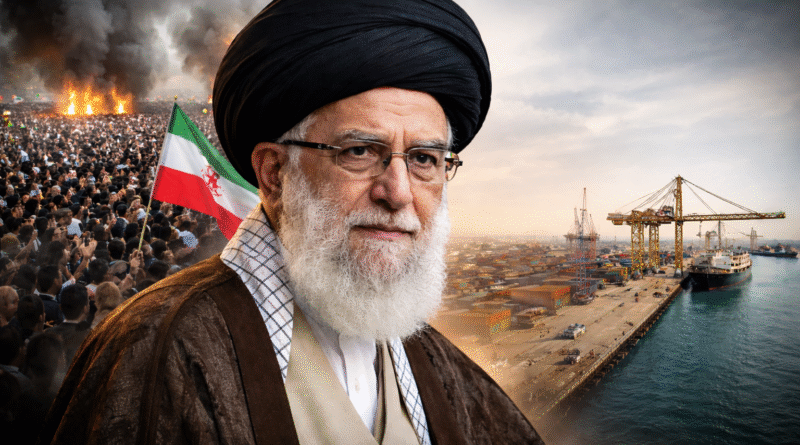
Ayatollah Khamenei Dead: What It Means for India–Iran Relations
The reported killing of Iran’s Supreme Leader, Ayatollah Khamenei, has sent shockwaves across West Asia. Iran’s state news agency confirmed that he was killed in coordinated strikes in Tehran. Along with him, senior officials including Revolutionary Guard commander Mohammad Pakpour and defence council secretary Ali Shamkhani were also reported dead.
If true, this is not just a leadership change. It could mark the end of an era that began with the Iranian Revolution. And for India, a country that has shared civilisational and strategic ties with Iran for decades, the question is simple but serious. What happens now?
To understand where things might head, we must first look back.
1979: A Revolution That Reshaped West Asia
India and Iran’s ties go back centuries. But modern diplomatic relations formally began with a friendship treaty in 1950, signed under Prime Minister Jawaharlal Nehru’s non-aligned vision.
During the Cold War, Iran under the Shah leaned heavily towards the United States and maintained close ties with Pakistan. That limited how far India and Iran could go strategically.
Everything changed in 1979. The Shah was overthrown. Ayatollah Ruhollah Khomeini came to power. The Islamic Republic was born.
The new regime distanced itself from both Washington and Moscow. It also reached out to the Non-Aligned Movement, where India played a founding role. There was room for fresh engagement.
At the same time, India’s own foreign policy was shifting. Prime Minister Rajiv Gandhi was trying to open up to the United States, moving away from the Soviet-leaning posture of the past. It was a delicate balancing act.
Interestingly, Iran’s growing distance from Pakistan worked in India’s favour. Despite the Iran-Iraq War forcing India to reduce oil imports temporarily, New Delhi maintained a neutral position. It kept economic and political channels open.
Iran also quietly supported India at forums like the Organisation of Islamic Cooperation, often pushing back against Pakistan-sponsored resolutions targeting India.
Afghanistan: A Quiet Strategic Convergence
The Soviet invasion of Afghanistan in 1979 added another layer.
Iran opposed the invasion and coordinated with Pakistan in supporting Afghan resistance groups during the 1980s. But in the 1990s, as the Taliban rose with Pakistan’s backing, Iran found itself aligned with India and Russia in supporting the Northern Alliance.
It was not a formal alliance. But it was a moment of practical cooperation shaped by shared concerns.
The High Point: Strategic Partnership in the 2000s
After the Cold War ended in 1991, ties deepened.
In 1993, Prime Minister P.V. Narasimha Rao visited Tehran. Talks included a proposed gas pipeline and transit routes to Central Asia. Later, during Prime Minister Atal Bihari Vajpayee’s 2001 visit, the Tehran Declaration was signed. In 2003, Iranian President Mohammad Khatami was the Republic Day Chief Guest in New Delhi. Relations were elevated to a strategic partnership.
Energy became the backbone. By 2009, India was importing around 22 million tonnes of Iranian crude annually. Iran was among India’s top oil suppliers.
Then came connectivity. The development of Chabahar Port was a bold strategic move. For India, it offered direct access to Afghanistan and Central Asia, bypassing Pakistan. For Iran, it meant investment and regional leverage.
There was optimism. It felt like both sides had found common ground.
The Sanctions Wall and the Nuclear Deal
The turning point came with the Joint Comprehensive Plan of Action in 2015. The nuclear agreement briefly opened economic doors. India increased oil imports. Engagement picked up pace.
But hope did not last.
In 2018, the United States withdrew from the deal and reimposed sanctions. Under pressure, India stopped importing Iranian oil by 2019. Payment mechanisms collapsed. Projects slowed. Momentum faded.
Chabahar survived on paper, but progress remained limited. Trade continued in smaller volumes. Yet the strategic warmth of the early 2000s cooled noticeably.
Many analysts now say that US sanctions have steadily shrunk the space for India–Iran cooperation. Not because the logic disappeared, but because the risks became too high.
Where Do India–Iran Ties Stand Today?
Today, India exports rice, tea, pharmaceuticals, machinery and textiles to Iran. It imports dry fruits, chemicals and glassware. Diplomatic channels remain open. Joint working groups still exist.
But the big-ticket strategic projects are largely stalled.
Now, with the reported death of Ayatollah Khamenei, uncertainty deepens. Leadership transitions in Iran are never simple. Internal factions, regional rivalries and global power politics will all shape what comes next.
For India, the challenge is familiar yet harder than before. It must protect its energy security. It must preserve connectivity ambitions like Chabahar. At the same time, it cannot afford to strain ties with Washington.
This is not just about diplomacy. It is about strategic autonomy, something India values deeply.
The Bigger Picture
India–Iran relations have never been linear. They have risen, stalled and recalibrated many times since 1979.
On paper, the logic for cooperation remains strong. Geography has not changed. Energy needs remain real. Regional security still connects their interests.
But geopolitics today leaves less room for manoeuvre. India’s balancing act has become more complex than ever.
As Iran enters a new and uncertain chapter, New Delhi will be watching closely. History shows that both nations have found ways to engage despite pressure. Whether they can do so again will depend not just on Tehran’s internal shifts, but also on how global power equations evolve.
For now, one thing is clear. The story of India and Iran is far from over. It is simply entering another difficult chapter.
The Analysis Desk at ThirdPol analyses political and economic developments in Iran and their wider impact on West Asian geopolitics.