Rubio India Visit 2026: Trade Reset, Quad, and the Hard Work of Mending Ties
US Secretary of State Marco Rubio landed in Kolkata on Saturday, May 23, 2026, kicking off what is being billed as Washington’s most significant attempt to repair a strained relationship with New Delhi in years. The Rubio India visit his first trip to the country comes at a moment of acute diplomatic sensitivity, with bilateral ties buffeted by Trump-era tariffs, American engagement with Pakistan and China, and a trade deal that has been in negotiation for months without a final landing. Rubio’s four-day itinerary covering Kolkata, New Delhi, Agra, and Jaipur is as much about optics as it is about substance.
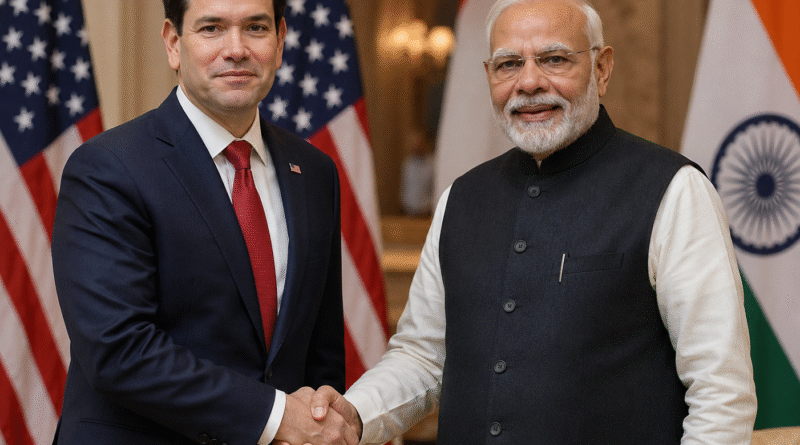
The timing of the visit carries unmistakable diplomatic weight. Rubio arrived in Kolkata just hours after Prime Minister Narendra Modi had wrapped up his UAE leg and was mid-way through a five-nation European tour. The two men met at Seva Teerth in New Delhi on Saturday afternoon, where Rubio briefed Modi on the bilateral agenda spanning defence, strategic technologies, trade, investment, energy, and connectivity. In a notable gesture, Rubio extended a formal White House invitation for Modi to visit Washington a move designed to signal that the Trump administration is serious about resetting the relationship at the highest level.
Trade Friction and the Unfinished Deal
The commercial friction between the two countries forms the unavoidable backdrop to the Rubio India visit. Since taking office, President Trump has imposed tariffs on Indian goods, including an additional 25 percent levy specifically targeting India’s purchases of Russian crude oil pushing the total tariff burden on some Indian exports to 50 percent. New Delhi publicly described the move as “unfair, unjustified, and unreasonable.” An interim agreement has since rolled back the most punishing measures, but a final comprehensive trade deal remains unsigned. Five rounds of negotiations have been completed; both sides describe a deal as “very near” but that phrase has been in circulation for long enough to invite scepticism.
Energy: Washington’s Strategic Ask
Energy cooperation is the issue that connects trade anxiety with geopolitical urgency. Washington wants India to replace Russian crude with American energy exports — a commercial and strategic ask wrapped into one. From the US side, expanding energy sales to India addresses both the trade deficit and Russia’s ability to fund its war through oil revenues. From India’s side, the Hormuz crisis triggered by Iran has added a new dimension to energy security calculations, making supply diversification genuinely attractive rather than merely diplomatic. Rubio is expected to push for concrete timelines on American LNG and oil sales to India during his Jaishankar meeting on Sunday.
The Quad Ministerial Confidence Rebuilding
The Quad is the other major pillar of the Rubio India visit. On Tuesday, May 26, Rubio will chair the Quad Foreign Ministers’ Meeting in New Delhi bringing together the foreign ministers of the United States, India, Japan, and Australia. The grouping, often described as the Indo-Pacific’s informal security architecture, has faced its own turbulence. The Quad Leaders’ Summit, originally scheduled for 2025, was postponed amid the downturn in India-US ties. The foreign ministers’ meeting this week is being positioned as a confidence-rebuilding exercise and a signal that the Quad framework remains intact despite bilateral pressures.
The China dimension runs through everything. Washington’s core strategic interest in India is its role as a counterweight to Chinese influence in the Indo-Pacific. India-China relations have seen a limited thaw in recent months, with border patrolling arrangements restored following the 2020 Galwan clash. India has been careful not to be seen as a tool of American China policy New Delhi’s doctrine of strategic autonomy means it will pursue its own border management agenda with Beijing on its own terms. For Rubio, the task is to convince India that the Quad and the bilateral partnership can coexist with India’s multi-alignment without turning New Delhi into a strategic satellite.
The Adani Undercurrent
The Adani case hangs uneasily in the background. The Trump administration’s Department of Justice recently dismissed federal fraud charges against Indian billionaire Gautam Adani charges related to alleged bribery of Indian officials for solar energy contracts and misleading US investors. The case was dropped after Adani pledged a ten billion dollar investment in the United States. For Indian observers, the sequence raised pointed questions about the politicisation of American legal institutions; for American observers, it looked like a quid pro quo. Rubio has not addressed the issue publicly, but the diplomatic awkwardness is real.
Beyond the formal agenda, Rubio’s choice of Kolkata as his first stop is itself a signal. The city is home to one of the oldest US consulates in the world and the first American consulate established in India. His visit to Mother House — the headquarters of the Missionaries of Charity founded by Mother Teresa was a personal gesture by Rubio, a Catholic, but also a carefully chosen piece of public diplomacy. He is the first US Secretary of State to visit Kolkata since Hillary Clinton did so in 2012. The cultural itinerary extending to Agra and Jaipur reinforces Washington’s message that this is not a transactional visit but an investment in the relationship’s longer arc.
The Rubio India visit will not resolve every tension in the bilateral relationship in four days. The trade deal may or may not cross the finishing line; energy timelines will be discussed but probably not committed; the Quad ministerial will produce a joint statement that reaffirms shared principles without binding any country to specific action. What the visit can do and what it is designed to do is arrest the drift. India and the United States share deep interests: a stable Indo-Pacific, a functioning global trading system, critical and emerging technology cooperation, and a counterweight to Chinese hegemony. Rubio’s task is to remind both capitals of those shared interests at a moment when short-term friction has been allowed to obscure the longer-term strategic logic.