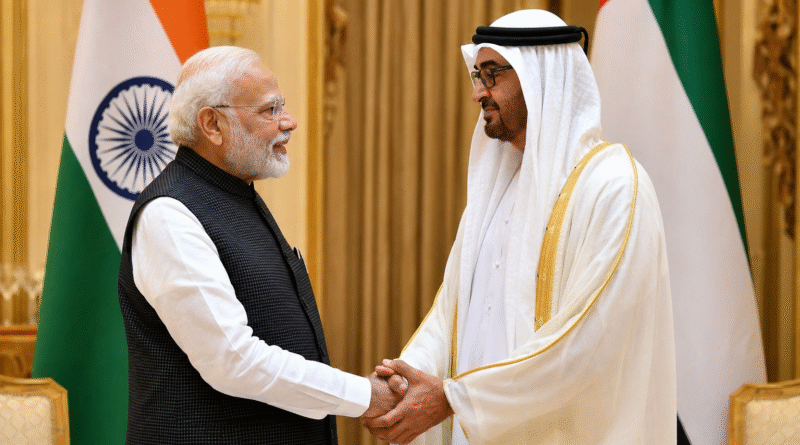
Modi UAE Visit 2026: Energy Security and Hormuz Crisis at the Heart of Abu Dhabi Talks
Prime Minister Narendra Modi landed in Abu Dhabi on Friday, May 15, 2026, kicking off a six-day, five-nation diplomatic tour that carries enormous stakes for India’s energy security. The Modi UAE visit is the first leg of a whirlwind itinerary that will take him through the Netherlands, Sweden, Norway, and Italy before he returns home. But it is the Gulf stop that analysts are watching most closely.
The timing is not incidental. Iran’s effective closure of the Strait of Hormuz has sent energy markets into turmoil, threatening the flow of oil and liquefied petroleum gas (LPG) that India depends on to keep its economy moving. With roughly a fifth of the world’s traded oil passing through that narrow waterway, New Delhi has been scrambling to secure alternative supply routes. Abu Dhabi, sitting at the crossroads of both the threat and its solution, is the natural starting point.
The Fujairah Option: Bypassing Hormuz
At the heart of Thursday’s talks between Modi and UAE President Sheikh Mohamed bin Zayed Al Nahyan is the Port of Fujairah. Located on the Gulf of Oman, Fujairah sits outside the Strait of Hormuz entirely. In recent weeks, the two governments have quietly explored a plan to reroute Indian oil and LPG shipments through this port, bypassing the choke point altogether. The plan would require expanding the Fujairah oil terminal’s handling capacity and completing an additional cross-peninsula pipeline from Abu Dhabi’s Habshan terminal to Fujairah. This is not a minor engineering undertaking, but the urgency of the moment is concentrating minds on both sides.
Beyond the immediate energy emergency, the Modi UAE visit is also about deepening a Comprehensive Strategic Partnership that has been years in the making. The UAE is India’s third-largest trading partner and the seventh-largest cumulative source of foreign direct investment over the past quarter-century. Trade and investment ties between the two countries have expanded steadily under the India-UAE Comprehensive Economic Partnership Agreement (CEPA) signed in 2022, and both governments are keen to consolidate those gains.
The two leaders are also expected to discuss the broader regional situation in West Asia. The ongoing Iran conflict has rattled Gulf governments, and the UAE, as a key stakeholder in regional stability, has been navigating its own diplomatic balancing act. India, which maintains warm ties with both Iran and the Gulf Arab states, has a strong interest in keeping those channels open. Modi’s presence in Abu Dhabi sends a signal that New Delhi intends to remain engaged rather than retreat to the sidelines.
The Indian diaspora dimension is never far from any Modi UAE visit. Over 3.5 million Indians live and work in the UAE, making them the single largest expatriate community in the country. Remittances flowing from this community form a significant part of India’s annual inflows. While this visit does not include any large public event a contrast to the 2024 trip, when Modi addressed a crowd of 40,000 Indians at Zayed Sports City Stadium the community’s interests remain embedded in the bilateral agenda through discussions on labour mobility, digital payments, and the UPI-based payment linkage between the two countries.
The UAE is also a founding member of the Global Biofuels Alliance, launched under India’s G20 presidency in September 2023. Clean energy transition and green hydrogen cooperation are expected to feature in the talks, reflecting a shared interest in diversifying energy portfolios away from pure fossil fuel dependence even as the two governments scramble to manage the immediate Hormuz disruption.
When the Modi UAE visit concludes, the prime minister will head to the Netherlands, where bilateral trade stood at $27.8 billion in 2024-25 and where the Tata Group’s Dholera semiconductor fabrication project depends on equipment from Dutch giant ASML. Sweden, Norway, and Italy follow in quick succession, with each stop carrying its own trade, technology, and strategic partnership agenda. The India-EU Free Trade Agreement, recently concluded, provides fresh energy to these European conversations.
For India, the key takeaway from the UAE leg will be whether it can secure a credible alternative energy corridor before the Hormuz disruption does lasting damage to domestic fuel prices and inflationary expectations. The Fujairah pipeline option, if it moves from exploratory talks to a formal commitment, would represent a significant strategic win. That is the prize Modi is flying to Abu Dhabi to chase.
Key Points
- PM Modi’s five-nation tour (May 15-20, 2026) covers the UAE, Netherlands, Sweden, Norway, and Italy — the first visit to Norway by an Indian PM in 43 years.
- The Strait of Hormuz, through which roughly one-fifth of globally traded oil passes, has been disrupted by Iran’s actions, prompting India to seek alternative supply routes.
- The Port of Fujairah on the Gulf of Oman bypasses the Hormuz chokepoint; India and the UAE are exploring routing Indian oil and LPG shipments through this port.
- The UAE is India’s third-largest trading partner and seventh-largest cumulative FDI source; bilateral relations are governed by the India-UAE CEPA (2022) and the Comprehensive Strategic Partnership.
- Over 3.5 million Indians constitute the largest expatriate community in the UAE; India-UAE UPI payment linkage is a flagship fintech cooperation.
- The UAE is a founding member of India’s Global Biofuels Alliance (GBA), launched at the G20 Summit in September 2023.
- India-EU FTA: recently concluded, underscores India’s expanding trade architecture with Europe and provides strategic context for Modi’s European legs.
- The India-Nordic Summit (3rd edition) will be held in Oslo; it reflects India’s deepening engagement with Scandinavian economies in green technology and the blue economy.
By Amit Mangal | ThirdPol | May 2026