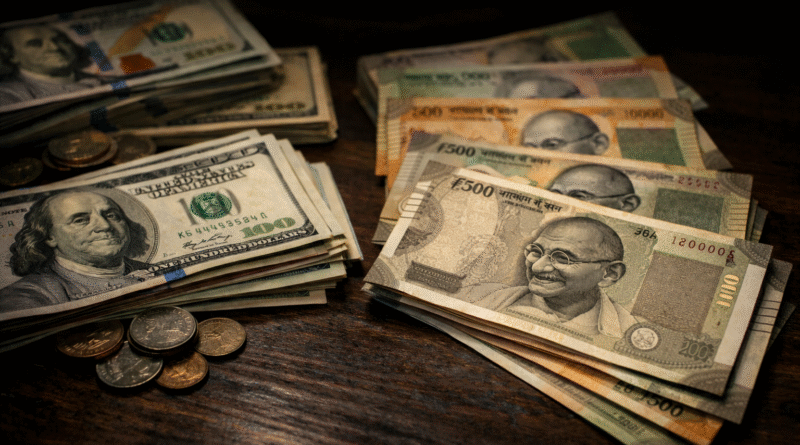
De-dollarisation and India: Moving Away from the Dollar or Just Talking About It?
Every few months, the words de-dollarisation and India resurfaces in Indian foreign policy discussions. It comes up at BRICS summits. It comes up when India buys Russian oil in rupees. It comes up when Jaishankar talks about multipolarity and financial sovereignty. And every single time it comes up, India’s official position is the same — careful, calibrated, and deliberately vague.
So here is the straightforward question this article tries to answer. Is India actually moving away from the US dollar? Or is de-dollarisation one of those ideas India talks about at multilateral forums but quietly steps away from the moment Washington starts paying attention?
The honest answer is more interesting than either the BRICS enthusiasts or the dollar defenders want to admit.
What De-dollarisation Actually Means
Before getting into India’s position, it helps to be clear about what de-dollarisation actually is — because the term is used to mean very different things by different people.
At one end of the spectrum, de-dollarisation means replacing the US dollar as the world’s primary reserve currency — the currency that central banks hold, that commodities are priced in, and that most international trade is settled in. This is the version Russia pushes loudly and that most Western analysts worry about.
At the other end, de-dollarisation simply means finding ways to conduct certain bilateral transactions — Russia-India oil trade, India-UAE payments — without going through dollar-denominated systems like SWIFT. This is the version India actually practises.
The gap between these two versions of the idea is enormous. And India sits firmly, deliberately, at the modest end of the spectrum.
What Jaishankar Has Actually Said
India’s position on de-dollarisation is not ambiguous. It has been stated clearly, publicly, and repeatedly by External Affairs Minister S. Jaishankar — the person most directly responsible for articulating India’s foreign policy.
Speaking in London in March 2025, he said: “I don’t think there’s any policy on our part to replace the dollar. The dollar as the reserve currency is the source of global economic stability, and right now what we want in the world is more economic stability, not less. I don’t think there’s a unified BRICS position on this.”
That statement is not a diplomatic hedge. It is a clear policy position. India does not want to replace the dollar. India does not think BRICS has a coherent plan to replace the dollar. And India is not going to pretend otherwise just because Russia and some analysts would like it to.
Trump helped clarify India’s thinking further. When he threatened 100% tariffs on any country that tried to de-dollarise, India went very quiet on the topic very quickly. India’s Prime Minister has made no statements in favour of a common currency since Trump implemented his tariff threats in August 2025. That is a data point worth sitting with.
So What Is India Actually Doing
Here is where it gets more interesting. India’s official policy is not to replace the dollar. But India is doing things every day that reduce dollar dependence in specific corridors — not as a grand ideological project, but as practical economics.
The clearest example is the Russia trade. Since the Ukraine war began, India has been settling much of its oil trade with Russia in rupees and rubles, bypassing SWIFT and dollar-denominated transactions entirely. This was not a geopolitical statement. It was a response to the practical reality that dollar-denominated transactions with Russian entities had become complicated, slow, and expensive after sanctions. India found a workaround and used it.
The second example is the UAE corridor. India and the UAE have been settling a growing share of bilateral trade in rupees and dirhams. India-UAE trade reached $83 billion in 2024-25. Moving even a fraction of that out of dollar settlement has real value — it reduces transaction costs, speeds up payments, and reduces India’s exposure to dollar exchange rate volatility.
The third is UPI expansion. India’s Unified Payments Interface has been linked to payment systems in Singapore, Malaysia, UAE, France, Sri Lanka, Mauritius and several other countries. The Reserve Bank of India has formally proposed linking digital rupees with BRICS countries’ Central Bank Digital Currencies for cross-border trade and tourism. The 2026 BRICS Summit agenda includes a CBDC interoperability framework.
None of this amounts to de-dollarisation in the grand sense. But all of it amounts to a gradual, quiet, practical reduction in dollar dependence in specific trade corridors — exactly the kind of thing India does when it wants to move in a direction without making a public declaration about it.
The BRICS Dimension
BRICS has been the loudest forum for de-dollarisation talk, and India’s chairship in 2026 has put it squarely at the centre of those conversations.
The BRICS de-dollarisation agenda for 2026 includes several real initiatives. BRICS Pay — a decentralised system linking national payment networks including Russia’s SPFS, China’s CIPS and India’s UPI — has already reduced dollar usage in intra-bloc trade significantly in certain corridors. A pilot for the BRICS Unit — a gold-backed settlement tool supported by 40% gold and 60% BRICS currencies — was launched on October 31, 2025. The New Development Bank now issues roughly a third of its loans in domestic currencies.
These are not nothing. Intra-BRICS trade hit $500 billion in 2025 with a large portion settled outside dollar systems in some corridors. The dollar’s share of global reserves has fallen from 88% in 2000 to around 58% today. That decline is slow but it is real and it is structural, not cyclical.
But there is an important distinction to make. Russia and China are driving this agenda for very different reasons than India. Russia is under sanctions and genuinely cannot use the dollar for much of its trade — de-dollarisation is not a choice for Moscow, it is a necessity. China is building the internationalisation of the renminbi as a long-term strategic project, using the Belt and Road Initiative to create structural demand for yuan across 140 countries.
India’s situation is different from both. India is not under sanctions. India does not want to internationalise the rupee at the scale China wants for the yuan. And India is wary of being seen as part of an anti-Western financial project at a moment when it is trying to negotiate a trade deal with Washington.
As CADTM’s analysis of the Rio BRICS summit noted pointedly: nowhere in the 126-point Rio de Janeiro BRICS leaders’ declaration is there any mention of the term de-dollarisation. The loudest advocates of a BRICS currency got no reference to it in the final communiqué. That is not an accident.
Why India Will Not Go Further
There is a structural reason why India’s de-dollarisation will remain limited, practical, and corridor-specific rather than becoming a grand ideological project.
The rupee is not ready to be a reserve currency. It is not fully convertible. India’s bond market is deep but not globally liquid. India’s financial system, while growing fast, does not have the institutional depth to support a rupee that functions the way the dollar does — as the currency that the rest of the world holds and transacts in.
More fundamentally, India’s largest trading partners and investors are still dollar-denominated systems. The US, the EU, Japan, South Korea — these are the relationships that matter most for India’s economic growth. Walking away from dollar systems would complicate all of those relationships simultaneously. India is not willing to pay that price for an ideological position.
And then there is Trump. The threat of 100% tariffs on de-dollarising countries was not subtle. India registered the message and adjusted its public posture accordingly. This is strategic autonomy in practice — India supports the principle of financial multipolarity when it costs nothing, and goes quiet when the cost becomes real.
ThirdPol’s Take
The de-dollarisation debate is one of those areas where the noise is much louder than the signal.
Russia and certain analysts talk about the dollar’s imminent collapse and BRICS’s revolutionary financial project. American commentators respond with articles about how the dollar is untouchable and BRICS will never amount to anything. Both are wrong in their extremes.
What is actually happening is quieter and more interesting. The dollar’s share of global reserves has been declining slowly for two decades. Alternative payment systems are being built and used. Local currency trade is growing in specific corridors. These are structural changes that will take decades to fully play out.
India’s role in this is pragmatic to the point of being boring. It uses rupees where it makes economic sense. It expands UPI where it can. It supports CBDC interoperability as a long-term project. It does not challenge the dollar’s reserve currency status because it cannot afford to — not yet, and probably not for a long time.
That is not a weakness. It is a reasonably accurate reading of India’s actual position in the global financial system. India is the world’s fifth largest economy, growing fast, with an increasingly internationalised digital payments stack. In fifteen years the conversation about de-dollarisation and India will look different from how it looks today.
For now, the answer to the question this article started with — is India moving away from the US dollar — is: a little, carefully, in specific places, and always with one eye on what Washington thinks about it.
Amit Mangal writes on India’s foreign policy and geopolitics at ThirdPol. Follow ThirdPol on X and LinkedIn.