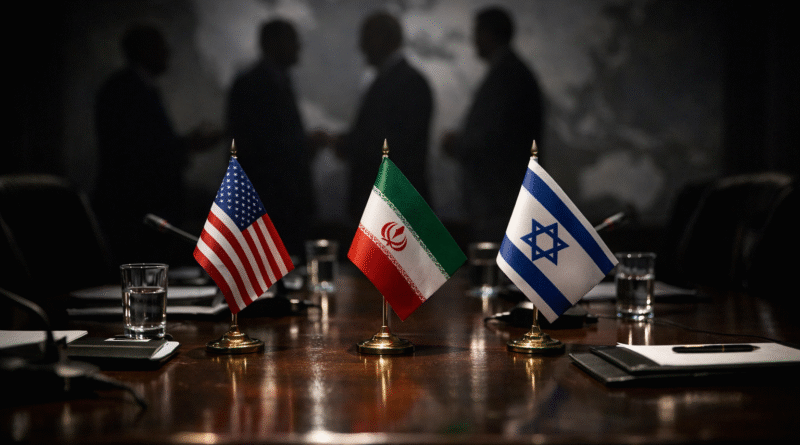
US Iran War: The 15 Demands, Iran’s 5 Conditions, and Why a Deal Is Harder Than Trump Claims
US Iran war negotiations are at the most critical juncture since the conflict began on February 28. On Day 26 of what the Pentagon calls Operation Epic Fury, Washington and Tehran are simultaneously talking and fighting. Trump says the US is winning so big that Iran has agreed to never have a nuclear weapon. Iran says all of this is false. Its military called Trump’s claims proof that the US is ‘negotiating with itself.’
The result is a war that is the strangest diplomatic spectacle since the Cold War — a conflict in which both sides are bombing each other, exchanging messages through five different intermediaries, publicly contradicting each other’s accounts of whether talks are even happening, and privately edging toward a deal that neither side can publicly admit it wants.
Here is everything that happened in the last 24 hours — and an honest assessment of whether a deal is actually possible.
The State of the War on Day 26
The US and Israel began Operation Epic Fury on February 28. As of March 26, the human and economic cost has been staggering. Iran’s health ministry reports 1,500 people killed and 18,551 injured. The UN estimates the war has caused $63 billion in economic losses across the Arab region alone. More than 40 Middle East energy assets have been severely damaged according to the International Energy Agency.
Iranian strikes have hit energy and water infrastructure across the Gulf. Kuwait’s international airport was struck by a drone attack that set a fuel tank on fire. Saudi Arabia intercepted 32 drones and a ballistic missile aimed at its Eastern Province — home to Ras Tanura, Ghawar and Abqaiq, three of the world’s most important oil facilities. Bahrain has taken casualties. Iranian-backed groups in Iraq have launched 23 operations against US military assets in the last 24 hours alone.
Israel launched fresh strikes on Iran in the fourth week of the conflict. Iran retaliated with missile strikes on Dimona and Haifa. Israeli Prime Minister Netanyahu said Iran has been decimated but added that finishing the revolution requires a ground component — a statement that alarmed Washington, which has not authorised ground operations.
The US has deployed additional Marines to the Middle East. Speaker Mike Johnson said Operation Epic Fury is almost done and the objectives have been met. But the Pentagon continues to ask Congress for a $200 billion war supplemental funding bill — which is not the behaviour of a military that believes the war is over.
Trump’s 15 Demands — The Full List
On Tuesday March 24, Trump told reporters that there are like 15 points of agreement between the US and Iran. The Washington Post and Al Jazeera have both confirmed the existence of a formal 15-point US ceasefire proposal that was delivered to Iran through Pakistan.
Iran’s response came on March 25. Tehran called the US plan maximalist and unreasonable and issued its own 5-point counter-proposal. The gap between the two positions is enormous.
| US 15-Point Plan | Iran’s 5-Point Counter |
| 1. One-month ceasefire while talks continue | 1. End to all aggression by the US and Israel immediately |
| 2. Complete removal of all enriched uranium from Iran | 2. Concrete, legally binding guarantees preventing future attacks |
| 3. Abandonment of all uranium enrichment capabilities | 3. Full payment of war reparations and compensation for destruction |
| 4. Limits on Iran’s ballistic missile programme | 4. Comprehensive end to war across all fronts including Hezbollah, Houthis, Hamas |
| 5. Cessation of support for Hezbollah | 5. Recognition of Iran’s full sovereignty over the Strait of Hormuz |
| 6. Cessation of support for Hamas | |
| 7. Cessation of support for the Houthis | |
| 8. Cessation of support for Iraqi paramilitary groups | |
| 9. Reopening of Strait of Hormuz for international shipping | |
| 10. Sanctions relief in return for compliance | |
| 11. No pursuit of nuclear weapons programme | |
| 12. International inspection regime for nuclear sites | |
| 13. Normalisation of relations with Gulf Arab states | |
| 14. Release of US and allied nationals held in Iran | |
| 15. Formal peace treaty with Israel |
Reading those two columns side by side tells you everything about why a deal is difficult. The US is asking Iran to dismantle its nuclear programme, give up its missile capabilities, abandon all its regional allies, and open the Strait of Hormuz. Iran is asking the US to stop bombing it, pay for the damage already done, and recognise Iranian sovereignty over the world’s most important oil chokepoint. These are not negotiating positions that are close to each other.
Who Is Mediating — And What Each Country Wants
| Country/Actor | Role | Why Involved |
| Pakistan | Primary intermediary — delivered US 15-point plan to Iran | Warm ties with both Trump and Tehran. PM Sharif offered to host talks. Trump endorsed on Truth Social. |
| Oman | Back-channel messaging | Traditional US-Iran intermediary. Hosted secret Obama-era nuclear talks. Trusted by both sides. |
| Qatar | Humanitarian corridor and messaging | Hosts US military base AND maintains strong Iran ties. Qatar Airways still flies to Tehran. |
| Egypt | Offered to host formal talks | FM Badr Abdelatty said Cairo ready to host any meetings. Egypt wants regional stability for economic reasons. |
| Turkey | Passing messages between sides | AKP VP confirmed Ankara ‘playing a role passing messages.’ Turkey benefits from neither side winning decisively. |
| China | Diplomatic pressure on Iran | Wang Yi told Iran ‘talking is always better than fighting.’ China losing billions from Hormuz closure. |
| France | EU diplomatic pressure | Macron urged Iran to engage in good-faith negotiations. Europe desperate to reopen energy supplies. |
| JD Vance / Steve Witkoff / Jared Kushner | US negotiating team | Trump named all three as involved. Witkoff and Kushner reportedly met Iranian counterparts on Sunday evening. |
The number of intermediaries is itself revealing. When there is only one back-channel, it suggests a genuine secret negotiation. When there are seven different countries all claiming to be passing messages, it suggests something messier — a diplomatic free-for-all in which every regional power is trying to position itself as the indispensable broker of a deal it can take credit for.
Pakistan’s role is the most significant and the most surprising. Pakistan delivered the US 15-point plan to Iran. PM Shehbaz Sharif publicly offered to host talks on X. Trump shared Sharif’s post on Truth Social — an implicit endorsement. This is Pakistan acting as a genuine regional power broker for the first time in years, leveraging its unique position as a country with warm ties to both Washington and Tehran.
The Negotiations Contradiction — Who Is Telling the Truth
The biggest diplomatic puzzle of Day 26 is the direct contradiction between Washington and Tehran on whether talks are actually happening.
Trump has said multiple times this week that the US and Iran are in negotiations right now. He named JD Vance, Marco Rubio, Steve Witkoff, and Jared Kushner as personally involved and emphasising that Iran has agreed it will never have a nuclear weapon.
Iran has denied every single one of these claims. Foreign Minister Abbas Araghchi said there are no negotiations underway. Iran’s military said the US is negotiating with itself. Iran’s ambassador to Pakistan said no direct or indirect negotiations have taken place between the two countries so far. Iran’s parliament speaker said no negotiations have been held two days before Trump’s first claim of talks.
Araghchi added a pointed observation: why are they talking about negotiation now? Didn’t the Americans say unconditional surrender? The fact that they are talking about negotiation now is exactly an admission of defeat.
The most likely explanation for the contradiction is that both sides are telling a version of the truth. What is happening is an exchange of messages through intermediaries — not direct talks. Trump is calling this negotiations. Iran is saying message exchange through third parties does not constitute negotiations. Both framings serve domestic political purposes: Trump needs to show he is winning and making deals; Iran cannot be seen talking to the country that is bombing it.
Why Israel Is Alarmed by the Peace Push
One of the most significant developments of the last 24 hours is the reported Israeli alarm at Washington’s diplomatic push. Israeli officials told CNN that Israel was surprised by the submission of a ceasefire plan. Israel’s UN Ambassador Danny Danon said explicitly that Israel is not part of US-Iran talks and that military operations will continue until Iran’s nuclear and missile capabilities are eliminated.
Netanyahu is expected to discuss the latest developments with his security cabinet. The second Israeli source told CNN that the maximum Iran might be willing to give does not meet the minimum the US is demanding — and that Israel views several elements of the US framework as positive but remains sceptical about a breakthrough.
This divergence between Washington and Tel Aviv is crucial. Trump appears to be genuinely exploring a deal. Netanyahu wants the war to continue until Iran’s revolutionary government collapses. These are fundamentally different objectives. If Trump moves toward a deal that Iran accepts but that leaves the Islamic Republic in power, it is not clear that Israel will stop its military operations. Israel has shown before — in Gaza — that it is willing to continue military action regardless of what Washington says.
The Hormuz Demand — The Biggest Sticking Point
Of all the gaps between the two sides, the Strait of Hormuz question is the most immediately consequential and the most difficult to bridge.
The US 15-point plan demands the reopening of Hormuz. Iran’s 5-point counter-proposal demands recognition of Iranian sovereignty over Hormuz. Trump himself floated the bizarre idea that Hormuz could be controlled jointly by me and the ayatollah — an idea that was rejected by everyone involved, including apparently the ayatollah.
Iran’s position on Hormuz is legally complicated. Under the UN Convention on the Law of the Sea, Hormuz is an international strait through which all countries have a right of transit passage. Iran argues that its sovereignty over the territorial waters on both sides gives it the right to regulate and restrict passage during a time of war. Most international legal experts disagree, but the practical reality is that no ships are transiting without Iranian consent right now.
For Iran, Hormuz control is its single most powerful economic leverage point over the entire world. Giving it up as part of a peace deal means giving up the one asset that makes the rest of the world pay attention to its demands. Iran will not do this cheaply. And any deal that allows Iran to retain even nominal sovereignty over Hormuz is something Israel will resist fiercely.
What India Should Be Watching
For India, the next 72 hours matter enormously. Three specific developments are worth tracking.
First, the Chabahar waiver. India’s US sanctions waiver for Chabahar expires on April 26. If a ceasefire deal is reached before then, the geopolitical situation changes dramatically and there may be room to negotiate a new arrangement for the port. If the war continues, the waiver expiry forces India into a binary choice it has been trying to avoid.
Second, the Hormuz situation. Indian ships are being allowed passage through Hormuz on a case-by-case basis following diplomatic engagement with Tehran. If the war escalates again — which is possible given Israel’s stated intent to continue operations — that informal arrangement could collapse. India has 330 million households dependent on LPG that flows through this strait.
Third, Pakistan’s rise as a mediator. Pakistan delivering the US peace plan to Iran is a significant diplomatic development. It gives Islamabad influence in the resolution of a conflict that directly affects India’s energy security, strategic investments, and regional interests. India is conspicuously absent from the mediation architecture despite being one of the most affected parties to the conflict.
ThirdPol’s Take
The US Iran war negotiations are real but they are not what Trump describes. There is no signed agreement. There are no direct talks. Iran has not agreed to give up nuclear weapons. What exists is a carefully structured system of indirect communication designed to allow both sides to explore a deal without either side losing face in the process.
The gap between the two positions is genuinely large. The US is asking Iran to accept conditions that would leave it strategically defenceless — no nuclear programme, no missiles, no regional allies, no Hormuz leverage. Iran is asking the US to accept conditions that amount to acknowledging it lost the war — reparations, sovereignty over Hormuz, guarantees against future attacks. Neither side can publicly accept what the other is asking.
And yet deals have been made in more unpromising circumstances. The 2015 nuclear deal was negotiated between adversaries who genuinely hated each other. The question is whether Trump’s real objective — preventing Iran from getting a nuclear weapon and declaring victory — can be squared with Iran’s real objective, which is survival as a state and political system.
The answer to that question will be found not in press conferences or Truth Social posts but in the back channels running through Islamabad, Muscat, Doha, Cairo and Ankara. Right now those channels are active. Whether they produce a deal before the next escalation is the question that will define the next chapter of this war.
Amit Mangal writes on India’s foreign policy and geopolitics at ThirdPol. Follow ThirdPol on X and LinkedIn.
Pingback: Elon Musk Was on the Modi-Trump Call. Nobody Knows Why. That Is the Problem.
Pingback: Iran War Ceasefire 2026: What Is Being Negotiated, Who Is Mediating?