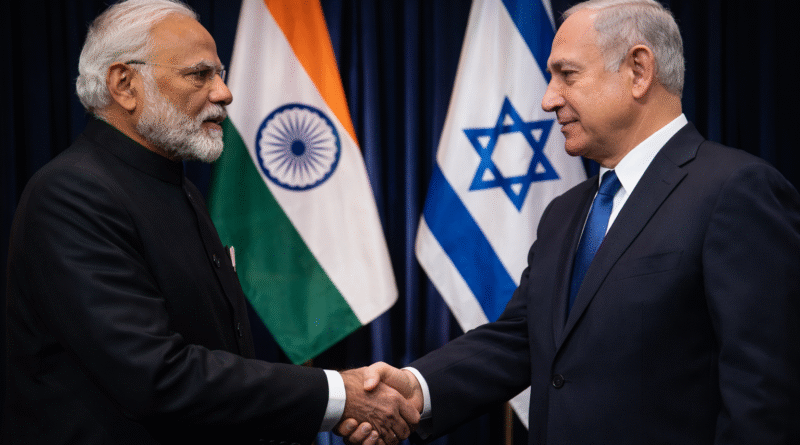
Modi Israel Visit 2026: What It Signals About India’s Foreign Policy
Modi Israel visit 2026 will likely be debated by Indian foreign policy analysts for years. On February 25-26, Prime Minister Narendra Modi flew to Tel Aviv, addressed the Israeli parliament for the first time in Indian history, embraced Benjamin Netanyahu on the Knesset floor, and declared to a standing ovation: ‘India stands with Israel, firmly, with full conviction, in this moment and beyond.’
Forty-eight hours later, the United States and Israel struck Iran.
The timing alone raises questions that have not been answered clearly. The outcomes of the visit tell one story about India’s strategic interests. The context in which it happened tells another. And the consequences for India’s relationship with Iran, its credibility in the Muslim world, its standing in the Global South, and its claim to strategic autonomy are still unfolding.
What Actually Happened During the Visit
Modi’s Israel visit on February 25-26, 2026 was his second trip to Israel — the first was in 2017 when he became the first Indian PM ever to visit the country. This visit was different in scale and symbolism.
Modi addressed the Knesset Israel’s parliament becoming the first Indian Prime Minister to do so. He received a standing ovation. Parliamentarians chanted his name. Netanyahu called him ‘more than a friend’ and ‘a brother.’ Modi signed the guestbook at Yad Vashem, the Holocaust memorial. He toured the Nova music festival memorial site — the site of the October 7 Hamas attack.
In his Knesset speech, Modi said: ‘We feel your pain. We share your grief. India stands with Israel firmly, with full conviction, in this moment and beyond. No cause can justify the murder of civilians. Nothing can justify terrorism.’ He drew an explicit parallel between the October 7 Hamas attack and the 2008 Mumbai attacks — framing both as instances of the same phenomenon.
The two countries announced 27 bilateral outcomes,16 agreements and 11 joint initiatives. The partnership was elevated from a Strategic Partnership to a Special Strategic Partnership.
| Area | What Was Agreed |
| Partnership level | Elevated from ‘Strategic Partnership’ to ‘Special Strategic Partnership’ |
| Technology | Indo-Israel Cyber Centre of Excellence to be set up in India |
| Defence | Cooperation on defence electronics, radar systems, counter-terrorism tech, Iron Dome evaluation |
| Digital payments | UPI linked to Israel’s MASAV — Indians can pay via UPI in Israel |
| Agriculture | India-Israel Innovation Centre for Agriculture (IINCA) under ICAR and MASHAV |
| Trade | Discussions on India-Israel Free Trade Agreement accelerated |
| AI and education | Joint research agreements on AI-driven learning and technology exchange |
| IMEC corridor | Modi reaffirmed commitment to India-Middle East-Europe Economic Corridor |
| I2U2 grouping | India-Israel-UAE-US cooperation framework endorsed |
| NSA channel | Critical and emerging technologies initiative to be led by national security advisors |
The History Behind the Visit
To understand why this visit was significant, you need to understand how dramatically India-Israel relations have changed since independence.
| Year | Milestone |
| 1947-48 | India opposes Israel’s creation at UN. Votes against UN partition plan. |
| 1950 | India recognises Israel but does not establish full diplomatic ties |
| 1975 | India supports UN resolution equating Zionism with racism |
| 1988 | India among first non-Arab states to recognise Palestinian state |
| 1992 | Full diplomatic relations established with Israel — under Narasimha Rao |
| 2017 | Modi first Indian PM to visit Israel — bilateral ties elevated to Strategic Partnership |
| 2018 | Netanyahu visits India — first Israeli PM visit in 15 years |
| 2023-24 | India ships rockets and explosives to Israel during Gaza war (reported) |
| Feb 25-26, 2026 | Modi addresses Knesset — first Indian PM ever to do so. ‘India stands with Israel firmly.’ |
| Feb 28, 2026 | US-Israel strikes Iran — 48 hours after Modi leaves Tel Aviv |
The trajectory is clear. India went from opposing Israel’s creation to becoming its largest arms customer and closest Asian partner in less than three decades. The shift accelerated sharply after 2014 when Modi came to power. As Foreign Policy noted, India has been Israel’s biggest defence customer for years, and the two sides have deepened collaboration in surveillance technology, drones, and cyber capabilities.
The 48-Hour Question Nobody Has Answered
The most contested aspect of the Modi Israel visit 2026 is the timing. Modi left Tel Aviv on February 26. The US and Israel struck Iran on February 28 — 48 hours later.
The question of whether Modi knew about the impending strikes has not been answered definitively. Israeli Ambassador to Delhi and the Israeli Foreign Minister both said a decision had not been made when Modi was there and so he was not told. But as Nicolas Blarel, Associate Professor at Leiden University and author of The Evolution of India’s Israel Policy, told journalist Rohan Venkat: ‘The whole timeline raises questions about trust between Israel, the US and India.’
Jaishankar’s performance at the Raisina Dialogue in the days after the strikes was telling. A minister known for his precision and confidence with words appeared, by multiple accounts, to lack a clear formulation for what had happened. He used bland, cautious language that suggested the government was still processing the situation and waiting for clarity from Washington. They were trying to navigate the tension without clearly condemning the US action.
Whether or not Modi was briefed, the optics were devastating. India’s Prime Minister had been photographed embracing the leader of the country that was about to bomb a nation India maintains close ties with, whose oil it depends on, whose port it has invested $370 million in, and whose diplomatic goodwill it cannot afford to lose.
Was There a Clear Reason for the Visit at This Moment
Blarel’s analysis cuts to the heart of the matter. Modi had been the first Indian PM to go to Israel nine years ago. There was not necessarily any hurry to go again. There were no big deals announced that were not already negotiated and known. The visit seemed purely symbolic — the hug on the tarmac, the Knesset speech, the standing ovation. There was no clear tangible need for it to happen at this precise moment, except perhaps to reciprocate Israel’s diplomatic support for India.
The domestic political calculation is also relevant. The BJP’s voter base has long been sympathetic to Israel. The ideological overlap between Hindutva and Zionism — two nationalist movements that frame themselves as civilisational responses to what they call Islamist threats — has been noted by multiple analysts. As Al Jazeera reported, Modi’s Hindu nationalist BJP envisions India as a Hindu homeland, echoing Israel’s self-image as a Jewish state. Both frame ‘Islamic terrorism’ as a key threat.
But even on domestic political terms, the timing was poor. Blarel noted that five states are heading to elections in 2026 —West Bengal, Tamil Nadu, Kerala, Puducherry, and Assam — all with significant Muslim populations for whom the Gaza issue and India’s silence are real concerns. The BJP may be less able to deflect blame given that Modi was in Tel Aviv just days before the strikes happened.
What India Has Gained From Closer Israel Ties
The case for deeper India-Israel ties is real and should be stated honestly, even amid the controversy.
Defence cooperation is the most tangible gain. As India reduces its dependence on Russian weapons, Israel has emerged as a critical alternative supplier. Israeli drones, missile defence technology, cyber capabilities, and surveillance systems have all strengthened India’s military. The Iron Dome evaluation and the Cyber Centre of Excellence announced during the visit are part of a serious, long-term technology partnership.
On counter-terrorism, the convergence is genuine. India and Israel share operational experience of dealing with terrorist attacks that target civilians. Intelligence sharing between the two countries has been a real feature of the relationship for years.
On technology and agriculture, the collaboration has been extensive and beneficial. Israeli water management expertise and agricultural innovation have been adopted across Indian states. The UPI linkage to Israel’s MASAV payment system is a small but concrete example of digital cooperation.
The IMEC corridor — the India-Middle East-Europe Economic Corridor — is potentially transformative. If it proceeds, it would give India a trade route to Europe via the Middle East and Israel that bypasses the Suez Canal and reduces dependency on Chinese-controlled routes. Modi’s reaffirmation of IMEC at the Knesset was a signal that India sees the corridor as a serious long-term project.
What India Has Lost or Risked
The costs are equally real.
India has invested over $370 million in Chabahar port. It depends on Iranian goodwill for the port’s continued operation. India buys significant volumes of Iranian LPG specifications even when not buying directly from Iran. Iran is now furious with India — not because India attacked it, but because India’s Prime Minister stood with the leader of the country that did, days before the attack happened. The diplomatic damage to Chabahar and to India’s Iran relationship is significant.
India has 200 million Muslim citizens. It has significant trade and diaspora relationships with Gulf countries. Its 9.6 million workers in Gulf states send home billions in remittances. The image of Modi in the Knesset, silent on Gaza, embracing Netanyahu while 72,000 Palestinians had been killed, has been noted and criticised across the Muslim world. This is not a negligible cost.
As a retired Indian diplomat told The Diplomat, Modi’s visit and his strong words of support for Israel’s actions against Iran have ‘diminished India’s stature in the eyes of the world.’ India’s claim to Global South leadership is directly undermined by being seen as aligned with the US-Israel axis during a conflict that much of the Global South views as deeply unjust.
As Foreign Policy noted, Modi’s decision to deepen relations with Israel poses risks for India’s cornerstone foreign policy principle. For years India balanced modest relations with both Israelis and Palestinians. The Knesset speech ended that balance in the most public and irreversible way possible.
ThirdPol’s Take
The Modi Israel visit 2026 was not a mistake in terms of the relationship it was building. India-Israel ties are in India’s national interest and the partnership has delivered real value in defence, technology, and agriculture.
The mistake was the timing and the words.
A visit that happened in March, after the Iran war began and after India had had time to assess the situation, would have looked very different. The same agreements could have been signed. The same partnership could have been deepened. Without the backdrop of an imminent war on a country India calls a friend and partner, the visit would have been routine.
But Modi chose to go on February 25. He chose to say ‘India stands with Israel, firmly, with full conviction.’ He chose to draw the parallel between October 7 and Mumbai — a framing that implicitly endorsed Israel’s military response in Iran. And he chose to stay silent on Gaza in a way that even India’s own diplomats have described as damaging.
The question is not whether India should have deep ties with Israel. It should. The question is whether a country that claims strategic autonomy and Global South leadership can afford to make such an unambiguous public statement of alignment on the eve of a regional war — and whether the domestic political benefits of doing so were worth the foreign policy costs.
Based on what has happened since, the answer appears to be no. India is scrambling to manage its Iran relationship, is under pressure on Chabahar, has lost credibility with large parts of the Global South, and has given opposition parties a domestic political weapon at exactly the wrong moment in the electoral calendar.
The visit deepened one relationship. It complicated several others. Whether that trade-off was worth it is a question India will be answering for some time.
Amit Mangal writes on India’s foreign policy and geopolitics at ThirdPol. Follow ThirdPol on X and LinkedIn.